


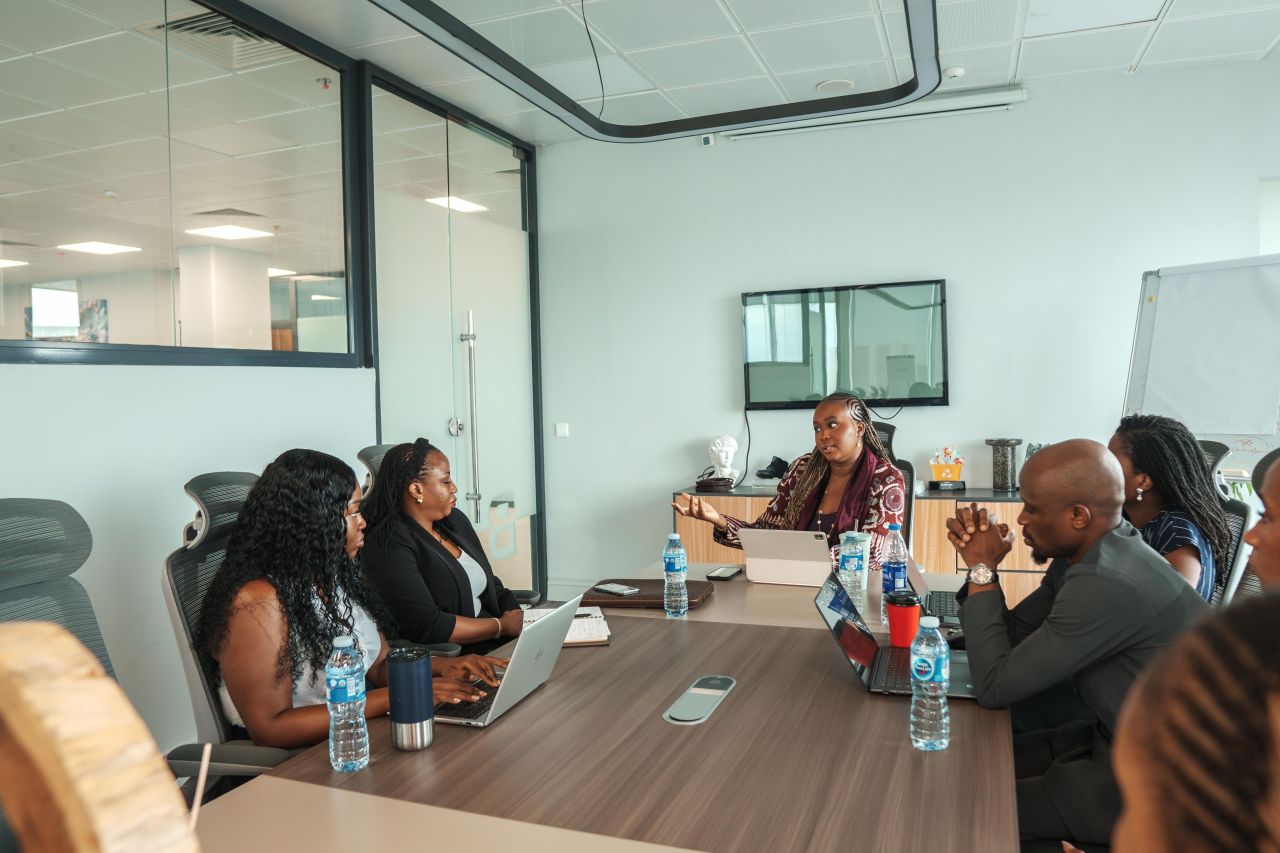






Aruwa Capital Management has held discussions with representatives of the UK Foreign, Commonwealth and Development Office (FCDO) and McKinsey & Company on opportunities to strengthen support for manufacturing businesses and small and medium-sized enterprises (SMEs) in Nigeria.
The meeting was hosted by Adesuwa Okunbo Rhodes, Managing Partner at Aruwa Capital Management, at the investment firm’s office and brought together Nicola Tofowomo, Manufacturing Africa Adviser, Nigeria, at the British Deputy High Commission in Lagos, and Kemi Onabanjo, Partner at McKinsey & Company.
According to Okunbo Rhodes, the engagement was facilitated through an introduction by Aruwa Capital’s investor, FSD Africa, with the participating organisations sharing significant areas of interest in supporting Nigerian manufacturers and SMEs.
She said the existing relationships among the organisations, including links with FSD Africa and British International Investment, provided a strong foundation for discussions around potential areas of collaboration.
The discussions focused on identifying synergies, developing investment pipelines and exploring how Aruwa Capital’s investment activities could complement ecosystem initiatives being driven by the FCDO and Manufacturing Africa.
A major area of focus was import substitution and investment in local manufacturing, with Aruwa Capital reaffirming its commitment to supporting Nigerian businesses producing essential goods locally.
Okunbo Rhodes disclosed that five of Aruwa Capital’s 16 portfolio companies are manufacturers, describing the significant representation of manufacturing businesses in the firm’s portfolio as a deliberate investment strategy rather than an outcome of deal flow.
She said the firm remains particularly interested in supporting businesses that can contribute to reducing Nigeria’s dependence on imported goods while strengthening domestic production capacity.
The discussions also addressed the challenges facing SMEs in what is often described as the “missing middle”—businesses that have moved beyond the micro-enterprise stage but may not yet have access to the scale of capital, governance structures and institutional support available to larger companies.
According to Okunbo Rhodes, these challenges include limited experience among founders in raising institutional capital, the need to develop stronger governance and reporting systems, foreign exchange volatility and the relatively developing nature of exit opportunities for investors.
Despite these challenges, she said Aruwa Capital’s experience over seven years and across 16 portfolio companies had demonstrated the importance of a disciplined and hands-on approach to investing in Nigerian SMEs.
She identified the firm’s strategy as focusing on $1 million to $3 million investments in non-cyclical sectors with healthy gross margins and demonstrated historical growth through different economic cycles.
The investment firm also places significant emphasis on assessing founders alongside financial performance, while remaining actively involved in businesses after investment.
Okunbo Rhodes said this hands-on approach was necessary because value creation at the SME level is largely operational rather than dependent solely on financial engineering.
She also highlighted Aruwa Capital’s application of a gender lens to investment decisions, describing it as a commercial consideration rather than merely a reporting or compliance requirement.
The engagement is expected to strengthen collaboration between Aruwa Capital, FCDO and Manufacturing Africa, particularly around investment opportunities, manufacturing development and support for Nigeria’s growing SME ecosystem.
Okunbo Rhodes expressed optimism about deepening the relationship with FCDO and Manufacturing Africa, as stakeholders seek to unlock more capital and build stronger local businesses capable of driving economic growth and import substitution in Nigeria.