






Accra, Ghana — Former Vice President of Nigeria, Yemi Osinbajo, has described the legacy of former President Olusegun Obasanjo as a “living curriculum” for contemporary leadership and diplomacy, during a high-level international event focused on statecraft and negotiation.
Osinbajo delivered a special reading at the launch of the Global Union of Negotiators for Sovereignty and the unveiling of the inaugural case study by the Sankoree Institute, an initiative dedicated to documenting the leadership and negotiation legacy of former Nigerian President Olusegun Obasanjo.
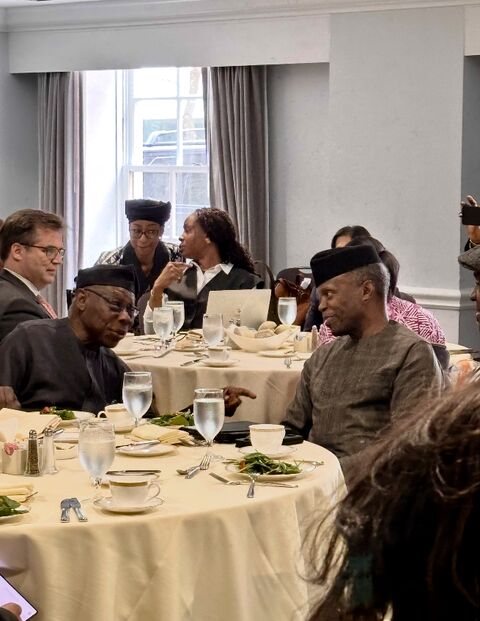
The event, held in Accra, Ghana, brought together prominent African policymakers, development leaders, and international institutions under the coordination of the Accra Reset and the Sankoree Institute.
In his remarks, Osinbajo reflected on over four decades of Obasanjo’s involvement in statecraft, describing it as a body of work that has influenced major negotiations, shaped national policies, and contributed to diplomatic precedents across Africa and beyond. He noted that such experiences provide critical lessons for the continent’s emerging leaders navigating today’s complex global environment.
The programme featured contributions from several high-profile figures, including Ngozi Okonjo-Iweala, Director-General of the World Trade Organization, Samaila Zubairu, Chief Executive Officer of the Africa Finance Corporation, and Wale Edun, Nigeria’s Minister of Finance and Coordinating Minister of the Economy.
Discussions focused on governance, economic sovereignty, and the importance of structured negotiation frameworks in strengthening Africa’s position in global affairs.
The event was hosted with moderation by Serah Makka, Executive Director for Africa at the ONE Campaign, who facilitated discussions among participants on leadership, development, and institutional memory.
Osinbajo emphasised that Obasanjo’s contributions should not be viewed as historical records alone, but as ongoing reference points for leadership practice and policy formulation in Africa.
According to him, the newly launched case study represents an effort to institutionalise such knowledge, ensuring that future generations of leaders can draw practical insights from past experiences in governance and diplomacy.
The launch marks a growing push across the continent to formalise African leadership experiences into structured learning resources for policymakers and negotiators.