


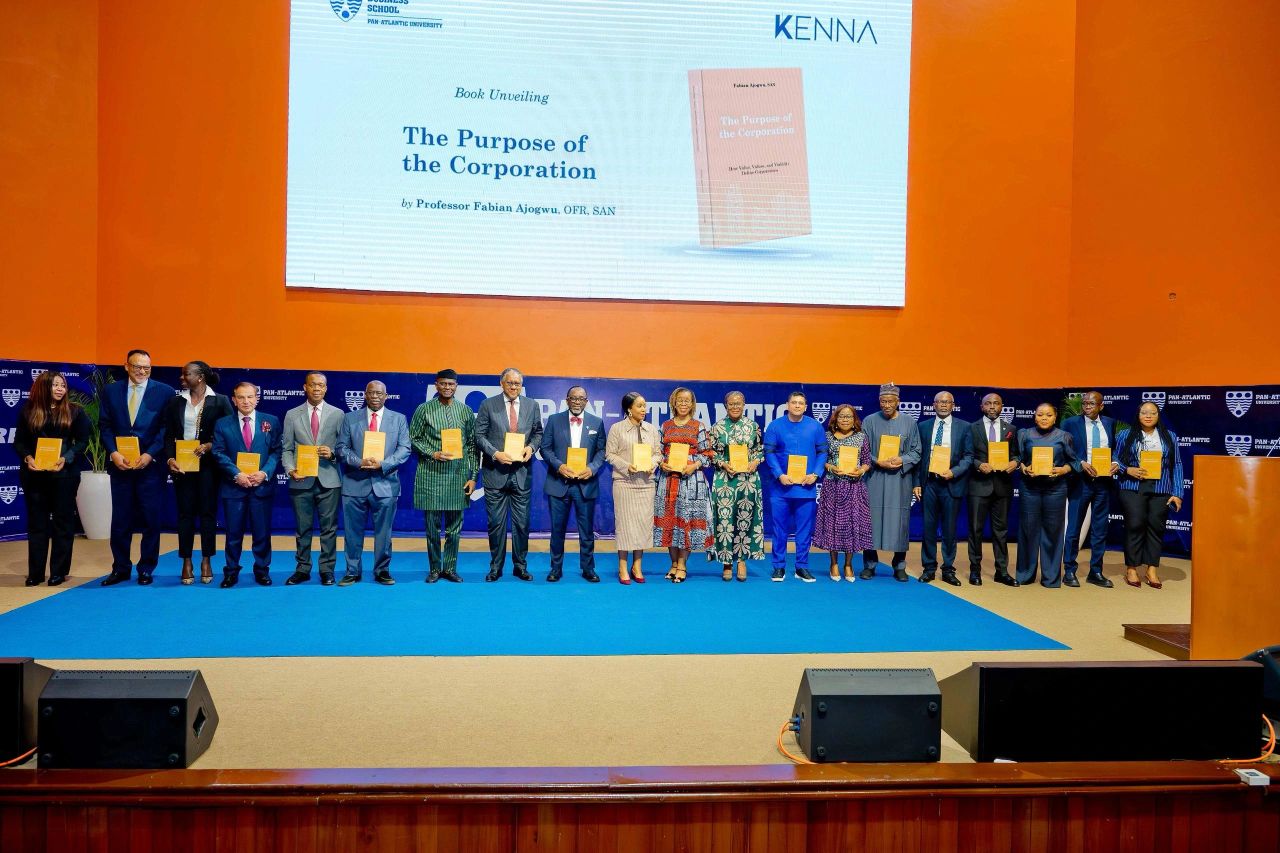






A significant conversation about the future of corporations and their role in society unfolded at a recent public lecture hosted by Lagos Business School. The event, led by renowned corporate governance expert Fabian Ajogwu, highlighted a growing shift away from traditional profit-centered business models toward a broader, more purpose-driven understanding of corporate responsibility.
Delivering a lecture titled “The Purpose of the Corporation: How Value, Values, and Viability Define Corporations,” Ajogwu challenged long-standing assumptions about what corporations exist to achieve. For decades, he explained, corporate governance frameworks have largely been constructed around two central ideas: the control of resources and the maximization of shareholder returns. While these principles have shaped modern business systems and remain relevant, he argued that they no longer capture the full reality of what corporations are or what society now expects from them.
According to Ajogwu, a third dimension—purpose—has emerged as an essential pillar in defining corporate identity and legitimacy. This evolving perspective reflects a broader global movement in which companies are increasingly seen not just as economic entities, but as participants in a wider social and environmental ecosystem. In this new framework, the success of a corporation is no longer measured solely by financial performance. Instead, it is evaluated through its ability to create value across multiple interconnected dimensions, including its treatment of employees, its impact on communities, and its stewardship of the natural environment.
Central to this argument is the idea that corporate governance is not merely a matter of formal structures, policies, or compliance mechanisms. Rather, it is deeply behavioral, shaped by the quality of decisions made by those in positions of authority. Ajogwu emphasized that the effectiveness of governance depends on the judgment of directors, the incentives guiding management, the expectations set by regulators, and the level of trust placed in corporations by the public. In this sense, even the most well-designed governance systems can fall short if they are not animated by responsible and ethical decision-making.
The lecture also addressed the growing popularity of purpose-driven or conscious capitalism, a model that seeks to align business success with broader societal well-being. While this approach is gaining traction across industries and regions, Ajogwu cautioned that it remains conceptually unclear in many respects. The term “corporate purpose” is frequently invoked in corporate communications and strategic documents, yet it is often left undefined or loosely interpreted. This ambiguity, he noted, creates a risk that purpose becomes more of a rhetorical device than a practical guide for action.
A critical challenge, therefore, lies in translating the idea of purpose into concrete operational and governance frameworks. Questions remain about how corporations can meaningfully embed purpose into their day-to-day activities, how they can reconcile differing interpretations of purpose across legal, economic, and social contexts, and how they can measure outcomes in a way that goes beyond financial metrics. Without clear answers, there is a danger that commitments to purpose will remain symbolic rather than transformative.
The social implications of this shift are particularly significant in emerging economies such as Nigeria, where corporations play a central role in economic development and social stability. A more expansive view of corporate purpose has the potential to reshape relationships between businesses and society, encouraging greater accountability, improving working conditions, and fostering stronger community engagement. It also places increasing pressure on companies to address environmental concerns, especially in sectors with substantial ecological footprints.
At its core, the lecture underscored a profound rethinking of the corporation’s place in society. Ajogwu argued that reducing corporate purpose to a single measure—whether profit, shareholder returns, or any other isolated metric—ultimately undermines the broader responsibilities that corporations carry. Instead, he presented purpose not as a constraint on profitability, but as the very condition that enables long-term sustainability and legitimacy.
As global expectations continue to evolve, the message from this gathering at Lagos Business School is clear: corporations can no longer operate in isolation from the societies that sustain them. Their continued relevance will depend on their ability to create value in a way that is not only economically viable, but also socially responsible and environmentally conscious.