


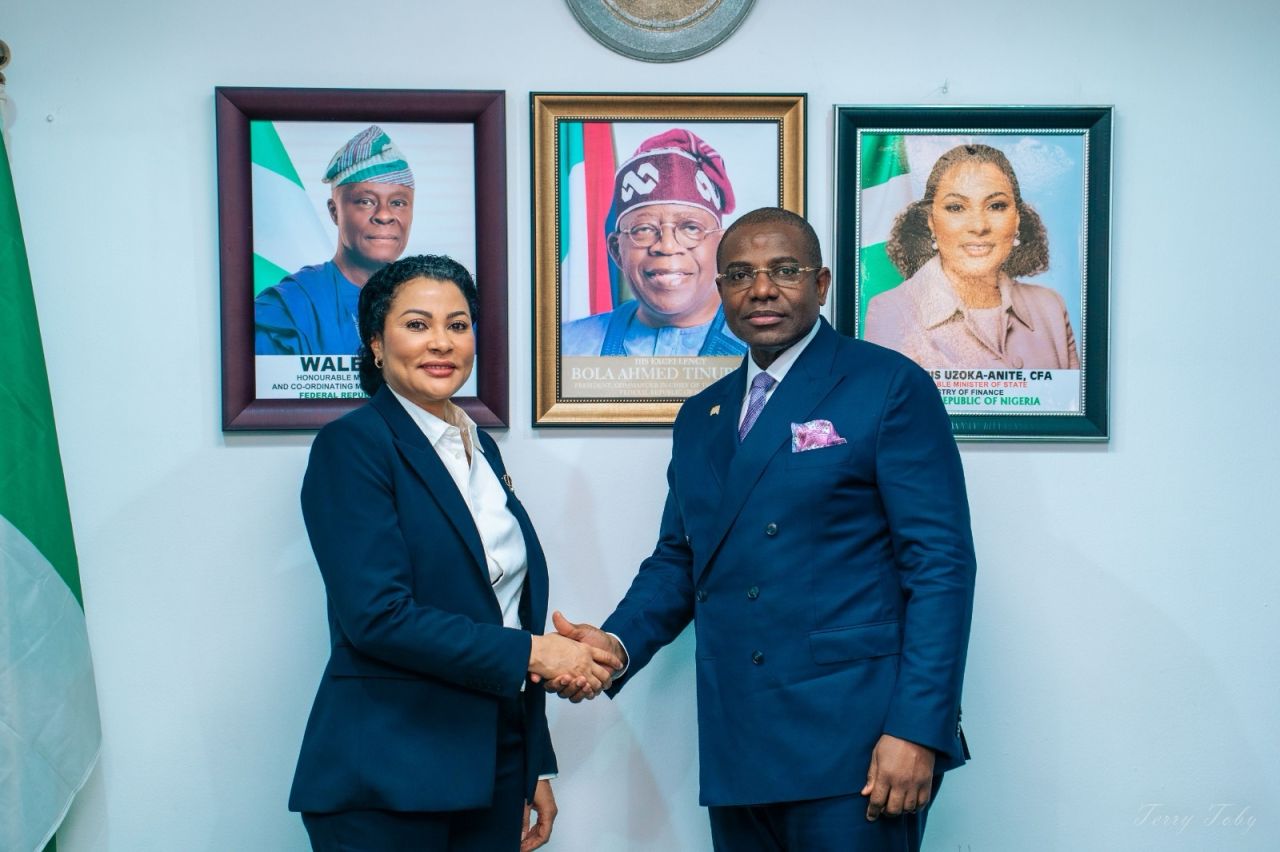





Nigeria’s economic reform agenda gained fresh momentum as the Honourable Minister of State for Finance, Dr. Doris Uzoka-Anite, MD, CFA, on Thursday hosted a high-level delegation aimed at strengthening liquidity, resilience, and long-term capital mobilisation within the country’s financial system.
The strategic engagement focused on two cornerstone initiatives central to the Federal Government’s “Renewed Hope” economic mandate: the optimisation of a ₦1 trillion revolving credit line for the Ministry of Finance Incorporated (MOFI) and the accelerated deployment of the Nigerian Gas Infrastructure Fund, a critical vehicle for unlocking Nigeria’s vast but underutilised energy potential.
According to the Minister, the discussions were designed to move beyond policy intent and fast-track execution, ensuring that large-scale infrastructure projects transition decisively from planning stages into real-sector delivery. The initiatives are expected to deepen market liquidity, strengthen investor confidence, and catalyse growth across energy and industrial value chains.
Uzoka-Anite emphasised that strategic partnerships remain the engine of reform, highlighting the deliberate alignment of public-sector capital with global financial expertise. The collaboration brings together the Federal Ministry of Finance and MOFI with Afreximbank, Africa’s premier trade finance institution, and PAC Capital Limited, a leading Nigerian investment and advisory firm.
She noted that this blend of sovereign coordination, continental banking strength, and private-sector innovation is designed to de-risk critical infrastructure investments and unlock new pools of domestic and international capital.
The Minister commended Mr. Alain-Thierry Mbongue of Afreximbank and Mr. Humphrey Oriakhi of PAC Capital Limited for their commitment to what she described as a “powerhouse collaboration” capable of reshaping Nigeria’s infrastructure financing architecture.
Analysts say the renewed focus on gas infrastructure funding is particularly significant, as it positions natural gas as a transition fuel capable of driving industrialisation, improving energy security, and supporting Nigeria’s climate commitments, while the ₦1 trillion MOFI credit framework is expected to enhance the government’s capacity to strategically deploy capital across priority sectors.
With these initiatives, the Ministry of Finance is reinforcing Nigeria’s signal to investors: that fiscal reforms are being matched with actionable financing structures, strong governance frameworks, and partnerships built for scale.
As Uzoka-Anite concluded, the objective is clear — to power progress, crowd in investment, and deliver sustainable economic outcomes for Nigerians, translating financial strategy into measurable national impact.