


By Anthony Emeka Nwosu
For many people, Artificial Intelligence (AI) is becoming a source of anxiety. Across industries, machines are increasingly performing tasks once handled by humans. In newsrooms, AI now assists with writing, editing and content production. Graphic designers are competing with AI tools capable of producing stunning visuals in seconds, while software developers, marketers and customer service professionals are witnessing the rapid transformation of their professions.
While concerns about job displacement continue to dominate public conversations, another side of AI is quietly emerging—one that could improve lives rather than simply replace jobs.
Healthcare may become the biggest beneficiary of the next wave of artificial intelligence.
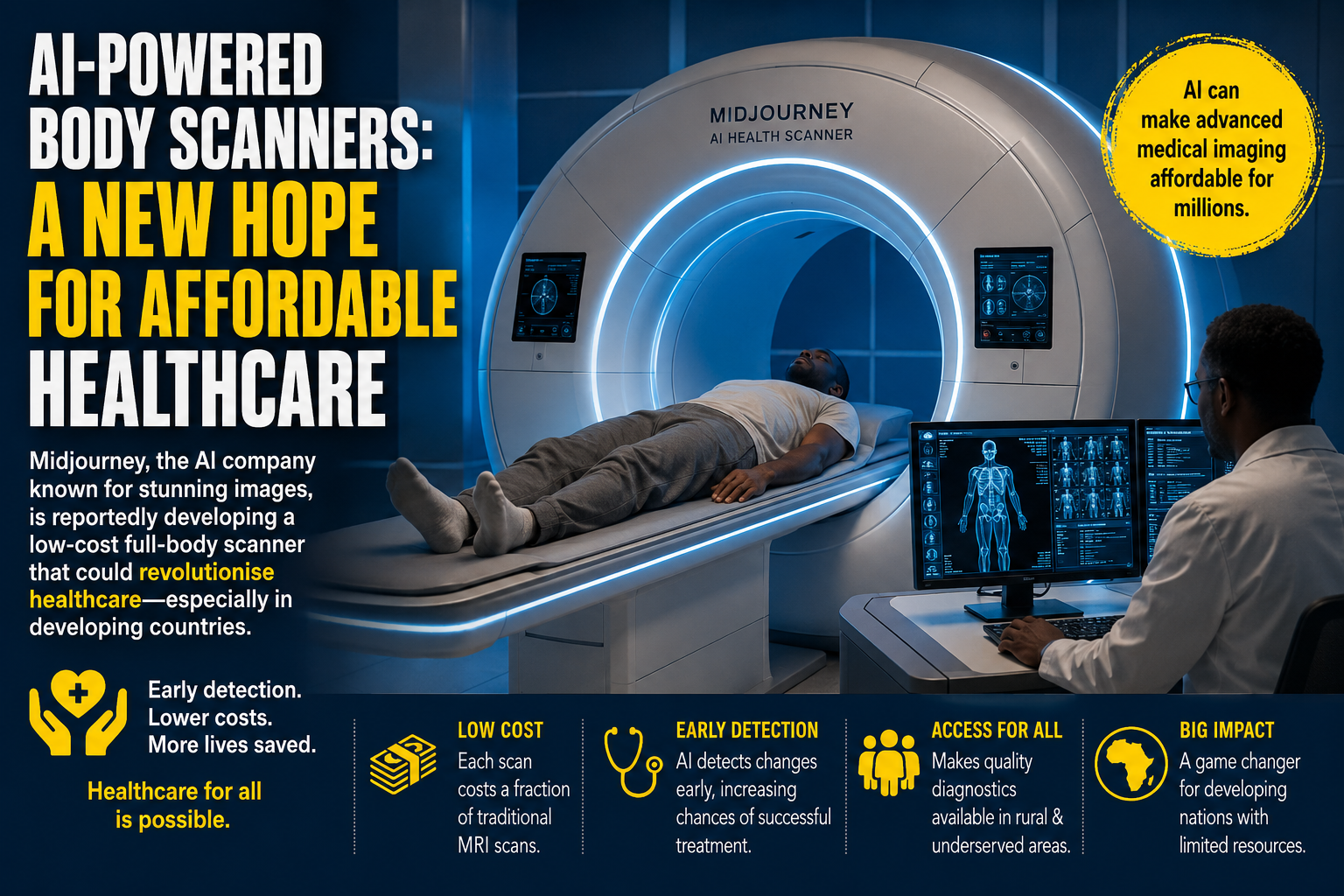
A company many people only know for creating AI-generated images, Midjourney, is now being linked with a breakthrough that could fundamentally change how millions of people access healthcare. Reports indicate that the company is developing an AI-powered full-body scanning system capable of delivering detailed medical imaging at a fraction of today’s costs.
If that vision becomes reality, it could mark one of the biggest healthcare breakthroughs in decades.
Anyone who has ever undergone an MRI scan or accompanied a loved one for one understands how expensive the process can be. Beyond the high cost to patients, MRI machines cost millions to acquire, require specialised buildings to house them, consume enormous amounts of power and demand constant maintenance by highly trained professionals.
These costs are ultimately passed on to patients.
For many Nigerians, an MRI scan remains a luxury. Families often struggle to raise the money needed for the procedure, while many public hospitals either have limited imaging facilities or none at all. In several parts of the country, patients travel long distances simply to find a hospital with functional diagnostic equipment.
Sadly, many illnesses are discovered too late—not because doctors lack the expertise, but because the equipment needed to detect diseases early is either unavailable or too expensive.
This is where artificial intelligence could become a game changer.
According to reports, Midjourney is exploring a ring-shaped body scanner capable of capturing detailed images of the entire body. Even more remarkable is the claim that each scan could cost next to nothing compared to conventional imaging.
Imagine being able to scan your body regularly without worrying about huge hospital bills. Imagine detecting cancer, heart disease or internal abnormalities long before they become life-threatening. Imagine doctors identifying tiny changes in the body months or even years before symptoms appear.
That is the promise AI is beginning to offer.
The idea may sound futuristic, but it is built on technology Midjourney already understands. For years, the company has trained its artificial intelligence to recognise complex visual patterns while generating highly realistic images. Experts believe those same capabilities could be applied to medical imaging, where recognising subtle changes in scans can make the difference between early treatment and late diagnosis.
What makes this development even more significant is its potential impact on developing countries.
Across Africa and many other third-world nations, access to quality healthcare remains one of the biggest challenges facing governments and citizens alike. Advanced diagnostic equipment such as MRI scanners is still concentrated in a few major cities, leaving millions of people in rural communities without access to life-saving investigations.
Many governments simply do not have the financial resources to purchase enough MRI machines to meet the needs of their growing populations. Even where the equipment exists, maintaining it remains another major challenge due to unstable electricity supply, shortage of technical personnel and high operating costs.
If AI can reduce the cost of medical imaging to a level where hospitals, clinics and even community health centres can afford it, the impact would be enormous.
Healthcare would become more preventive than reactive. Diseases could be detected before they become critical. Treatment costs would reduce significantly because patients would receive care earlier. Governments would spend less managing advanced illnesses, while families would avoid the devastating financial burden that often accompanies prolonged medical treatment.
For countries like Nigeria, where many citizens pay for healthcare directly from their pockets, affordable AI-powered diagnostics could literally save millions of lives while making quality healthcare accessible to ordinary people.
Midjourney itself has become one of the most remarkable companies in the AI industry. Reports indicate that the company generates around $500 million in annual revenue, operates with a relatively small workforce and has achieved profitability without relying on external investors.
While many AI companies are focused on chatbots and coding assistants, Midjourney appears to be looking beyond digital creativity towards solving real-world problems with far-reaching social impact.
The company’s official philosophy reflects that ambition. It describes itself as a laboratory dedicated to building AI models that advance imagination, beauty, human flourishing and a better future for society.
Although the medical scanning technology has yet to be officially unveiled, the possibility alone offers hope that AI’s greatest contribution may not be replacing human workers, but helping humanity live longer and healthier lives.
As the world continues to debate whether artificial intelligence will take away jobs, perhaps the more important question is whether it can save lives.
If affordable AI-powered body scanners become a reality, millions of people in Nigeria, Africa and other developing nations may finally gain access to early diagnosis and quality healthcare that has remained beyond their reach for generations.
Sometimes, the greatest technological revolution is not the one that changes how we work—it is the one that gives more people the chance to live.