


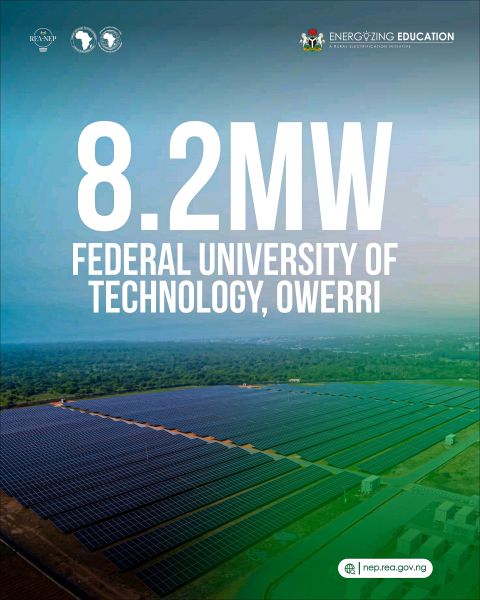
The Federal University of Technology Owerri (FUTO) has reached a major milestone in Nigeria’s clean energy transition, following the deployment of an 8.2MW solar hybrid power system under the national Energizing Education Programme Phase 3 (EEP 3). The installation positions the institution as one of the largest beneficiaries of the initiative, and the second-largest EEP 3 site nationwide.
The development is part of the broader efforts of the Nigeria Electrification Programme, implemented through the Rural Electrification Agency of Nigeria (REA) and financed by the African Development Bank Group. The programme is designed to address long-standing electricity challenges in federal universities and teaching hospitals across Nigeria by providing reliable, renewable, and decentralised power solutions.
A Shift From Unreliable Supply to Clean Energy Stability
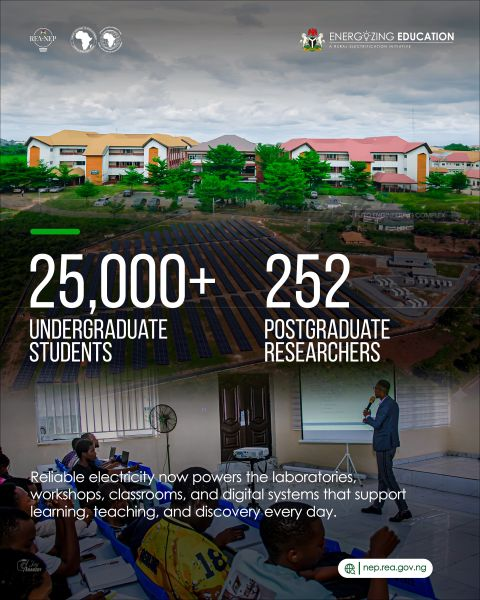
With the new 8.2MW solar infrastructure, FUTO now benefits from a stable and continuous electricity supply that supports core academic and research operations. Laboratories, engineering workshops, lecture halls, digital learning platforms, and administrative systems are now powered by clean energy, improving both productivity and learning conditions across the institution.
The system currently serves more than 25,000 undergraduate students and 252 postgraduate researchers, ensuring that power interruptions—long seen as a barrier to academic progress in many Nigerian institutions—are significantly reduced.
Security and Campus Life Improvements
Beyond academic infrastructure, the project also includes the installation of 400 solar-powered streetlights across the campus. This development has improved nighttime visibility, enhanced security, and extended productive campus hours for students and staff.
University stakeholders note that the improved lighting has also contributed to a safer and more active campus environment after dark, supporting both academic and social activities.
Skills Development Through Renewable Energy Training
A key feature of the EEP 3 intervention at FUTO is the establishment of an on-site Renewable Energy Workshop Training Centre. The facility provides hands-on technical training in solar installation, maintenance, and broader renewable energy systems.
Notably, the programme includes the first cohort of female trainees in STEM-focused renewable energy skills development, marking a step forward in gender inclusion within Nigeria’s emerging clean energy workforce.
A Model for Sustainable University Infrastructure
Officials involved in the programme describe the FUTO installation as a flagship example of how clean energy can transform public institutions in Nigeria. By reducing dependence on diesel generators and unstable grid supply, the project is expected to lower operational costs while significantly cutting carbon emissions.
According to programme leadership, the intervention reflects a broader philosophy: energy is not merely infrastructure, but a foundational enabler of education, innovation, and long-term national development.
Regional Leadership and Broader Significance
The success of the FUTO solar deployment is also being cited in some circles as a demonstration of effective educational and infrastructure leadership emerging from the South East, reflecting what proponents describe as strong Igbo regional commitment to innovation-driven development in higher education.
Supporters of the project argue that it sets a benchmark that other regions and institutions across Nigeria can emulate, particularly in integrating renewable energy solutions into public universities as a pathway to improving learning conditions, research capacity, and institutional resilience.