


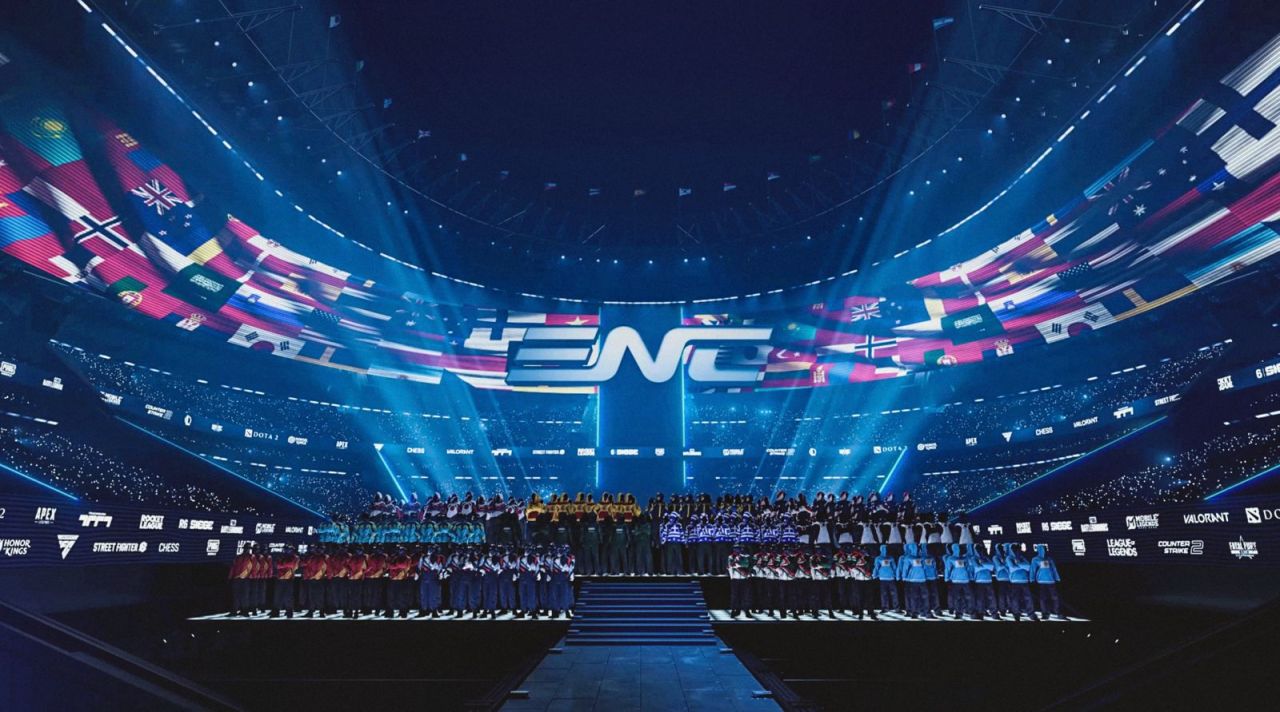





The global esports ecosystem is witnessing unprecedented expansion, with more than 150 countries and territories assembling national teams for the upcoming Esports Nations Cup (ENC), according to Ralf Reichert, Chief Executive Officer of the Esports Foundation.
Reichert described the growth as evidence that esports is evolving beyond entertainment into a structured international competition platform comparable in participation to traditional global sporting events.
Highlighting a personal story to illustrate the movement, Reichert recounted the journey of a Polish player whose father once represented his country at the Olympics.
“An Olympian father took his son to a League of Legends event years ago. Back then, the son was just a kid who loved the game. This year, he’ll represent Poland at the Esports Nations Cup, the same way his father once represented his country at the Olympic Games,” Reichert said.
According to him, countries with historically limited visibility in competitive gaming are increasingly creating pathways for players to compete internationally.
“In Djibouti, Honduras, Maldives, Suriname and Palau — five countries from five continents with no notable presence in international esports — players are now building a formal pathway to compete among the best in the world,” he stated.
He noted that the scale of participation is unusual for relatively young competitive ecosystems, comparing esports’ international reach with established sporting institutions.
“Only a handful of competitions ever get there: the Olympics and the FIFA World Cup. Now esports does too. Most other world championships like rugby, cricket, basketball gather 40 to 80 nations,” Reichert said.
The Esports Foundation CEO emphasized that esports’ global growth is being driven by multiple gaming titles rather than reliance on a single franchise. He cited participation figures showing PUBG MOBILE attracting representation from 121 countries and territories, VALORANT from 111, League of Legends from 110, Mobile Legends from 108, and Rocket League from 106.
According to Reichert, mobile gaming has played a major role in expanding access to competitive esports across regions including Southeast Asia, the Middle East and North Africa, South Asia, Latin America, and Africa.
“PC titles bring depth in established esports markets; mobile titles open participation across Southeast Asia, MENA, South Asia, Latin America and Africa. No single game gets you there alone. Together, they cover the world,” he explained.
He added that the ecosystem now supports a broad competitive pipeline, from casual gamers to elite national representation.
“At the bottom, close to 700 qualified entries will compete at the ENC across 16 titles — almost 370 national team slots in team-based games and over 300 individual slots in solo titles,” he noted.
Beyond participation numbers, Reichert argued that national identity and representation are becoming defining features of competitive gaming.
“For many players, this will be the first time they walk into elite competition with a flag next to their name. You don’t need to understand every patch note or meta shift to understand what it means to represent your country,” he said.
He revealed that national rosters are currently undergoing verification and that official announcements later this month will influence qualification pathways and rankings.
“Every country outside direct invites will still have a path through regional qualification. The ecosystem only becomes truly global if people believe they can enter it,” Reichert added.
The comments reflect a broader shift in esports from commercial tournaments toward internationally structured competitions, with increasing recognition of national representation, governance frameworks, and global participation comparable to traditional sports.