


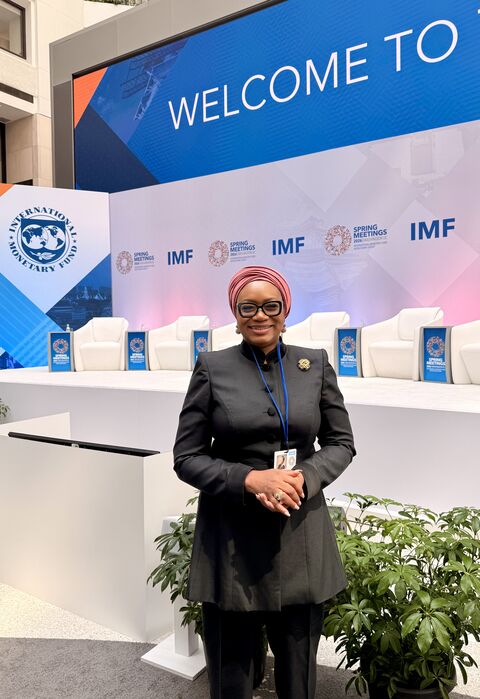






Aishah Ahmad has raised concerns over what she describes as the weakening of the global cooperative order, warning that developing economies, particularly in Africa, could face significant challenges in an increasingly fragmented world.
Reflecting on recent high-level discussions in Washington, Ahmad said debates around tariffs, aid reductions, debt pressures, and industrial policy revealed deeper structural shifts in the international system that did not receive sufficient attention.
According to Ahmad, decades of progress in areas such as poverty reduction, financial inclusion, women’s economic participation, healthcare, and education were accelerated through coordinated global efforts under frameworks including the United Nations Sustainable Development Goals (SDGs) and Millennium Development Goals (MDGs).
She warned that as multilateral cooperation weakens, developing economies may struggle to replace the financing, technical assistance, market access, and institutional support previously enabled through stronger global partnerships.
Ahmad argued that discussions at the meetings lacked adequate urgency regarding how emerging markets, particularly African economies, will identify new growth opportunities in a more divided global environment.
She further noted that Africa may no longer be able to rely on the export-led growth models that previously helped drive economic expansion in parts of Asia, citing changing geopolitical conditions, rising trade tensions, and declining confidence in multilateral systems.
Instead, she called for what she described as a more original African growth architecture built around regional integration, implementation of the African Continental Free Trade Area (AfCFTA), digital trade, value addition, domestic productivity, and improved capital mobilisation.
Ahmad also highlighted Africa’s rapidly growing population as a defining global economic issue. She noted projections that Sub-Saharan Africa will account for a significant share of global working-age population growth by the early 2030s and could represent nearly half of new entrants into the global labour force by mid-century.
She warned that the continent’s demographic expansion could either become a driver of global economic growth or contribute to instability if sufficient opportunities are not created.
According to Ahmad, the broader challenge facing policymakers is whether nations can continue to solve shared global problems amid increasing geopolitical and economic fragmentation — a question she described as one of the defining economic tests of the decade.