
When Obi Iyiegbu, popularly known as Obi Cubana, was perfecting plans to gift his beloved mother a befitting burial, little did he know that such a sincere honour to his mom would shoot his fame to a crescendo and later open him up for barrages of needless scrutiny and vile propaganda.

The recent invitation, detention and subsequent release of Obi Cubana by the Economic and Financial Crimes Commission, EFCC, and later the National Drug Law Enforcement Agency, NDLEA, on allegations of cybercrime, money laundering, tax issues and drug-related offences, did not come as a surprise to many, including me. I saw it coming. Being a hitherto silent successful entrepreneur, whose mother’s funeral ceremony brought to the limelight, I knew the powers-that-be would want to vet the source(s) of his wealth.

There is absolutely nothing wrong if law enforcement agencies decide to probe an individual or a business entity, provided it is done within the confines of the law, where the suspect’s fundamental human right of “innocent until proven guilty” is respected in the entire process. After all, no one is above the law. No nation can prosper if some of her citizens are treated as sacred cows. I commend EFCC and NDLEA for being steadfast on their constitutional responsibilities.

Meanwhile, Obi Cubana has vehemently denied all the allegations against him. We have to give him the benefit of the doubt as being innocent of all the accusations while the appropriate law enforcement agencies do their work. Iyiegbu has verifiable businesses commensurate to his networth.

But beyond the ongoing scrutiny by the law enforcement agencies, it is clear that Obi Cubana is currently standing trial in the court of public opinion. Though no one is a saint, but people like us, who knew Obi Cubana’s startup cum success stories have no reason to believe the allegations. Yet we uphold the right of others who choose to believe otherwise.

However, whatever anyone believes does not justify what has become a full-scale propaganda attack on Obi Cubana. Yes, there has been a deliberate and sustained campaign of calumny to profile Obi Cubana with either internet scams or drug trafficking and related offences. It is a well-oiled vicious onslaught against him and his brand. It has become obvious even to the blind that there is a thickening conspiracy to stereotype and tag one of Nigeria’s rising stars of entrepreneurship and philanthropists along with dirty businesses of drugs and economic crimes.

I have seen, read and dismissed a lot of conjectures, innuendoes and prejudiced narratives wickedly put together to damage the hard-earned reputation of Obi Cubana.

As someone who understood this man’s early struggles and followed up on his entrepreneurial voyage; beginning in Nigeria’s Federal Capital Territory, FCT, I am as heartbroken as Obi Cubana on how some sadists and fifth columnists could be peddling barefaced lies and falsehood just to convict him in the court of public opinion and make him an easy prey to malevolent tendencies.

This is not only injustice and wickedness being meted out to Obi Cubana, but every hardworking Nigerian youth, who believes in entrepreneurship as the ultimate escape from poverty and self-actualisation. Why the media trial? If anyone has evidences against him, why not wait to present it in the court of law or even take them to one of the investigating agencies instead of rushing to the court of public opinion where jungle justice of vile propaganda and bile falsehood thrive?

Imagine such sensational and wicked profiling headlines and titles as: “NDLEA links Obi Cubana to drugs”, “Obi Cubana and drug pushers”, “Is Obi Cubana the king of nightlife or a drug kingpin?”, etcetera, being splashed all over the world by some Nigerian media and columnists not minding that it is someone’s reputation they are dragging in the mud. Without being reminded, crafters of such prejudiced stories and vile articles have one goal in mind—to destroy credibility of Obi Cubana and his businesses. It is not about crime-fighting, but to pull down a perceived entrepreneurial enigma. It is predetermined.

Let us do diagnosis and prognosis on one of the weighty accusations. From media reports, NDLEA alleged that a drug convict in Asia paid money into Cubana’s account. An allegation he has since denied. Juxtapose with Obi’s nature of business—clubs, hotels and entertainment, a discerning mind will wonder how Obi is supposed to know the sources of income of his customers and potential clients.

If a customer visits one of Cubana’s clubs, after drinking expensive wines and whiskeys, probably with his friends, and wants to pay with PoS, where else will the money go if not into Cubana’s bank account? Tomorrow if it is discovered that the said customer is a drug pusher, checking his financial transactions, Obi Cubana—the owner of one of the clubs he visited will be maligned for being a drug baron. What an imprudence!

In the foregoing context, if a married man decides to cheat on his wife, and because of the exquisite nature of Cubana Hotels, makes up his mind to lodge there, should women activists allege that Obi Cubana is promoting infidelity—just for running a hospitality business? Should Obi Cubana mandate his members of staff to vet sources of income of their potential customers before attending to them? where is it done across the world?

After a lot of media trial, EFCC lost its case against media mogul Raymond Dokpesi. The Court of Appeal quashed the N2.1 billion money laundering charges against him because the prosecuting team could not substantiate its case. The founder of DAAR Communications was accused of receiving part of arms funds allegedly diverting under then National Security Adviser (NSA), Sambo Dasuki.

One of the strong points of argument made by Dokpesi’s defense counsel, was that he got paid for services rendered by his media conglomerate to the Jonathan Administration. It was not his duty to question the source of funds used to pay for the services his company rendered. The case died a natural death. If a media company couldn’t be held liable for source of funds a client paid for a job, can a hospitality company like Cubana Group, let alone its owner, be held responsible for how any if his customers chose to make his money?

While we must collectively uphold the right of law enforcement agencies to do their work, we must also collectively rebuke the resort to media trial. It was not a crime that Obi Cubana chose to bid his mother farewell in the manner that he did. It was his choice. What was displayed at Oba was an outpour of massive goodwill invested in the youth over the years by this entrepreneurial colossus.

Obi Cubana should be commended for popularising entrepreneurship amongst graduates and for promoting the nation’s entertainment industry, instead of this sadistic propaganda targeted at his reputation.

By Chidiebere Nwobodo

Nwobodo writes from Abuja.

Ondo State Governor, Arakunrin Oluwarotimi Akeredolu Aketi , SAN, has sworn in Chief Adetunji Adeleye as the Special Adviser on Security matters.

The swearing-in took place on Tuesday at the State Executive Council chamber of the Governor’s office few hours after the appointment was announced.

The event was well attended by the state Commissioner of Police, Oyediran Oyeyemi; and the commandant of the Nigeria Security and Civil Defense Corps (NSCSC), Dr. Hammed Abodunrin; members of the state Executive Council led by the Secretary to the State Government, Princess Oladunni Odu; among others.

Governor Akeredolu disclosed that the appointment was necessitated by the need to keep the state executive council abreast of the security situation in the state.

The Governor said the invasion of Ondo communities and villages by criminals masquerading as herdsmen was part of what informed his decision to have a Special Adviser who had been part of the system.

“When we had this threat over and over, initially, I never knew we would get to this point. That people will have the audacity to come to our villages and communities, killed our people and set their houses ablaze. I knew I needed to do something. Part of my immediate reactions is what you are seeing here today.

“I am a practical person. And I have seen that we are faced with a lot of challenges, particularly, one of the topmost challenges we are facing is security.

“It is important that the Exco is properly briefed on the security challenges in the state because every local government is represented at the Exco. And we are faced with security challenges all over the state.

“We decided that Exco must now make robust contributions on the issue of insecurity we are facing. I was convinced that the time has come for this state to have a Special Adviser on Security matters,” Governor Akeredolu explained.

He thanked all heads of security agencies in the state for their great efforts at keeping the state safe.

“I want to thank all heads of security agencies in Ondo state. I do receive text messages on daily basis on the great efforts you are making and your exploits. Police, NSCDC, the military and Amotekun, I thank you,” he said.

Arakunrin Akeredolu, while congratulating Chief Adeleye, described his appointment as well-deserved, adding that he has done so much in assisting the state in security matters.

Responding, Chief Adeleye thanked the Governor for finding him worthy of the appointment, saying his commitment to the security of the state was borne out of his passion for a better Ondo State.

He promised to always work with other security agencies in the state and contribute immensely to the efforts at making Ondo state safe.

Olabode Richard Olatunde

Speculations have been going on about Chinmark an investment company that pays clients their profits known as return on investment (ROI). The company has been having issues with some regulatory authorities making some people to be a bit skeptical and demanding their money.

In line with the trends and the current realities the company has put up a press release telling the clients to hold on for their payment till the next 60 days at most.

Speaking via his social media, the chief executive officer of Chinmark, Marksman Chinedu Ijiomah said via his Facebook page that “We want to thank you for your support in the growth of the Chinmark Group. Over the years, we have been able to setup businesses that have spread in Africa, Asia and other parts of the world successfully and creating sustainable means of livelihood for over 4,000 individuals working with the Chinmark Group. “

” You will recall that since the commencement of the company, we have successfully built a track record of excellent and quality customer service delivery, we have never disappointed, and we promise not to disappoint you now.”

” However, the Chinmark Group wants to reassure all its clients that there is no cause for panic as the Partnership arm is taking all necessary measures to ensure the system starts working again and more effectively.”

We wish to inform all our partners that we are working efficiently to comply with government regulations for quality control and assurance.

These processes are currently affecting the activities of the partnership arm of the company for a short period of time which will not exceed 45-60 days.

All our offices are open and activities are running. We implore you, our partners, to kindly support the smooth running of all our businesses during this period to enable us pass through this phase and remain as strong as ever. Panic and unrest will affect the businesses that generate returns for the sustainability of the partnership arm.

For further enquires, don’t hesitate to reach us via our official email address, info@chinmarkgroup.com. A follow up email will be sent periodically to our clients who are affected within the period of this process to update them on progress made.

Thank you for patience and support as we are committed to serving you better.

Cheers to Chinmark @50

As we move further into the digital age, paperless systems are becoming a more appealing way to deal with document management and storage. Instead of physical filing systems and cabinets taking up space, a document management system (DMS) enables you to store and organise your important documents in an electronic archive that only permissioned users to access and edit.

The system assists in the generation of documents, electronic signing, authentication and verification, and it can also digitise your existing paper records, making them accessible to retrieve at any stage. By eradicating the need for manual, paper-based processes, a DMS reduces an organisation’s carbon footprint,and requires less human interaction, a key concern in light of the COVID-19 pandemic.

Carla De Abreu, Business Development Manager at digitalisation specialist e4, says that at a basic level, a DMS ensures that a contract between multiple parties is sound and can stand up legally in court if necessary. “The system allows you to manage documents from generation to validation through to storage and retrieval, seeing to it that all clauses are correctly and clearly defined so that all the parties involved can avoid disputes later in the process.”

While all this can be done manually, is that the most effective way? De Abreu outlines some of the benefits of an effective document management system:

Less paper, less storage space

No filing cabinets means more office space, an advantage at a time when commercial property costs are increasing. Paperless systems also mean less waste, a key consideration in the modern organisation.

Accurate records

A DMS ensures that a document is valid and authentic from the beginning of the contract process to the end. “For an electronic document to be valid and stand up in a court of law, you need to apply the right rules for that specific document and use the right type of digital signature, making sure it is airtight if you do need it at later stage,” explains De Abreu.

Enhanced security

It is essential for an organisation to keep its sensitive data secure. A DMS provides better control over and access to documents – allowing only permissioned members to view or edit them. The system leaves an audit trail of who has viewed a document, when it was accessed and if it was modified, which is traceable, and document tracking capabilities reduce the likelihood of documents being lost or misfiled after viewing.

Improved compliance

Compliance requirements for documents can be complicated, and non-compliance can lead to fines, revoked licenses and sometimes criminal liability. A DMS can reduce the risk of non-compliance. According to South Africa’s Electronic Communications and Transactions Act, a valid electronic signature can take the form of a name typed in digital format at the bottom of an email, an ‘I accept’ tick box, or an electronic or finger signature on a document. The correct electronic signature is critical to maintaining the integrity of a document throughout its lifecycle.

Better, remote collaboration

A DMS ensures that the right parties have access to and know what data is stored on their behalf. It enables all authorised parties to quickly find pertinent documents and collaborate easily as the data can be access from multiple locations.Electronic imaging makes sharing documents over a network via email or the Internet possible.

Easier retrieval

Filing, retrieving data and searching for misfiled documents can be time-consuming and labour intensive, costing an organisation money and can hampering productivity. A DMS, which can retrieve files by a word or phrase in a document – remotely if necessary, is a powerful, time-saving tool.

e4 offers four fully integrated products in the document management space, namely DocFusion, ProSign, AutoVerifiy and StorDoc. “Our system is vertically agnostic, so suited to any organisation sending and receiving sensitive documentation, where multiple parties need data traceability, including banks, insurance companies, cell phone providers and law institutions,” explains De Abreu.

DocFusion is a preferred document generation platform for South Africa’s banks, assisting organisations in the management of documents and data through digital signatures, dynamic barcodes and workflow. It allows for multiple templates of documents to be stored, filled in and generated for different parties. “As banks and other institutions have centrally managed documents, when a clause is changed, our system ensures that all parties get the latest version of the template.”

ProSign enables the user to electronically sign any document and includes the recording of forensic biometrics of each electronic signature. All documents are encrypted, authenticated and forensically audited to secure the contents and instantly detect any form of tampering. “We are in the process of introducing a video signing component, which will meet the ‘in the presence of a witness’ rule but can still be done in the comfort of your home.”

AutoVerify checks that data submitted is correct against a subset of rules from the organisation and authenticates documents such as proof of residence and ID. It allows you to scan and lift certain clauses from documents, ensuring it matches to third party and source data. “This product uses the latest in Machine Learning technology – Optical Character Recognition (OCR), which is the core technology for automatic text recognition.”  This replaces a human having to verify documents and scrutinises data to a deeper level.

StorDoc is e4’s flagship product and currently all local banks are using this secure, online FICA and document management system to store documents and make sure that the right level of people has access to them. It includes a complete workflow system to review and approve (or reject) electronic documents.

In summary, a Document Management System can form a key component of a Business Process Improvement Initiative, lowering risk, improving auditability, enforcing workflow, electronically signing, and automatically verifying the contents.

De Abreu concludes by commenting that “Any medium to large business processing documents can benefit from our proven technologies.”


…Existing policies are designed to accelerate the delivery of digital economy benefits – Pantami

…We’re poised to deepening digital access – Danbatta

The Federal Government has applauded the commitment and dedication of the Nigerian Communications Commission (NCC) towards enhancing digital skills development among youths, through implementation of various Information and Communication Technology skill acquisition programmes.

Minister of Interior, Ogbeni Rauf Aregbesola and the Minister of Communications and Digital Economy, Prof. Isa Ali Ibrahim Pantami, gave the commendation during the inauguration of a Digital Nigeria Centre (DNC), a project executed by the Universal Service Provision Fund (USPF), an arm of NCC, at the Ijesa Muslim Grammar School, Ilesa, Osun State recently
.
Representing President Muhamadu Buhari at the event, Aregbesola commended the NCC for timely and thorough implementation of the project, saying he was confident that the project will promote the connection of public secondary schools to broadband internet in Ilesa community and ultimately equip beneficiaries with 21st century skills.

“I would like to thank my very good friend and brother, the Honourable Minister of Communications and Digital Economy, Prof. Isa Ali Ibrahim Pantami, for assenting to our request to have the first of this remodeled project in Osun State sited in Ilesa. I will also like to thank the Executive Vice Chairman of NCC, Prof. Umar Garba Danbatta and the entire Management and staff of NCC and the USPF, as well as their technical partners for a timely and successful completion of this laudable project,” he said.

On the sideline of the commissioning, Aregbesola also announced the establishment of President Muhammadu Buhari N100 million Technology Fund for Youth Empowerment, to nudge the emergence of world class technology experts. The Minister of Interior stated that the Fund targets 2,000 youths in the next two years, who will be provided with devices for training in different areas such as software development and design, amongst others.

The Governor of Osun State, Adegboyega Oyetola, who was represented by the State’s Commissioner for Innovation, Science and Technology, Dr. Babatunde Olawale, expressed the gratitude of the State Government to the Federal Government, the Ministry of Communications and Digital Economy and the Nigerian Communications Commission, for initiative and particularly for inaugurating the pioneer remodeled DNC project in Osun State. Oyetola also informed the enthusiastic gathering that Osun State Government was willing and ready to collaborate with NCC to replicate the project in other parts of the State.

Speaking in the same vein, Pantami, who was represented at the event by the Chairman, Board of Commissioners of NCC, Prof. Adeolu Akande, also commended the NCC and USPF on the delivery of the DNC project on behalf of the Federal Republic of Nigeria. He declared that the project and similarly instituted ones were initiated by government to give expression to its vision to effectively digitise the nation’s economy for increased prosperity for all Nigerians.

Pantami stated that the Federal Government is focused on promoting digital economy across the country and that this had informed the renaming of the Ministry of Communications to the Ministry of Communications and Digital Economy. On the heels of the re-christening, Pantami recalled that the Federal Government emplaced Digital Nigeria-oriented policies to reinforce the focus of existing policies in order to accelerate the delivery of derivable benefits of digital economy to Nigerians, regardless of their locations and circumstances.


Very central among the policies is the National Digital Economy Policy and Strategy (NDEPS) 2020-2030, a 10-year, eight-pillar focused blueprint for actualising Federal Government’s digital economy agenda unveiled in November, 2019.

Pantami asserted that the DNC inaugurated at Ilesa was a concrete implementation of the Digital Literacy and Skills, the second pillar of NDEPS.
According to Pantami, the overarching objective of the DNC project is to facilitate adoption of digital lifestyle in the schools as well as in the school communities. The Minister averred that the project’s significance cannot be under-estimated, considering its ability to improve digital skill for the youths and subsequently make them globally competitive.
Pantami said the Nigerian government is determined to arm the youths with digital skills, strong literacy and numeracy skills, critical and innovative thinking skills, complex problem solving aptitude, the ability to collaborate, and deploy socio-emotional skills, which they require to transform their lives and build the economy.

“We have already made a number of giant strides in the development of our digital economy culture and the deployment of initiatives such as the Digital Nigeria Centre eloquently demonstrates the current administration’s commitment to connecting all Nigerians,” Pantami said as he equally expressed Federal Government’s commitment to its tripartite agenda of improving the economy, curbing corruption and enhancing national security through effective deployment of ICT in all nooks and crannies of the country.

In his remark, Danbatta, who was represented at the event by the Commission’s Director of Projects, Iyabode Solanke, said all the regulatory activities, initiatives and programmes that the Commission had undertaken since 2019, in collaboration with its critical stakeholders, including its arm, the USPF, have been targeted at giving concrete expression to Nigeria’s deliberate policy to migrate to a full digital economy.

He said the Commission achieves this by consistently committing itself to expansion of appropriate infrastructure to enhance digital literacy and skills in view of the economic and social impact of digitization on all sectors.

The NCC Chief Executive restated the Commission’s commitment to the overall objective of bridging the digital divide through the provision of Information and Communication Technology (ICT) as well as broadband access to the unserved and underserved institutions and communities in the country.
Earlier, the Principal of Ijesa Muslim Grammar School, Ramota Ilesanmi, thanked the President Buhari-led Federal Government for the project, saying that it will go a long way in meeting the ICT needs of students and residents of the city.

The DNC, formerly known as School Knowledge Centre (SKC), is one of the projects in the Access Programme framework of the USPF, conceptualized to promote the availability and utilisation of ICT and resources of the Internet in teaching and learning in public schools in underserved, unserved and rural areas.
Specific objectives of DNC are to increase ICT literacy among school teachers and students; provide a platform for accessing online educational resources; equip students with ICT skills; facilitate ICT adoption in teaching and learning; as well as increase pass rate in Mathematics, English language and other science subjects.

Staff of the Ibadan Zonal Office (IBZO) of the Nigerian Communications Commission (NCC), have been tasked by the Executive Vice Chairman of NCC, Prof. Umar Danbatta, to sustain their commitment to regulatory effectiveness in keeping with Commission’s strategic objectives.

Danbatta made the call to the staff not to rest on their oars, recently at Ibadan when he visited the IBZO of the Commission en route Osogbo to deliver the 10th and 11th Convocation Lecture of the Fountain University.

The EVC, management and other staff in his entourage, were earlier received on arrival at Ibadan by the Controller, Ibadan Zonal Office of the Commission, Yomi Arowosafe, who led the EVC and his team on a tour of the Zonal Office.

Speaking later at an interactive session with staff of the Zonal Office, Danbatta commended the zonal controller and his team on the good work they have been doing in ensuring the people of the zone feel the presence and impact, as well as the significance of the Commission’s regulatory activities.

The EVC particularly urged the staff of the Commission not to relax because of the successes that have been recorded. Rather, he implored the staff to rededicate themselves decidedly, to their assigned responsibilities, in order to sustain effective delivery of regulatory services to the people of the zone in keeping with
Commission’s commitment to ensuring greater regulatory effectiveness.

Danbatta asserted that his appeal takes life off the fact that the Commission and its staff have become major drivers of the Federal Government’s vision for the birth of a robust digital economy as encapsulated in the National Digital Economy Policy and Strategy (NDEPS) 2020-2030 and the Nigerian national Broadband Plan (NNBP) 2020-2025.

The NCC CEO reminded the staff of the necessity to internalise the regulatory imperatives of the Strategic Management Plan (SMP), 2021-2024, as well as the Strategic Vision Plan (SVP) 2021-2025, both of which are streamlined implementation roadmaps by which the Commission plans to actualise the national digital economy and broadband targets as articulated by the Federal Government.

In his response, Arowosafe who spoke on behalf of the staff of the Zonal Office, expressed gratitude to the Management for the visit and promised to ensure the zonal office sustains effective delivery of NCC’s regulatory services to the people of the geo-political zone.

Staff in the EVC’s entourage to the zonal office include NCC’s Director, Projects, Abigail Sholanke; Director, Digital Economy, Dr. Austin Nwaulune; Director, Public Affairs, Dr. Ikechukwu Adinde; Head Research and Development, Kelechi Nwankwo; and other senior management staff of the Commission.

The IBZO was established in October 2005 to bring the Commission’s regulatory services closer to the South West geopolitical zone, except Lagos and Ogun which are in the purview of Lagos ZonalOffice. However, the jurisdictional sphere of the Ibadan Zonal Office, however includes other South West states and Kwara State.

The recently constructed NCC Zonal Office building at Ibadan became fully functional in 2015 when the Commission’s Management directed staff to commence operational activities from the new complex.

As part of efforts in bridging the digital divide in the country through the implementation of the National Digital Economy Policy and Strategy, the National Information Technology Development Agency (NITDA) has continued in its national-wide capacity building on digital literacy for the teeming youths and women across the country.

Digital literacy and skills, which is a key pillar in the Agency’s Strategic Road Map and Action Plan (SRAP) 2021-2024 have remained a key focus of the Agency’s Director-General, Kashifu Inuwa, CCIE, in ensuring the acquisition of digital skills across different works of life as well as support the goal of achieving 95% digital literacy level in the next ten years.

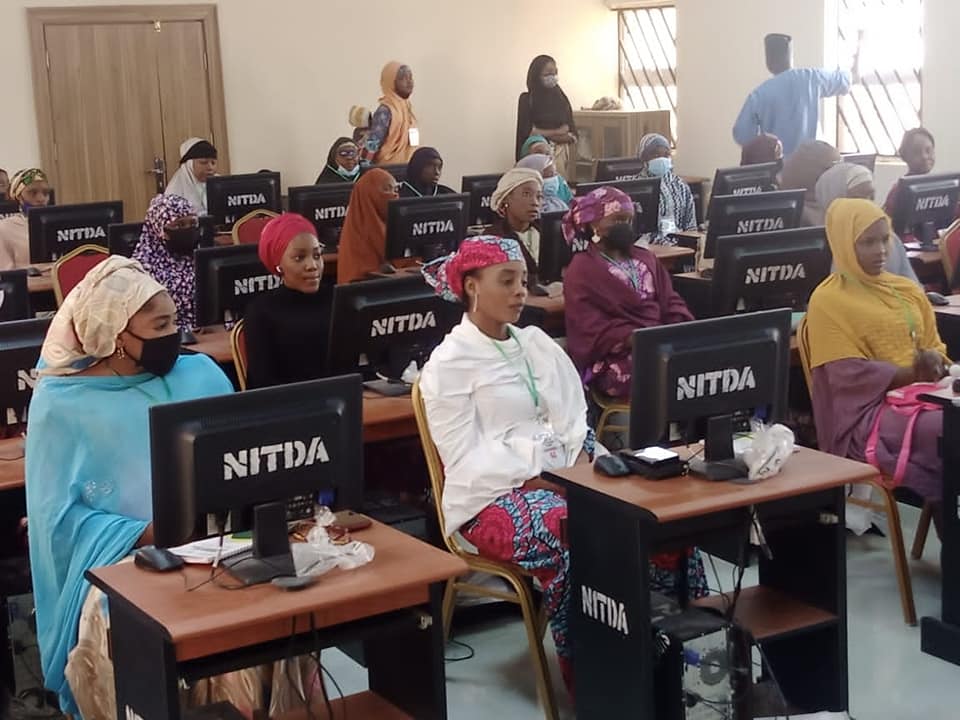
In implementing this strategic pillar, NITDA, in conjunction with the Federal Ministry of Communications and Digital Economy, has concluded a 4-day capacity building of Women on ICT Techprenuership in Dutse, Jigawa State capital, where 60 brand new HP laptops were presented to all participants who were drawn from various local governments within the state.

The Governor of Jigawa State, Badaru Abubakar who was represented by the Special Assistant on Economic Empowerment, Malam Muhammed Mujaddadi commended NITDA’s commitment to innovation-driven enterprises for micro, small and medium enterprises to thrive.

The participants were advised to make good use of the tools received from NITDA in collaboration with the Jigawa State Government in ensuring that they are self-reliant in the Digital world.

In his remarks, The NITDA Director-General, who was represented by the supervisory department’s desk officer, Folayan Michael Oluwasegun, admonished all participants to apply the knowledge gained in their various fields.

“The aim of the training is to equip the women on how to utilize modern ICT tools in doing their online businesses”, the DG averred.

The participants expressed their gratitude to the organizers of the laudable program and promised to make good use of the knowledge and materials received.


On their part, the participants thanked NITDA and Jigawa state Government for this laudable initiative.

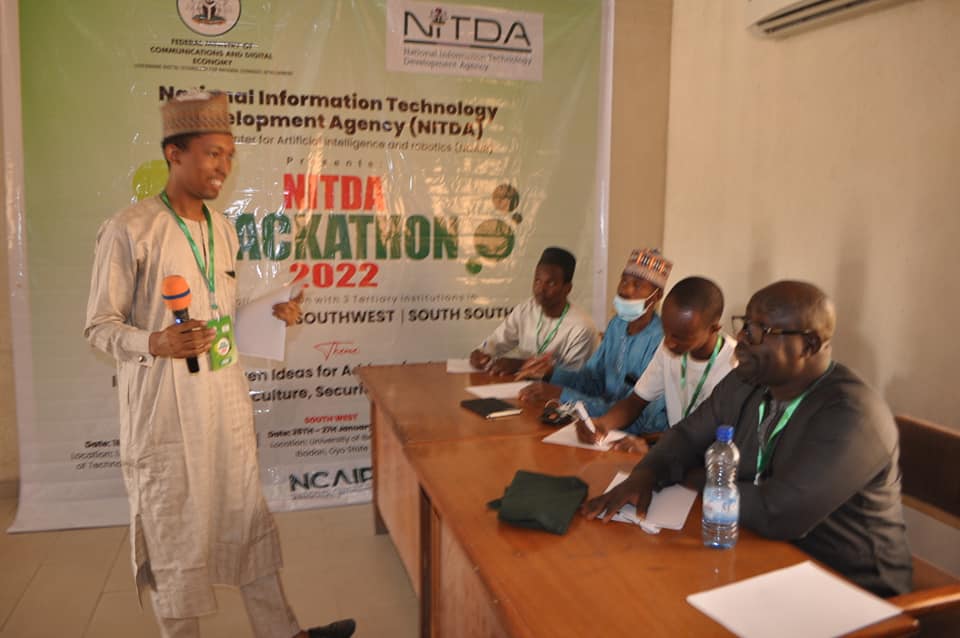
In its bid in providing platform for young Nigerian tech students to showcase their talents, the National Information Technology Development Agency (NITDA) under the supervision of Ministry of Communications and Digital Economy has commenced this year’s Hackathon where participants would come together and share ideas on ways to confront the country’s challenges using digital innovation.


The programme which is being coordinated by the Agency’s subsidiary, the National Centre for Artificial Intelligence and Robotics (NCAIR) and to be hosted in Cross River (South-South), Oyo (South West) and Adamawa (North-East), kicked off in Modibbo Adama University of Technology, Yola, Adamawa State, with students, entrepreneurs and innovators from different field with the purpose of harnessing the potentials of Nigerian youths in their quest to become problem solvers through digital innovation.

NITDA Hackathon is a National event in collaboration with academic institutions to drive digital innovation and entrepreneurship by challenging Nigeria’s teeming youths to ideate and develop solutions from inception through to the market.
The programme is set to develop and grow a global network of IT experts, comprising Nigerian youths within the country and in the diaspora.
It is targeted at inculcating entrepreneurship spirit in academia, creating a platform where industry and public institutions will leverage the academic research ecosystem to solve national challenges using technology.

The focus of this year’s programme is on Agriculture, Security and Logistics – considering the country’s current security challenges, the Agency gave security top priority; and Agriculture, as a result of President Muhammadu Buhari’s commitment to ensure Nigeria become a food self-sufficient nation and fight against insecurity.
Director General of NITDA, Kashifu Inuwa, CCIE, has equally urged the participants to show commitment and use their brain to come up with innovative ideas that will turn the security situation in the country around.

He said, “Technology is all about changing the way people do things, by coming up with ideas that will solve problems. This programme is aimed at giving Nigerian students, entrepreneurs and innovators the motivation to think, ideate and come up with digital innovation that will solve our problems locally.”

While commenting on the role NITDA’s subsidiaries are playing in supporting Nigerian startups, Inuwa said, “National Centre for Artificial Intelligence and Robotics (NCAIR) is one of NITDA’s special purpose vehicles created to promote research and development on emerging technologies and their practical application in areas of Nigerian national interest. NCAIR is also focused on creating a thriving ecosystem for innovation-driven entrepreneurship (IDE), job creation, and national development.”

On his part, the NITDA team lead, Dr Salihu Abdulkarim, noted that the participants were divided into groups, and winners in each category will be awarded cash prizes. They will also have the opportunity to conceptualize their ideas for commercialisation to meet global standards with NITDA’s support.

In an internet and data hungry ecosystem, Nigerian corporate space has shown promise and regarded as one of the biggest markets in Africa. With a lot of organization increasingly adopting modern technologies especially in the area of data analytics, cyber security and IT outsourcing to increase their productivity. Having seen this thriving ecosystem, Netcom Africa, one of the foremost information and communication technology (ICT) firm located in the Victoria Island, Lagos has brought a bouquet of services that will enable many Nigerian corporate organizations to scale and deepen their productivity.

Servicing many industries such as Financial Services, the company said that their solutions for this sector is crucial. In their words, they said “The financial services industry has its unique set of technology challenges owing to a complex set of regulations and industry best practices to which organizations must adhere. We deliver flexible technology solutions that will allow you to meet your organizational objectives while maintaining the strictest levels of compliance with security and fiduciary requirements.”

They added that “For a leading Nigerian Financial Institution, the contact center is a vital part of its customer-focused operations. The inbound side takes around One hundred and fifty thousand calls a month, while the outbound team makes over 30,000 calls per month. The outbound calls are a combination of sales activity and customer support follow up calls. To sell successfully, reaching a targeted number of customers at a time convenient to communicate effectively is the best way to close the sale.”

Netcom Africa has been using the On-Premise Avaya (contact center) since 2012. While that delivered reliability and a range of features, particularly for the inbound operation, the Company’s felt they needed to outsource the infrastructure while giving their distributed contact center operators the ability to have equal access to inbound calls and customer information from a managed service partner. This facilitated their move away from On-Premise to IP based cloud telephony for internal and outbound calls”

“We were working in a single location and at the mercy of a single point of failure. Our Sales Agents were not able to respond effectively to local needs, while our customer data was disconnected from our customer service agents”, Charles Harrington – VP, Corporate Development & Marketing.

On the manufacturing sub sector, Netcom has robust solution for this sector. Netcom Africa added that “The frequent need for innovation and adaptability is amplified by strong economic pressures, resulting in the need for cost-effective and robust IT environments ready to meet today’s fast-paced changes head-on. our solutions provide the Manufacturing and distribution sector with the technology they need to support their business goals.”

Netcom Africa has been known to be the industry leader in various IT solution such as Managed Cyber Security, Disaster Recovery And Backup, Firewall, Enterprise technology/solutions such as Enterprise Resource Planning (ERP), Productivity Applications and Unified Communications.

Netcom is Nigeria’s leading Managed Service Provider. Since 2004, companies across Nigeria have been relying on Netcom to ensure that they are connected to the world. Over time, Netcom has transformed to meet their clients demands with a host of leading solutions by partnering with local and global experts and OEM’s. Today they are the leading MSP (Managed Service Provider) in Nigeria with hundreds of companies relying on our expertise and leading solutions to help them navigate their digital transformation.

“The technology landscape is complex and ever changing, and we have a solid understanding of the problems today and the solutions that will drive your business into the future. We not only have the expertise and solutions to bring about fundamental change in the way you do business, but we have also taken that journey ourselves.”

Netcom Africa has provided world-class solutions to various blue-chip firms in Nigeria such as Actis, Hennessy, BW Offshore, Dana, Air France, Emirates Airline, AMCON, Leventis and a host of others.

ANTHONY NWOSU .E.

“For a leading Nigerian Financial Institution, the contact center is a vital part of its customer-focused operations. The inbound side takes around One hundred and fifty thousand calls a month, while the outbound team makes over 30,000 calls per month. The outbound calls are a combination of sales activity and customer support follow up calls. To sell successfully, reaching a targeted number of customers at a time convenient to communicate effectively is the best way to close the sale.”

… Seeks Collaborative Multi-Sectoral Approach for Improved Mental Health Services

Lagos State Government, through the Ministry of Health, is set to hold a mental health conference geared towards drawing attention to the importance of a multi-sectoral approach to providing improved mental health interventions for citizens as well as charting a positive and realistic course towards mental, social health assets and infrastructures needed in the State.

The conference themed: “Responding to the Mental Health Needs of a 21st Century Megacity”, is scheduled to hold at Landmark Event Centre, Oniru, Victoria Island, Lagos on Tuesday, 18th January 2022.

Giving details about the Conference, State Commissioner for Health, Prof. Akin Abayomi said the Mental Health Conference is an offshoot of the Livable City Conference held in 2013, which led to the drafting and enactment of the Mental Health Law of 2019 and the proposed establishment of a State-owned tertiary psychiatric hospital, amongst others.

He said: “This conference is a sequel to a previously organised event in 2013 where the Governor of Lagos State, top Government functionaries from the Executive, Legislative and Judiciary, Private Sector Care Providers, Mental Health Professionals and Social Justice as well as Security Experts gathered to discuss, engage, and address the Mental and Social Needs of Lagos State”.

The Commissioner noted that the conference will be a forum and platform for key Government Ministries and Agencies, Healthcare Professionals, Private Sector, Civil Society Organisations and Non-Governmental Organisations to discuss prevailing issues in Mental Health, identify opportunities and areas for collaboration, as well as professional networking in the Mental Health sub-sector.

He added that the outlined objectives of the conference include highlighting the growing scourge of Mental Health issues in Lagos State and providing a forum for dialogue amongst academics, decision-makers, policy implementers and the society, with a view to developing new policies and redesigning an existing one.

Other conference objectives, according to him, are providing a platform for all stakeholders to identify opportunities for strengthening investments towards a sustainable and collaborative mental health strategy in the State; displaying the achievements and strategic interventions that have been employed in implementing the Lagos State Mental Health Policy, as well as proffering and harmonising multi-sectoral recommendations in tackling the mental and social health needs of Lagos as an urban State.

Abayomi explained that conference participants will be drawn from a cross-section of the society with the representation of top decision-makers from the public and private sectors who have the right influence and expertise to drive the purpose of the engagement.

While noting that the last Livable City Conference provided the mileage needed to create the environment for improvement in the legal framework and access to mental health service, the Commissioner said the State government, through the plenary engagements of the mental health conference, intends to motivate and stimulate improved investments in mental health from the private sector and donor agencies.
He added that government will through the conference demonstrate to the international community, Lagos’ unequivocal commitment to Mental Healthcare and create a potential for global collaborations as well as allow all stakeholders to develop a clearer understanding of the emerging issues towards developing short and long-term improvement approaches.

Abayomi said experts who would speak at the conference include the lead speakers Dr. Vincent Udenze, a United Kingdom-based Consultant Psychiatrist and CEO of Intersect Consortium in Nigeria and Prof. Akinyinka Omigbodun, a Professor of Obstetrics and Gynaecology, and Consultant Gynaecological Oncologist at the College of Medicine, University of Ibadan.

Others, he said include Prof Cheluchi Onyemelukwe, a leading health lawyer in Nigeria; Dr. Yewande Oshodi, a Consultant Psychiatrist and a Senior Lecturer at the Department of Psychiatry, LUTH; Dr. Jibril Abdulmalik, a Senior Lecturer and Consultant Psychiatrist with the Department of Psychiatry, College of Medicine, University of Ibadan and Prof. Abiodun Adewuya, a Professor of Public Mental Health and Chairman, Lagos Mental Health Advisory Committee.

The Commissioner harped on the need for improved mental health services in the country, stressing that in recent years the role of mental health in sustainable development has received greater recognition, especially with the global public health crisis.