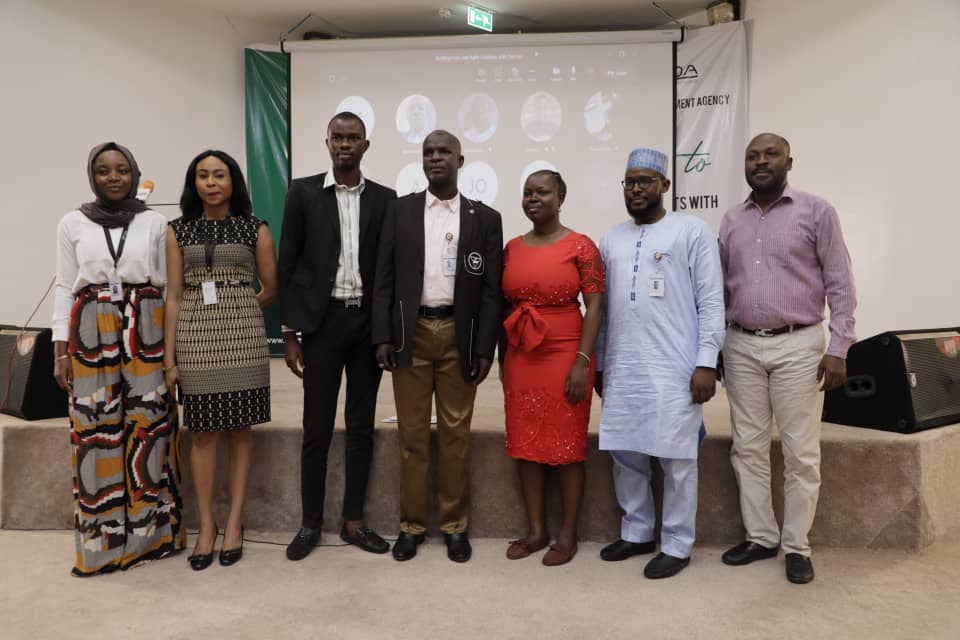
The National Information Technology Development Agency NITDA through one of its subsidiaries, the Office for Nigerian Digital Innovation(ONDI), in collaboration with Lotus Beta Analytics Nigeria Limited has commenced a Capacity Building Program for Vibrant Startups with the aim of supporting their Innovative capacities.
Held at the Public Service Institute (PSIN) Kubwa, Abuja, the training centered on Modernization of Legacy Solutions, Migration of On-Premises Business Solutions to the Cloud, Development of Cloud Applications and driving exponential revenue growth.
The Director General, NITDA, Kashifu Inuwa CCIE said the Capacity Building will help the Agency achieve its goal of creating more Innovation Driven Enterprises (IDEs) in line with the objectives of Digital Innovation and Entrepreneurship Pillar. Represented by the Acting Director of Digital Economy Development Department, NITDA, Engr Salisu Kaka,noted that it was borne out of the Agency’s desire of ensuring the successful implementation of the Present Administration’s National Digital Economy Policy and Strategy for a Digital Nigeria (NDEPS) within the stipulated period.
Adding that ” the sudden increase in demand for software and online web-based applications among businesses as necessitated by the COVID-19 outbreak had a positive impact on the growth of DevOps market and led to the growing need of DevOps solution among businesses to streamline the process of software application development by promoting collaboration between various entities of software development lifecycle.
Additionally, the rise in need for continuous and fast application delivery and increase in focus on reducing Capital Expenditures (CAPEX) and Operating Expenses (OPEX) drive the growth of the DevOps market. The global DevOps market size was valued at US$6.78 billion in 2020 and is projected to reach US$57.9 billion by 2030. Therefore, this collaboration is apt and timely in ensuring that our startups benefit from the DevOps market growth” he explained.
He urged participants to make the best use of the opportunity to tap into the growing DevOps market by ensuring that all learnings are translated into meaningful use to scale their businesses and contribute to the nation’s economic growth. On his part, the Managing Director, Lotus Analytics, Mr Ademola Akinbode,who featured virtually said the programme will serve as a springboard to groom tech startups,is also expected to develop Nigeria’s Tech ecosystem.
Also in her goodwill message,representative of Nigeria Country Director Microsoft, Mrs Edu-Abasi Chukunweike,lauded the initiative, while pledging Microsoft’s readiness to providing the platform required to develop indigenous startups.
The attention of the National Information Technology Development Agency (NITDA) has been drawn to series of media statements about NITDA’s role on the assessment of the University Transparency and Accountability Solution (UTAS). It is imperative therefore that the Agency puts the records straight for the interest of stakeholders and the general public.
It may be recalled that the Act establishing NITDA mandates it to create a framework for the planning, research, development, standardization, application, coordination, monitoring, evaluation and regulation of Information Technology (IT) practices in Nigeria. The Agency has, over the years, issued series of regulatory instruments including the Software Testing and Quality Assurance Framework and Guideline, issued in 2016. This regulatory instrument, currently being reviewed, provides guidelines for the design, development and testing of software projects in Nigeria. Furthermore, Section 10 of the Guidelines for Nigerian Content Development in ICT, 2019 provided detailed guidelines and expectations for Indigenous Software Development and Software Enabled Products and Services.
In line with its mandate, the Agency has been registering indigenous software solutions. Part of the registration process requires that solutions are subjected to tests in line with the requirements of the Software Testing and Quality Assurance Framework and Guideline and the Guidelines for Nigerian Content Development in ICT.
It is common knowledge that the Academic Staff Union of Universities (ASUU) has been engaging the Federal Government on a number of issues including payment of promotion arrears, earned academic allowance, funding for revitalisation of public Universities, and adoption of UTAS as payment platform for universities. On the 14th October, 2020, NITDA was invited to participate in an interactive session between ASUU, Federal Government and the Legislature. The session, held at the Conference Hall of Accountant General of the Federation’s office, was to avail ASUU the opportunity to demonstrate the UTAS platform.
As part of the conditions for acceptance of UTAS as payment platform for public universities by Federal Government, NITDA was directed to subject the platform to Integrity Test and advise Government appropriately. In doing so, the Agency decided to carry out 3 out of the 8 tests specified in the Software Testing and Quality Assurance Framework and Guideline. These tests are: User Acceptance Test (UAT);
Stress Test; and Vulnerability Assessment and Penetration Test (VAPT).
As part of the process, NITDA held its first meeting with ASUU on the 22nd October, 2020 and discussions centred on the modalities of the assessment. Furthermore, documents necessary for effective planning and execution of the tests were requested. As critical stakeholders to the implementation and deployment of the Solution, both the National Universities Commission (NUC) and the Office of the Accountant General of the Federation were also engaged. The main aim of this engagement was to obtain software requirements from their perspective.
Upon receipt of the documents from ASUU as well as access details of the UTAS platform in January, 2021, the Agency’s team carried out basic Functionality/User Acceptance Test on the platform. As NUC conducted UAT, NITDA felt it can use the report produced by NUC for its report. However, upon review, it was observed that the Solution was demonstrated to the Principal Officers in a similar way it was demonstrated at the Accountant General’s Office. The Agency decided that further UAT be carried out with actual end-users from the University System. As a result, arrangements were made and 46 staff members from 28 Federal Universities, mainly from Vice Chancellor’s Office, Human Resources, Accounts and Bursary participated in the UAT, held at NUC, on the 10th August, 2021.
Although the UAT was carried out as planned, challenges were encountered that negatively impacted on the outcome of the assessment. For instance, although the invitation emphasised the need for prospective participants to come with ICT tools for the exercise, very few of the participants had these tools. This resulted into grouping the participants and very limited hands-on interaction with the Solution was possible. Furthermore, there was limited connectivity thereby making it difficult for the participants with the relevant tools to follow the demonstration by ASUU. These issues were adequately reported to key stakeholders.
The Agency’s team also carried out series of Vulnerability Assessment and Penetration Tests on the UTAS platform. One of these assessments revealed five (5) High Risk vulnerabilities that are likely to negatively impact on the platform if exploited. Furthermore, two (2) Low Risk vulnerabilities were identified. These were discussed with the ASUU team and a further assessment carried out on the updated version of the Solution revealed that the High Risk Vulnerabilities have been addressed. However, one (1) Medium Risk, three (3) Low Risks and forty four (44) Informational Risks were identified. These also, were adequately communicated to the relevant stakeholders including ASUU.
A detailed Functionality/User Acceptance Test on the platform was carried out by our team. A total of 687 test cases were generated in which 529 passed, 156 failed and 2 cautionary warnings. As some of the failed cases are critical to the overall functionality of the Solution, the Agency could not recommend for the solution to be deployed in production environment. ASUU was therefore requested to work on the Solution and submit it for further assessment. Furthermore, a comprehensive report outlining all the tests carried out and issues identified was submitted to the Honourable Minister of Communications and Digital Economy on the 3rd December, 2021. This was in turn submitted to the chief conciliator, the Honourable Minister of Labour and Employment as well as other stakeholders in ASUU.
During the conciliation meeting held at the instance of the Honourable Minister of Labour and Employment on Tuesday, 22nd February, 2022, it resolved that NITDA works with ASUU and subject UTAS to re-assessment. Furthermore, it was resolved that key members of the conciliation team be in attendance during the Technical Team’s sessions as observers.
It may interest the Agency’s stakeholders to know that NITDA, as a responsible Agency of Government, made all arrangements to ensure that the exercise was carried out successfully. The interaction commenced on the 8th March, 2022 with discussion on the methodology to be used as specified in the Software Testing and Quality Assurance Framework and Guideline. Upon reaching agreement and starting the actual test on the Solution, a critical error occurred and the test could not continue. As a result, the interaction had to be postponed to enable the ASUU Team rectify the issue.
Considering the challenge encountered, the assessment methodology had to be reviewed to facilitate daily remediation of critical issues as they occur. This, although not in NITDA’s Standard Operating Procedure for exercises such as this, was adopted. Consideration was made to the national importance attached to the exercise as well as the need to complete it in a reasonably shorter period of time. It is important to note that despite making all efforts to fast-track the exercise, it took the team two weeks of continuous interaction on a daily basis. There is no doubt that the exercise has positively impacted on the functionality and robustness of the UTAS platform. Furthermore, we believe that the interaction availed ASUU the opportunity to understand and appreciate NITDA’s commitment and level of professionalism exhibited in carrying out its responsibilities.
The attention of stakeholders and the general public is drawn to the need for the UTAS platform to be sufficiently robust with key functionalities implemented before being deployed to the production environment. However, the assessment revealed that the Solution, as it is currently implemented, is limited. There are critical functionalities that have to be implemented, tested and passed before the Solution can considered to meet NITDA’s due diligence requirements. These areas of improvement have been fully documented and shared with the ASUU team for necessary action. It is expected that ASUU will improve on the areas identified, work on the security issues flagged and resubmit the Solution for further assessment. The Agency wishes to use this opportunity to assure stakeholders and the general public of its commitment to its mandate and the vision of proactively facilitating the development of Nigeria into a sustainable digital economy by creating an enabling environment where Nigerians develop, adopt and derive value from digital technology.
The National Information Technology Development Agency (NITDA) is the apex regulator for Information Technology in Nigeria under the supervision of the Federal Ministry of Communication and Digital Economy. NITDA was established in April 2001 to coordinate general IT development and regulation in the country. Specifically, Section 6(a & c) of the Act establishing the Agency mandates it to create a framework for the planning, research, development, standardization, application, coordination, monitoring, evaluation and regulation of Information Technology practices, activities and systems in Nigeria; develop guidelines for electronic governance and monitor the use of electronic data interchange and other forms of electronic communication transactions as an alternative to paper-based methods in government, commerce, education, the private and public sectors, labour, and other fields, where the use of electronic communication may improve the exchange of data and information. Signed:
The Director General Bureau of Public Service Reforms (BPSR) Mr. D.I Arabi has restated the commitment of the agency to support the Nigeria Tourism Development Cooperation (NTDC) to enhance it’s operations with view to strengthen the sector. The Director General made the remark during his courtesy visit to NTDC in Abuja recently.
According to Arabi, BPSR was ready to deploy it’s Self-Assessment Tool (SAT) programme on NTDC with the view to identifying areas of weakness and challenges facing NTDC, regardless of the successes being recorded.
This, he said would further strengthen the sector and boost the economic diversification policies of President Muhammadu Buhari.
He, therefore,.called on management staff to flank their support to DG, whom he said had remained committed in actualizing the visions and missions of the NTDC. In his remarks, the Director General Nigeria Tourism Development Cooperation NTDC Mr. Folorunsho Cooker commended BPSR for the visit and requested for more collaborations and partnership to enable NTDC realise its mandate.
He noted that the tourism sector has the potentials to turn around the economy of the country for the better, stressing that the sector has huge potential in view of its capacity to create positive infact to the Nation Gross Domestic Product (GDP), thereby reducing unemployment among teeming population.
He therefore lamented that, insecurity and lack of estern laws hindered the activities of Nigeria Tourism Development Cooperation (NTDC) among others.
“We’re faced with numerious challenge that make it almost impossible to attract both foreign and local tourist, which includes lack of estern laws, security challenge, infrastructure deficit among others”.
The Minister of Mines and Steel Development, Arc. Olamilekan Adegbite, has stated that the Federal Government through the Ministry has released the sum of N142.6M for the purpose of research development in the Mineral and Metal Sector. Adegbite stated this in Abuja, Tuesday, on the occasion of the Stakeholders Validation Exercise for the Research Development and Collaboration with some Nigeria Tertiary Institutions.
Adegbite named the institutions as; University of Ibadan, University of Port-Harcourt, University of Lagos, University of Jos, Ebonyi State University, Nasarawa State University, Federal University of Technology, The Kaduna Polytechnic, Ibrahim Badamasi Babangida University amongst others.
He added that these Tertiary Institutions, after due diligence, were carefully selected by independent faculty of five (5) erudite Professors of proven integrity who have contributed to the growth of the sector. The research covers areas of Mining Engineering, Metallurgy and Mineral Processing, Geological Mapping, Industrial and Minerals Utilization/Exports and Energy Minerals.
The Minister further stated that in order to succeed in fulfilling the mandate of the Ministry on job creation, raising the sector’s contribution to GDP of the country and promoting sustainable mining, the Ministry released the sum of N142.6million to achieve this collaboration with the stakeholders whose knowledge of the sector could facilitate the journey to shared mining in Nigeria.
He also added that in order to show the importance of the collaboration and to authenticate the findings of the research, it is also important for stakeholders to validate the exercise hence the essence of the workshop today.
The Permanent Secretary, Dr. Oluwatoyin Akinlade, who was represented by the Director Special Duties, Mr. Yisau Adepoju, said in the Ministry’s effort to rejuvenate the Mining Sector it finds it crucial to collaborate with this reputable institutions to carry out this research in specific areas which is intended to open up new frontiers in the Mining sector by providing the much needed data on the Nigerian Solid Mineral sector endorsement .
Dr. Akinlade added that it is gratifying that these reputable institutions have completed their works. For their findings to be acceptable, it is customary, like in any other piece of research work it remains only an academic exercise until critical stakeholders come together to give it life so as to pave the way towards its acceptance and implementations. This is what gave rise to this validation exercise by eminent stakeholders.
She stated that the Validation of the Research Findings by all the stakeholders will unlock the potentials and add value to the Mining and Mineral Sector.
The Permanent Secretary, also told the stakeholders that the Ministry is ready to partner with interested stakeholders in the areas of research, exploration, exploitation, beneficiation and the whole length of the value chain in the sector especially the gaps that would be identified in this research to create confidence as well as attract investors to the sector.
The Chairman of the committee, Prof. Gbenga Okunola, in his remarks thanked the Ministry for giving them the privilege to serve and told the gathering that nations develop as a result of collaborative research and development and that the objective of the Steering Committee is to help achieve the whole garment of the development mantra in the Mineral and Metal sector through collaborative research works such as this.
The recent spate of ‘crash’ among ROI Companies has called into question the activities of brand influencers. Whenever a company hits the rock or suffers opprobrium, its influencers, the same persons who had wooed members of the public into patronising the brand, would be quick to publish disclaimers, disassociating themselves from the embattled company and distancing themselves as much as possible from any liablity.
Time without number, the Nigerian media space has been greeted by this brouhaha of a company losing its footings and cascading down the pit; its flag bearers dropping-off the company’s flags and taking to their heels, leaving members of the public (the investors) stranded. In such situations, one question which usually arises is, whether the brand influencer(s) can be sued by any person or group of persons affected by the ‘crashed’ company, particularly where the owners of the company have disappeared.
WHO IS BRAND INFLUENCER?
A brand influencer is person contracted to market or promote the products or services of a particular brand (Wonder Legal). Such a person leverages on the trust bestowed on him/her by members of the public (followers) to influence choices.
An influencer, by his/her personage, wields so much power over his/her followers. This is because most followers regard an influencer as someone with a ‘superior knowledge’ about a pearticular brand, hence the trust. 86% of consumers who were interviewed during the 2020 Influencer Compensation Survey said they rely on social media influencers for credible information on brands (Theophilus Oladipo). This is why it is imperative that an influencer’s opinion on brands be based on experience, facts or adequate testing (Elvis Asia).
WHAT HAPPENS WHERE A FOLLOWER RELIES ON THE OPINION OF AN INFLUENCER TO INVEST IN A PARTICULAR SCHEME AND THE SCHEME FAILS?
It is crucial at this point to understand the somewhat ‘tripartite’ arrangement between a brand influencer, the company and members of the public. The company engages a brand influencer to be its flag bearer. By flying the flags of the brand, the influencer draws his/her followers to the company. However, the transaction/contract that eventually results is usually between the company and the customer. The influencer who acts as an intemediary between the company and the customer may not be a party to the eventual contract. He or she may also not be a shareholder or co-owner of the company, hence the tendency to deny responsibility when things go amiss.
BUT WOULD THIS DEFENCE OF ‘NO BE DO AM NAH!’ EXCULPATE AN INFLUENCER?
While the provisions of section 125 of the Federal Competition & Consumer Protection Act may have given a consumer the right to claim damages against deceptive marketers, deception or misrepresentation is a question of fact usually proved based on peculiarities of a particular case. For example, the court will have to find out whether such a misrepresentation was honestly made or not. In TERIBA V ADEYEMO (2010)LPELR-3143(SC), Tabai JSC stated thus: ‘it is my view that a statement of fact honestly made by a party cannot be held to be a misrepresentation simply because it turns out not to be quite incorrect.’
Where, however, it can be proven that an influencer ventured into promoting a brand carelessly or without adequate information about the brand, such an influencer will be guilty of misrepresentation. This is because the law expects that an influencer would conduct ‘DUE DILIGENCE’ on any brand before accepting to promote it.
Stressing on the above, Abimbola Osarague, JCA, held in OLAYIWOLA V FRN (2018) LPELR-46772(CA) that a representator (influencer) will be liable for misrepresentation where he or she –
(i) Knows or believes that the representation is not in accord with the facts; or (ii) Does not have the confidence that he/she states or implies with the representation; or (iii) Knows that he/she does not have the basis that he/she states or implies for the representation.
In JOHN HOLT & CO LTD V. OLADUNJONYE (1936)13 NLR 1, Mr. Killa, who needed a surety to enable him take some goods on credit, was described to his prospective surety as “a good produce buyer” by the seller of the goods despite the latter being aware that Mr. Killa was an unfaithful debtor. It was held that the seller’s representation constituted misrepresentation. Similarly in the English case of SMITH V. LAND & HOUSE PROPERTY CORPORATION (1884) 28 CH D 7, a vendor described a tenant as “most desirable tenant” when in actual fact the tenant owed several arrears of rent. The vendor’s representation amounted to misrepresentation.
CONCLUSION From the above analysis, any person (individual action) or group persons (through a class action) who suffer(s) loss(es) by virtue of any representation made by an influencer can maintain an action for damages against the influencer himself or both the influencer and the company. To succeed in such a claim against a brand influencer, it must be shown that the plaintiff relied on the representation made by the influencer; that the influencer didn’t exercise the level of diligence expected of a reasonabe/prudent man; or that the influencer was complicit in the entire mess, etc.
RECOMMENDATIONS
A sector-specific regulation to complement the provisions of existing laws such as the FCCP Act, the NAFDAC Act, the Advertising and Practitioners (Registration, Etc) Act, etc.
Brand Influencer should always endeavor to do due diligence on brands before promoting them.
Brand Influencers shoud always insert an indemnity clause in the Influencer Agreement, stating that the brand company will indemnify them of any claim for damages from their followers.
REFERENCES:
Elvis Asia, ‘Legal Issues in the Business of Social Media Influencer’ (online)
Theophilus Oladipo, ‘Nigeria Must Develop a Legal Framework against Deceptive Advertisement.’ (online)
Cloud computing is nothing new, but as the technology continues to evolve, companies are increasingly embracing the cloud to stay current and competitive. Marilyn Moodley, Country Leader for South Africa and WECA (West, East, Central Africa) at SoftwareONE looks at why the cloud is vital to businesses, and why some are still reluctant to make the move.
Are you on the cloud yet? This is an organisation’s equivalent of a young person’s ‘when are you getting married?’ which moves swiftly to ‘why aren’t you married yet?’ And the reasons for not making the jump in both cases are often the same: resistance to change; wariness of taking a risk; caution about compliance to a new situation; and aversion to the initial investment, which can be high.
While these are all valid concerns about cloud migration, it is still unwise to ignore the many benefits of doing so. The COVID-19 pandemic showed businesses that contingency plans are a non-negotiable in the face of potentially catastrophic events. Organisations that deploy to the cloud are very much on the front foot when it comes to being agile, flexible, and able to move quickly when adverse situations do arise.
According to research conducted by the Cloud Industry Forum on the state of cloud adoption, 91 percent of businesses said that shifting to the cloud has been vital in coping with the effects of the pandemic, as going digital enabled them to respond more readily to changing circumstances. In addition, 77 percent feel that the cloud has simplified their IT challenge. 50 percent of IT infrastructure is now cloud based, the first time it has ever topped this milestone in the 12 years since the Cloud Industry Forum started doing research.
Clearly, the cloud is the place to be, and businesses today are becoming more aware of the benefits of using the cloud to save on costs, enable scalability, innovate at pace, speed up operating systems, and increase flexibility and resilience.
However, making the move to the cloud isn’t always straightforward. One of the main worries expressed by organisations is that they lack the skills to do it. What’s more, over the years, as data centres have grown and evolved, servers added, acquisitions taken place and software installed, it is difficult to know what applications an organisation even has, much less knowing what to migrate and what to leave behind. Gordon Davey, Global Head of Azure Cloud Services at SoftwareONE, refers to this mass of technology as the ‘nachos effect’. Everything is interconnected, like a plate of nachos – when you pick up one nacho, hoping it won’t disturb the rest, strands of cheese bring three or four other nachos with it. So, too, with cloud migration, with so many interconnected parts.
This is where selecting a trusted partner, like SoftwareONE, is so important. An organisation’s journey to the cloud can be a smooth transition, backed by a clear strategy that takes an organisation’s unique environment and workloads into account. Experts can assist in establishing a consolidated and rationalised view of the current IT landscape, prioritise and recommend workloads to run in the cloud and define and execute the next steps in the cloud migration. Essentially, they can identify which nachos can be taken alone, and which are inextricably connected to others and need to have a migration plan to address this. Partners can also help organisations understand the licensing and cost ramifications of moving workloads to the cloud, how to optimise spend and ongoing cloud management to ensure value is realised.
The past few years have seen a significant increase in the use of the cloud and 69 percent of companies interviewed as part of the Cloud Industry Forum’s research are speeding up digital transformation plans. By 2025, research company Gartner estimates that 85 percent of enterprises will have a cloud-first strategy. It is undoubtedly the engine of transformation and companies need to keep up with the pace of change or risk being left behind.
The first businesses in the Middle East and Africa region have started to experience the seamless ease of Mastercard’s Track Instant Pay solution, in partnership with leading pan-African fintech enablement partner, Ukheshe Technologies.
Track Instant Pay is a next-generation virtual card solution that uses machine learning and straight-through processing to enable instant payment of supplier invoices – the first of its kind.
“It safely and intelligently authorises immediate payments to a supplier once a supplier submits an invoice,” says Paul Selibas, President: Channel Solutions at Ukheshe. “First, it analyses received invoices using sophisticated machine learning to identify those likely to be rejected, then authorises the rest for payment on the same day. These payments are sent digitally, directly, and securely to the supplier’s bank account via a Mastercard virtual card. It eliminates all the usual manual processes, from verifying and manually approving invoices to manual payments or lengthy check processing.”
Improving the bottom line
Mastercard’s whitepaper on this new solution revealed that extended payment terms and late payments create a long-standing point of friction between buyers and suppliers. Even virtual cards, in theory a great solution, have not eased these pain points.
According to the paper, suppliers receive an email indicating they have a virtual credit card payment. The supplier must click a hyperlink from the issuing bank, log in and manage credentials to that bank account to see the full number. They then see a list of invoices that are being paid in a different portal. Next, the supplier must key that transaction into its own system. Overall, this is a highly manual and expensive process, and Mercator estimates that roughly 90% of virtual card transactions are processed this way.
Furthermore, a 2020 study of SME suppliers in the UK showed that the average SME supplier was chasing five outstanding invoices at any point in time, eating up 1.5 hours per day. Says Selibas: “Within emerging markets across Africa and the Middle East, there is a specific and growing need for a system that can facilitate corporates in paying multiple large municipal bill payments at once, and this solution addresses that on all fronts.”
“It benefits every involved party – it unlocks cashflow for suppliers who usually suffer lengthy payment terms or late payments; saves valuable time, costs, and working capital for buyers; and it removes friction to improve business relationships. Buyers can manage their working capital more efficiently using the credit line tied to their commercial card account; while unique, dynamically generated virtual account numbers with layers of control provide enhanced security for supplier payments.”
The way forward
Ukheshe and its turnkey Eclipse platform is already Mastercard’s preferred implementation partner in South Africa, having successfully launched Africa’s first Mastercard virtual card for use on WhatsApp last year. The card giant once again appointed Ukheshe as its partner in this solution.
Anton Coertzen, CCO at Ukheshe, says this type of technology could change the business landscape forever. “Mastercard’s solution, combined with Ukheshe’s Eclipse platform, can change the way businesses manage payments – saving time, money and energy for all parties involved. With Eclipse, we can add new services to our clients’ suite so that it grows with them when their needs, and those of their own clients or suppliers, change over time. It fits perfectly into Ukheshe’s vision of fintech enablement, modernising business-to-business transactions, and financial inclusion.”
Continued Growth in Q4 Solidified #1 Ranking for the Year
Kingston Digital Europe Co LLP, a flash memory affiliate of Kingston Technology Company, Inc., a world leader in memory products and technology solutions, today announced it closed out a prosperous 2021 in the number one spot for SSD Unit market share in the channel. SSD demand through Q4 2021 remained high due to continued growth in the client, enterprise and OEM sectors. In October, Kingston also broadened its portfolio by launching two new high performance client M.2 NVMe PCIe Gen 4 SSDs, KC3000 and Kingston FURY Renegade.
Market share data from analyst research company TRENDFOCUS showed Kingston as the number one client SSD vendor in the channel with 22.2% for unit market share and 22.3 million client SSDs shipped for all of 2021 in the channel. In Q4 alone, Kingston’s client SSD market share grew to a substantial 26.8% in the channel which displays a healthy annual unit growth despite ongoing component shortages. According to TRENDFOCUS, total client SSD units increased 12.4% YoY in 2021. Notebook PC units increased 12% YoY while desktop PCs inched up 1% over the same period, reflecting the rapid adoption of solid-state drives by clients largely due to performance, size and reduced power consumption. Kingston maintains a competitive advantage by working closely with its suppliers, partners, and customers to remain flexible and adapt to ever-changing needs and market conditions.
“2021 saw a nearly 9% increase in total PC shipments1, the highest volume shipped since 2014. The transition of PC demand over to commercial models amplified an already high SSD-attach rate in notebook PCs and continued to fuel growth opportunities,” said Don Jeanette, vice president, TRENDFOCUS.
“The 2021 research findings validate Kingston’s growing presence and position in the SSD market,” said Tony Hollingsbee, SSD business manager, Kingston EMEA. “As we celebrate our 35 year anniversary, Kingston has been a consistent and trusted manufacturer of high-performance storage solutions. Over the past decade, we’ve continued to solidify our product portfolio with strong SATA offerings as well as distinct NVMe solutions optimised for notebooks and desktops. It takes an entire team to accomplish this feat and we both thank and share our success with our partners, vendors and customers.” For more information visit kingston.com.
#
About Kingston Digital Europe Co LLP Kingston Digital Europe Co LLP and Kingston Technology Company, Inc., are part of the same corporate group (“Kingston”). Kingston is the world’s largest independent manufacturer of memory products. From big data, to laptops and PCs, to IoT-based devices like smart and wearable technology, to design-in and contract manufacturing, Kingston helps deliver solutions used to live, work and play. The world’s largest PC makers and cloud-hosting companies depend on Kingston for their manufacturing needs, and our passion fuels technology used by the world every day. We strive beyond our products to see the bigger picture, to meet the needs of our customers and offer solutions that make a difference. To learn more about how Kingston Is With You, visit Kingston.com.
The Honourable Attorney General of the Federation and Minister of Justice, Abubakar Malami, SAN has said that his Office will accordingly give effect to the Court judgment in line with the dictates of the law and the spirit of the judgment. This was in a Statement signed by Dr. Umar Jibril Gwandu, the Special Assistant to the HAGF on media and made available to newsmen on 18th March. 2022.
The HAGF stated that the judgment of the Court will be recognized by the Government printers in printing the Electoral Act.
He disclosed that, “ The Act will be gazetted factoring the effect of the judgment into consideration and deleting the constitutionally offensive provision accordingly”.
He explained that, “the provision of Section 84(12) of the Electoral Act 2022 is not part of our law and will be so treated accordingly”.
According to him, “this is in line with the dictates of chapter 7, Part 4, Section 287 of the 1999 Constitution of the Federal Republic of Nigeria (as amended) on enforcement of decisions that makes it a point of duty and obligation on all authorities and persons to have the judgment of the federal High Court, among others, to be enforced”.
The Honourable Minister of Communications and Digital Economy, Professor Isa Ali Ibrahim (Pantami), has reiterated that the use of emerging technologies in combating insecurity remains a veritable tool which Nigeria will continue to capitalise on, as government and stakeholders are pointing towards digital technology as the next available option to help reduce the scourge of insecurity in the country.
Prof. Pantami, who was represented by the Director General of National Information Technology Development Agency (NITDA), Kashifu Inuwa CCIE said this during a paper presentation at the National Students Security Summit 2022 organised by National Association of Nigerian Students (NANS) at the International Conference Centre, Abuja.
He said that the rapid advancement of technology has brought about the term Emerging Technologies that are new, and they have not been fully explored or are still under development, and new cases are discovered every day.
According to the Minister, the technological revolution is transforming lives at breakneck speed, dramatically altering the way people work, learn and live together. He stated that Emerging Technologies such as Artificial Intelligence, Blockchain, Cloud Computing, Quantum Computing, Augmented Reality, Internet of Things and Robotics are exponentially growing and finding new applications in an ever-increasing number of sectors, including the way people receive, exchange and process information for security activities.
The Minister further said that unstoppable as insecurity is, the country has continuously explored various approaches to mitigate security challenges. “You would all agree that the ongoing Fourth Industrial Revolution (4IR), characterised by digitalisation and automation, is cutting across all sectors of industry and humanities. The copious role of digital technology in tackling insecurity can never be underestimated; making it a veritable tool for defeating all security threats in the country.
“It is pertinent to understand that advances in technology are reshaping global security capabilities, from enhancing the way borders are monitored to helping mitigate insecurity, the impact of natural disasters to intelligent detection, the identification of criminal activities to automatic detection of crime associated menace in the society,” he added.
Pantami further stated that these new challenges and opportunities are currently being utilised in facilitating digital solutions and building capacities to address national security challenges in Nigeria. Adding that Federal Government is not unmindful of the role of emerging technologies in a sustainable digital economy and national security issues.
He said that the National Information Technology Development Agency (NITDA), National Centre for Artificial Intelligence and Robotics has been established to foster the development of emerging technologies in preparing Nigeria for the Fourth Industrial Revolution via research and development of technologies like drones, robotics and Artificial Intelligence.
Pantami said to curb cybercrime activities, NITDA rejigged its Computer Emergency Readiness Response Team (CERRT) in response to the increase rate of cybercrime and fulfilment of the requirement of the National Cybersecurity Strategy. He added that CERRT functions in coordinating and facilitating information sharing, providing mitigation strategies and recommendations for the incident response and recovery, researching and analysing trends and patterns of incident activity for government Ministry, Department and Agencies (MDA) with extension to the private sector.
“We are taking steps to establish National Public Key Infrastructure to ensure the protection of Nigerian systems in cyberspace. We are establishing National Emergency lines in almost every part of the country to ensure citizens’ communication access. We are creating cybersecurity awareness across geopolitical zones to educate Nigerians on the potential of cyber threats. Every Nigerian must be aware of his responsibilities as far as security is concerned, and each person must be safe,” he added.
In an attempt to create a safe digital environment, the Minister said that President Muhammadu Buhari has approved the designation and protection of relevant telecommunications infrastructure across the country as Critical National Infrastructure (CNI) towards supporting implementation. The Minister added that Government at all levels, private and other critical stakeholders in the technology ecosystem are expected to respond more rapidly and effectively to the unique opportunities emerging technologies could bring to Nigeria’s security administration.
Pantami stressed that, “as government, we would channel our energy towards creating an enabling environment for innovation in emerging technologies that could be harnessed and utilised effectively to the country’s advantage. We would develop integrated frameworks and approaches for adopting and deploying Information and Communications Technology (ICT) in national security architectures. We will continue to create suitable platforms to foster trustworthy collaborations between the country’s public and private technology community and civil society organisations.”