The Nigerian Communications Commission (NCC) and Google Global Services Nigeria have expressed determination to work together toward advancing the actualisation of auspicious national targets for ubiquitous broadband access in furtherance of Nigeria’s digital transformation policy. This aligns with and gives unambiguous expression to NCC’s strategic vision plan centering on strategic partnership and collaboration with necessary stakeholders in order to achieve regulatory objectives.

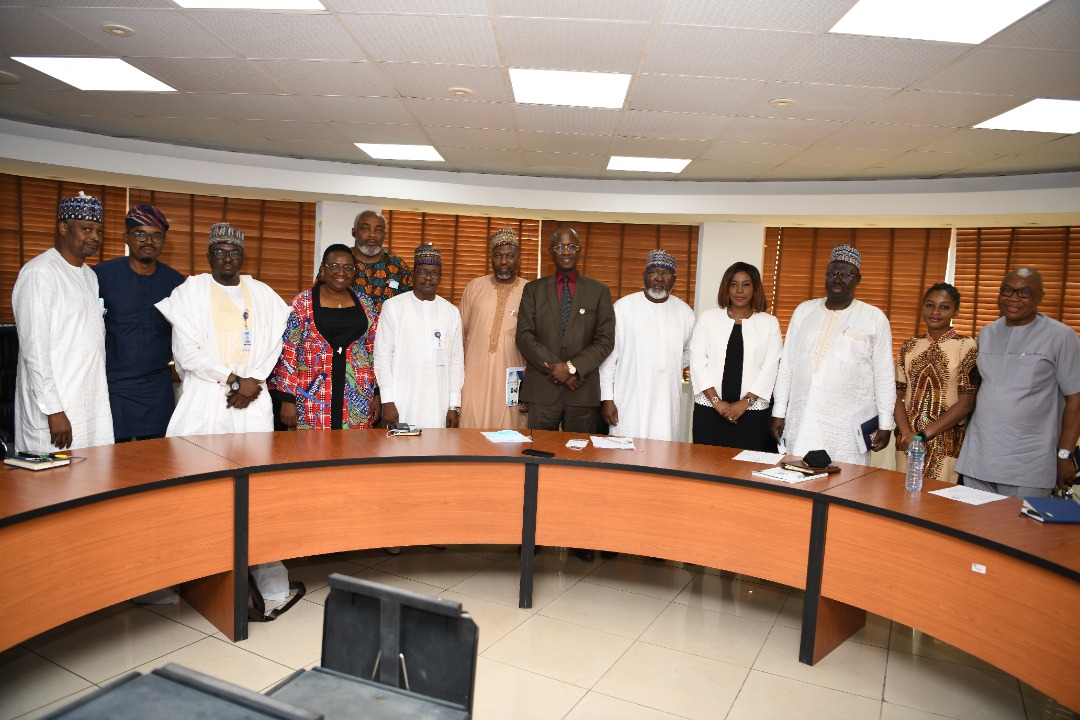
The two organisations made the commitment when a delegation from Google Global Services Nigeria paid a courtesy visit to the Commission’s Head Office in Abuja recently to deliberate on viable collaborative interventions to propel digital transformation across the country and Africa.

Receiving the Google delegation, the Executive Vice Chairman and Chief Executive Officer (EVC/CEO) of NCC, Prof. Umar Garba Danbatta, said the Commission’s expectations, initiatives, and vision towards increasing broadband penetration, quality of service, advancement of a digital economy and commitment to improving national security through technological advancement are at the front burner of its regulatory interventions.

Underscoring the importance of such synergy between the Commission and Google, Danbatta, who was represented by the Executive Commissioner, Technical Services (ECTS), NCC, Engr. Ubale Maska, said the Commission looked forward to making the initiatives of both parties more impactful by enhancing cooperation between the NCC and Google Nigeria for quantifiable and remarkable impact.

The EVC expressed optimism that Google’s investment in the subsea cable, Equiano, which is expected to land in Nigeria by end of April 2022, will be more impactful in driving NCC’s ongoing implementation of the Nigerian National Broadband Plan (NNBP), 2020-2025, aimed at increasing broadband penetration to 70 per cent by 2025.

“I am hopeful that Equiano will have additional landing points in the hinterlands through collaborative efforts with the licensed Infrastructure Companies (InfraCos) to reduce retail data prices significantly and thereby complementing the Commission’s efforts at ensuring affordable Internet services are available to boost the Commission’s ongoing broadband policy drive,” he said.

Earlier in her remarks, the Director, Google West Africa, Juliet Ehimuan, who led the delegation to NCC, commended the NCC for its consultative approach in formulating regulatory policies, as engine room for optimal delivery of telecommunications services that will in turn impact the digital economy drive of the government.

She particularly applauded the Commission for its seamless, fair, credible, impartial and successful auction of the 3.5 Gigahertz spectrum for the deployment of Fifth Generation (5G) in Nigeria, stating that it is evident that both the NCC and Google share a common goal.

According to Ehimuan, demands for internet services have increased the need for more capacity, and sustainable collaborations with all relevant stakeholders within the public and private sectors. She asserted that Google’s commitment of $1billion across five years in various interventions will support digital transformation in Nigeria and across Africa.

Ehimuan stated that research has proven that Africa will have an additional 300 million Internet users and Nigeria will lead in that number, given its current statistics of over 141 million internet subscribers and broadband penetration of over 40.88 percent as at January 2022.

The Equiano cable system is the third private international cable owned by Google and the 14th subsea cable invested by Google. Equiano connects Portugal and South Africa, running along the West Coast of Africa, with branching units along the way that can be used to extend connectivity to more African countries. The first branch is expected to land in Nigeria by end of April 2022

He came in with his father into my consulting room. They were almost passing for twin brothers, the only difference was the built and the look The father had more built and obviously looked older. That was the result of adolescents’ rapid growth. Adolescents are people between 10 and 19 years. My patient was 16. Many things are special about people in this age group. One prominent thing is their thinking and view about life. They believe in fairytales a lot. Dont mind me like I was not once in the same dreamland before age and reality of life woke me up.

What did I own this visit Tunde I asked my patient? (real name withheld), he went straight to the point my dad promised me a dental brace for my exam success. I just passed so I was here to get my brace. They had gone to dental unit of the hospital earlier. They were directed back to General out patient department to get referral. So victor was in my consulting room to get the referral letter to the dentist to get his dental brace promised him for exam success by his father. I asked him any tooth anomalies? What was his reason for wanting a dental brace. I was shocked the answer Tunde gave me and this was what prompted me to write this piece. He said the celebrity he loved was using dental brace that was why he wanted it. I am not sure I heard the reason victor gave well. As a General practitioner, I know people use dental brace for cosmetic reasons but a teenager of 16 years without any teeth anomalies wanted dental brace because his hero celebrity he was watching on TV was using it? This shock made me to turn to the father who granted such request. In fact, bigger shock came from the father. I asked him if he heard the reason his son gave for getting a dental brace. He said yes and further justified it by saying” Doctor what can I do ? He said that was what he wanted for his success in the exam. Even at home that was how he behaved. Anything he wanted if you didn’t give him, he would not be happy again. Did I just hear that from Tunde’s dad too? I screamed in my head. A 16 year old boy dictates what he wants to you at home and you are the father and parent? The father smiled back sheepishly again.

Seriously ladies and gentlemen I entered counselling mode immediately. I saw impending danger here. The future of a young man was at stake. I saw wrong parenting for an adolescent here. I asked Tunde for his permission to counsel him with his father together. He did not decline though but was wondering what the counselling was for. Any problem? Counselling format has always been basically to ask what the patients know about the topic and you as the the counsellor give them all the correct information and options then guide them to make a rational decision best for them. I ventured out on this voyage. The topic I had to deal with here with Tunde and his dad was ADOLESCENCE AND PARENTING. I asked Victor what he understood by being an adolescent. He seemed not to understand much about adolescence despite being one. I asked the father about parenting an adolescent, he said and I quote” doctor is there anything special about adolescents being parented ?”. Within me I was screaming in my head again. No wonder Tunde was in my consulting room this morning for cosmetic dental brace motivated by hero celebrity. Time will fail me to tell you all information I gave them on ADOLESCENCE AND PARENTING but l will summarise it not to bore you. I told them: Adolescence is a stage of life for people between 10 and 19 years. This stage can be developmentally divided into three according to World Health Organisation (WHO). First is early adolescence (10-13), mid adolescence ( 14-16) and late adolescence (17-19). These 3 stages can be summarized thus developmentally: Early adolescents have brain of a child and body of an adult. Mid adolescents have 50% child’s brain and 50% adult’s brain and body of an adult. The late adolescents have brain of an adult and the body of an adult. Hence the decisions taken at this stage of life go hand in hand with these peculiarities. Tunde is 16. He has body of an adult already but 50% child’s brain. You are wondering why I would say that? Was it not obvious from the decision made by Tunde so far?

Now to parenting, parenting is guiding and nurturing a child in all aspects of life either you are the biological or non biological parents. There are 4 ways you can parent a child and the meaning of each parenting style based on two issues which are LOVE AND DISCIPLINE.

The 4 types of parenting are:

Permissive parenting which is LOVING A CHILD ALL THE TIMES WITHOUT DISCIPLINE;

Authoritarian parenting style which means DISCPLINING A CHILD ALL THE TIMES WITHOUT ANY LOVE;

Uninvolved parenting style which means the parents are not even doing any of the two, NO LOVE, NO DISCIPLINE, the child is on his or her own and the last parenting style which is Authoritative parenting style,also known as Balanced parenting style, which involves LOVING AND DISCIPLINING A CHILD EQUALLY. Research rated Authoritative parenting style as the best parenting style world wide and the remaing three parenting styles as defective.

Now I turned to Tunde’s father which of the parenting styles I have explained now do you think you have been using for Tunde? The 60 year old man was quiet for almost 2 minutes, surprising to me, with almost tears in his eyes said, doctor I never knew all these types of parenting styles and their consequences as you just explained. He said doctor no doubt the permissive parenting style seemed to be the one I have been using with Tunde.” Doctor what can l do now? Is it not too late for him?” That was how l raised all his 2 elder brothers and doctor l must tell you they have not been doing well on their own. The first brother had drug issue and the second brother was irresponsible. To my surprise, Tunde in tears after hearing my oratory education on Adolescence and Parenting and its consequences and heard his father’s helpless question, he said daddy it is not too late. I dont want any dental brace again. Daddy guide me the authoritative way. The best way you think I would turn out best guide me. The two hugged each other with mist of tears in their eyes and left closing the door of my consulting room behind them. Now my own tears erupted in my head, did I just change a life, a future, a family, a generation? Because Tunde would have gone ahead to likely parent his own children too this wrong way and the trend continues and becomes transgenerational. I am happy l have just made another impact. As l close my write up, I will like to appeal to every parent reading this anywhere in the world, LOVING A CHILD WITHOUT DISCIPLINING THEM IS NOT LOVING THEM, IT IS DESTROYING THEIR LIVES. Please LOVE your child, meet their needs, cater for them, ask for their opinion and respect their opinions to the extent that opinion is beneficial to their present and future and make sure that after putting everything together and considering their highest good, have the final saying by showing them the right path. They may not appreciate you today don’t worry, when through your BALANCED LOVE AND DISCIPLINE PARENTING STYLE, they look back tomorrow as a fulfilled soul, they will forget the temporary gratification of all love without discipline and bless the day God gave you to them as their guide through life.

I hope this article speaks to you.

Once a niche criminal enterprise, ransomware has become big business, complete with R&D departments and sales and marketing divisions. The deeply layered onion that is today’s ransomware attack landscape has been wreaking havoc in large enterprises in South Africa and across the globe. 

Patrick Evans, CEO of SLVA Cybersecurity, says it only takes two hours to determine whether a network’s endpoint protection can be circumvented and if the organisation has controls in place to stop the encryption and ransomware behaviour: “Understanding an organisation’s current environment, and the likely costs of a ransomware attack, is crucial to making a more informed decision concerning security.” 

Evans says the recent ransomware attack on TransUnion has undoubtedly raised concerns among enterprises about their own potential security vulnerabilities. Irrespective of the amount of protection currently in place, ransomware has evolved into a complex and sophisticated form of organised crime.

“While many people believe the victims of ransomware have not secured their networks, the truth is most organisations have made significant investments in information and cyber security. Features such as firewalls, endpoint protection, intrusion detection, patch management, and many others are all in place and form part of the organisation’s layered defence,” explains Evans.

In addition, large enterprises typically have teams of experts running security operations, governance and compliance programs and more than likely even have a CISO playing a critical role of information security executive. “There is no doubt that the majority of businesses today know that the weak link is the human element which poses a tremendous risk to the safety of the overall company. For these reasons they have run security awareness programs for well over a decade, all with the aim to make their employees and contractors aware of the risks they create when clicking on a link in a document or having easily guessable passwords,” he says.

Yet, with such extensive measures in place, the question as to how ransomware attacks happen remains. As with any organised crime unit, there usually is a syndicate at work. These syndicates are comprised of experts who know their way around a complex digital world, and it is this complexity with its multiple layers that make it easy for criminals to strike successfully.

If you think of a typical IT environment, there are endpoints, servers, mobile devices, networks, multiple applications, cloud, and service providers. Every individual item develops vulnerabilities that attackers can use to gain access to the network, endpoint or server. There are also other vulnerabilities that need to be patched, which in itself, is a complex task according to Evans: “Today, it is virtually impractical to patch everything all the time, so patching needs to be prioritised, based on the likelihood and impact of an attack.  This requires intelligence about what is actually happening and needs to be collated, interpreted and insights derived in real-time.”

Legitimising the business of crime, as with organised crime, now includes ransomware, with these organisations often being registered as legitimate businesses. “There is nothing subtle about these businesses as their CEOs conduct TV and radio interviews, blatantly operating in countries which have no intention of stopping the activities because they bring in tens of millions of dollars of revenue,” says Evans.

He says this new, more organised form of ransomware or ransomware 3.0 kicked off in earnest in 2019. It is often referred to as ‘double extortion’ and is characterised by the theft of credentials, intellectual property and data while threatening public shaming and the organisation’s employees and customers. ”Threats to exfiltrate data in the absence of paying the ransom are 81 percent of the norm today, which is a worrying statistic.”

In ransomware 3.0, criminals are organised into mission-focused businesses, each playing a different role. There are developers of specialist attacks; access brokers who specialise in breaking into organisations and then selling that access; and finally, Ransomware-as-a-Service providers who work with affiliates to identify targets and then share the profit with the affiliates after successful attacks. They even have public relations departments that issue press releases and respond publicly to crises. Criminals also have crypto brokers and money launderers in the supply chain, which is, in essence, a multilevel eco-system of organised crime.

Ransomware 3.0 has also seen distributed denial of service attacks serving as a distraction or obfuscation of an attack, and it also sees the deployment of crypto-mining malware in a hybrid form of attack.  

The organised criminal syndicates have developed knowledge and experience in industry verticals such as healthcare, retail, government and education, which Evans says enables them to identify whether they are the likely intended target or not: “The goal of a ransomware attack is maximum disruption of business-critical services.  If they don’t achieve that, the ransom won’t be paid. As a result, these organisations often understand better than their intended targets what the business-critical services processes are and their interdependencies, and they target those with knowledge and foresight.”

The way forward, says Evans is to consider that ransomware is an advanced persistent threat or APT: “It’s important to note that attackers are playing a long game. Victims are tricked into letting an initial piece of malware in.  And where an organisation is already a victim of a ransomware attack, attackers already know multiple vulnerable entry points and may still have malicious code embedded in that environment masquerading as a benign process.  

Once in, it immediately downloads updates and additional malware getting instructions from command-and-control servers. The malware can be resident for between 8 to 12 months before it starts encrypting data.  It scans the environment to determine what is being used as endpoint protection/AV/EDR and updates itself to avoid detection and spreads.  

As it moves laterally, it collects credentials sending that information to command and control for hackers to use and learn as much about the environment as possible.”

He adds that the hackers will then study financial accounts and cyber insurance documents to determine how much that organisation can afford to pay or is insured for.  All IP and the crown jewels of data will be discovered and exfiltrated.  “To make matters worse, they will try to compromise data backups, making it impossible to restore the encrypted data. 

Then, and only then, will they encrypt the data and ask for a ransom. But worse still, payment of the ransom is no guarantee that a data decryption key will be provided.”

While it might be tempting to believe ransomware attacks are directed at large enterprises because they grab the lion’s share of the headlines, Evans says this is simply not true. “All organisations, from the micro business to the parastatal, are potential targets: irrespective of industry vertical. Small to medium-sized organisations simply cannot absorb the financial loss following a ransomware attack.”

Current estimates suggest 60 percent of SMEs fall under business administration or face total business failure within six months of a ransomware attack, while a staggering 80 percent of organisations that are successfully attacked will suffer a second attack.

While there is no silver bullet, Evans says there are proven ways to prevent a successful attack. “Efficient cyber security defences, including an effective last line of defence against ransomware, inside a fit-for-purpose budget remains the most sensible starting point.”

Ends

In the stride to strengthen the contribution of ICT to the nation’s GDP, the National Information Technology Development Agency (NITDA) has continued to engage Goggle on collaborative measures toward improving the ecosystem.

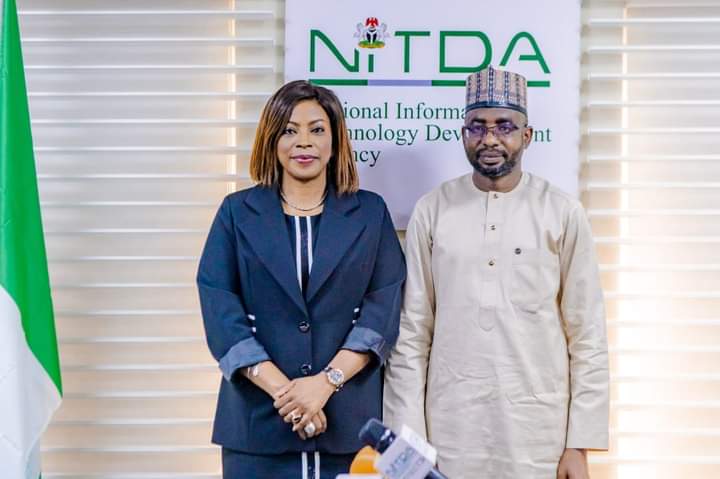
The NITDA Director-General, Kashifu Inuwa, while receiving the Google West Africa Director, Juliet Ehimuan, and the Government Relations and Public Policy team, noted that the symbiotic relationship between the two organisations would enable the adequate representation of data. He said this is in line with implementing the National Digital Economy Policy and Strategy (NDEPS) for a digital Nigeria.

“Together, we can achieve greater results. Governmental regulations are not to stifle or be an obstacle to your business; rather, it is to enable and unlock more opportunities and protect your business and our citizens’,” he said.

Inuwa noted that government has the responsibility to protect its citizens. “Today, our lives depend mostly on this digital technology, and your business contributes to meeting this demand.”

He emphasised the need to have a safer environment because the breach would affect both parties. “If we can come together to strengthen the collaboration, we will eliminate duplication of efforts and working in silos.”

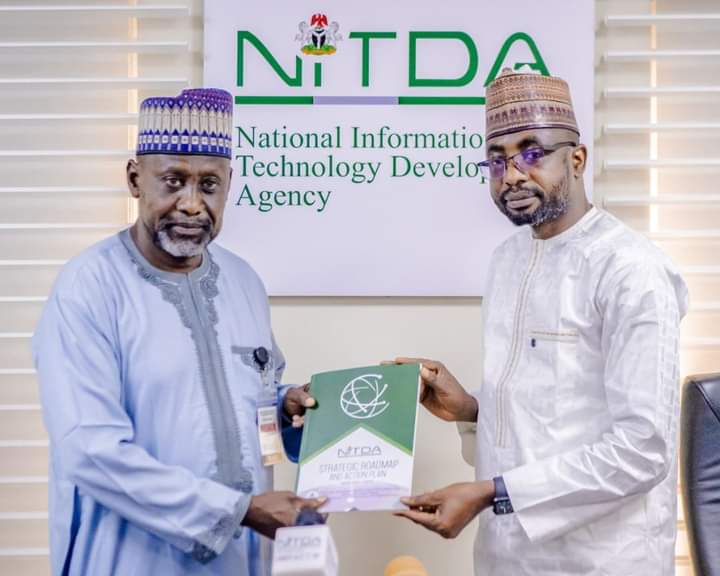
He affirmed that NITDA is currently engaging other tech innovators like Mastercard to improve the ecosystem and collaborating on Digital Literacy, Cyber Security, and some of the NITDA Strategic Roadmap and Action Plan (SRAP 2021-2024) including Data Protection.
Inuwa lamented that the lack of adequate data misrepresented information that would have attracted more foreign investors to our country.

He said people want to associate with success; ”if nobody shares success stories, people will think nothing is happening in the ecosystem”.

“We read what you tell and show us, and it helps in our decision making because we believe in Google,” he added.

The NITDA boss maintained that the algorithm must be ethical in the core values, laws, and culture, noting that technology can compromise through gender imbalance or racism. He blamed the situation on insufficient data and clamoured that working with locals to make our contents indigenous could avert such breaches.

He mentioned that four weeks ago, the Honorable Minister led a team from the Ministry to the Lagos ecosystem, where we met with most of the players in the sector. They shared some of the pinpoints we will present to the Federal Executive Council FEC and sought approval for things we need to do to help the ecosystem.

Inuwa applauded the effort of Google in the capacity building of Nigerians with a target to train 5 million indigenes. He implored that such records be made available to capture the number of digital literacy in Nigeria because President Muhammed Buhari’s government aims to achieve 95% digital literacy by 2030.

In her remarks, Google West Africa Director, Juliet Ehimuan, thanked NITDA for being one of Google’s key strategic partners and stakeholders in the public sector with a long-standing relationship. She acknowledged past collaborative efforts between both organisations, saying that her organisation is looking forward to continued collaborations.

While noting that the courtesy visit identifies possible areas for further collaboration, she physically introduces the new Government Relations and Public Policy team members to her host. They include; Adewole Adene and Dawn Dimowo who are to share updates on some of the work and initiatives that Google West Africa has been doing in the tech space within the country, and finally, to get feedback on Nigeria’s top priorities on the ecosystem.

Juliet confirmed that Google has invested in helping to build the digital ecosystem with all the government and private sector partners for almost a decade.

“In October last year, we had an event which we called Google for Africa, and during that event, we had our global CEO pledge, on our behalf, a $1 billion investment in Africa over five years.

“In the area of access, we have recently acquired a submarine cable called “Equiano” in partnership with a service provider in this environment which is landing in Nigeria on 21 April. Forecasts are indicating that a lot of people are coming online.

“At least 300 Million more Internet users in Africa over the next five years, so there will be more demand for the internet. And following the Covid pandemic, we saw a lot of migration online and acceleration in terms of digital engagement, which will create more demand, that its’ capacity would have a huge contribution to the GDP growth with the technology adoption and job creation.

“Our initial estimate is to contribute directly and indirectly to create about 1.6 million jobs over time and work around device financing in partnership with telcos to make sure that people have access either through infrastructure or device data to gauge the digital world”, she disclosed.

According to Juliet, Google is engaging in a lot of capacity building. Both organisations have a shared interest in providing free digital skills training to individuals to over 6 million people since 2017 when it pledged to train 10 million Africans and other notable areas of support contributing to the economic prosperity and education in ICT. “There is a $40 million grant to NGOs, of which $20 million will be in cash and $20 million in art credits.” she concluded.

The NITDA Director-General appointed Dr Aminu Lawal, the Special Adviser on Digital Transformation, to liaison between both organisations.

Global leader in cybersecurity is championing innovation and enabling progressive change by ensuring a safe digital future

We’re moving into an increasingly complex digital world – technology is how we connect, how we work and how we express ourselves. Communities are built and businesses grown through digital innovations, but these are open to attack, putting the future of technological innovation at risk.

A report by Accenture found that security breaches had increased by 67% over the last five years, and currently over 560,000 new pieces of malware are detected every day, according to research by the AV-Test Institute. Cybersecurity is becoming essential to ensure a positive digital future for all.

ESET, a global leader in cybersecurity, has announced its new branding with the tagline ‘Progress. Protected’. This new brand positioning is inspired by the insight that while the power of human ideas remains the leading catalyst for the world’s progression today, progress is advanced via the connectivity provided by technology, which needs protecting. Human and technological progress is now more vulnerable than ever to attack, and ESET is positioned to protect the continued advancement of this innovation through the provision of its industry-leading security software and services.

To celebrate the concept of Progress. Protected, ESET will put a spotlight on a number of thought leaders across a range of fields in a series of high-level brand films shot by Academy Award-nominated documentary filmmaker Hubert Davies. These experts in science, education, innovation, and space exploration will provide their insights on what progress in technology means to them and how it’s helping to change the world for the better.

The thought leaders include: 

  • Chris Hadfield, astronaut, engineer, pilot and author of four international bestsellers – for his work in promoting technological progress and innovation via collaboration, and his unique perspective on our world.
  • Dr. Mimi Ito, cultural anthropologist and Professor in Residence at the Humanities Research Institute at the University of California – for her research into and promotion of youth enablement in technology for a safe and progressive future.
  • Steven Johnson, author of 13 books focusing on the intersection of science, technology and personal experience, and host of the American Innovations podcast – for his research into the history of transformative ideas and the role diversity plays in creating the most innovative solutions for the present and future.

“The world continues to move forward at pace. When ESET was founded, the internet was in its infancy. Now technology is part of everything we do and is central to the continued advancement of our society,” explains Richard Marko, CEO of ESET. “To ensure continued progress in the digital age, we need someone to question what’s going on in the background. I believe that is an important task for our company, as to protect technology means to protect progress itself.”

“If we imagine for a moment, losing the contributions to our progress and future made by our champions of technology, it becomes clear exactly what is at stake. Through this new brand positioning, we hope to demonstrate ESET’s investment and passion for progress through technology.”

SmartWage, an innovative HR and communications technology startup, has raised USD$2 million (R29m). The oversubscribed seed funding round was raised to support SmartWage’s vision of transforming Africa’s workforce through digital inclusion, particularly for frontline employees like cashiers, restaurant staff, security personnel, and healthcare workers.

SmartWage is giving enterprises a simple yet effective way to digitise their most time-consuming HR processes, helping them save time and money in order to focus on what matters most – people. The product gives employees without email the ability to receive company-wide communication, access their payslips, request leave and get access to financial wellness products, all via WhatsApp.

90 percent of frontline employees don’t have or don’t use email, while 97 percent of formally employed people in South Africa use WhatsApp. In a country where most people have less than five apps on their phone, engagement is best when using an existing distribution channel like WhatsApp to reach employees.

SmartWage CEO, Simon Ellis, says that no solution adequately addresses the challenge of communicating with a distributed workforce, leaving employers unable to digitally transform. “There is a communication gap. Frontline employees don’t feel part of a company’s brand and its promise. Payslips and leave are still done manually with paper printouts, while employee communication is done using notice boards or apps, which have huge usage drop-offs. Onboarding and disciplinary procedures are still paper-based, costing businesses precious time, money and resources”.

But it’s not only about driving efficiencies for employers. SmartWage has developed a host of financial wellness products that give employees the financial lifeline they need. These include access to free financial education and on-demand pay. “We have learnt through our process that employees need access to cash more than ever before. 80% of South Africans struggle to make it to the end of the month without relying on some form of short term debt, and the payday loan industry is booming” says Ellis.

Ellis goes on to say “If we can save employers time and money through digitisation, we can bridge the gap between South African enterprises and their frontline employees, helping enterprises connect clearly and dynamically with their employees, whilst offering financial wellness tools at the same time. By offering tools that benefit both employers and employees, we have a powerful value proposition”

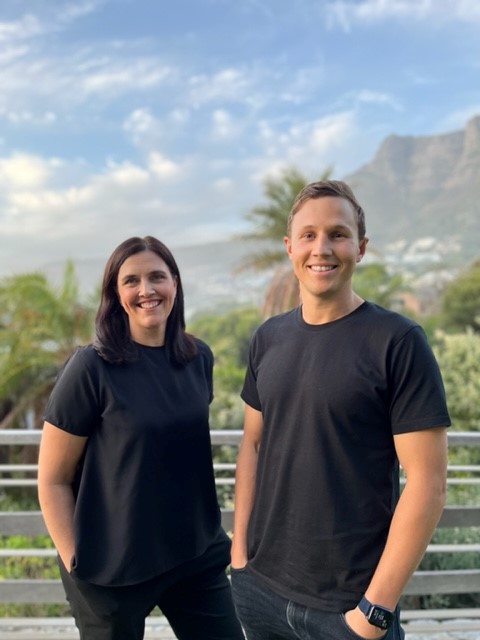
SmartWage was founded in May 2020 by Simon Ellis and Caroline van der Merwe. Van der Merwe, an expert in the field with almost a decade of experience managing employer benefit programs, says existing software like SAGE, SimplePay, Workday and Oracle has been built for those with email, smartphones and computers, which makes communicating and providing necessary HR services to frontline employees a real challenge. She goes on to explain “What we see day in and day out is that most large companies that employ frontline employees haven’t found a viable way to digitally engage and communicate with their employees, which also means that HR is still largely paper-based and cumbersome”.

The seed funding was accessed via several influential investors. One of those investors is Idris Bello, founding partner of LoftyInc Capital, a pan-African VC fund headquartered in Nigeria, and an early investor in Flutterwave and Andela, two of Africa’s tech unicorns. Bello said he was excited by the scalability of the SmartWage product set and the impact it could have, in both Africa and beyond the continent. “The team at SmartWage are innovators – they’re building more than just an earned wage access product, and have recognised that in order to make a tangible impact on employers, they need to build a powerful way for employers to engage with their workforce. We are excited to partner with Simon, Caroline and the powerful team they’ve assembled to support SmartWage’s mission to drive digital inclusion across Africa”.

Other investors include Creator Collective Capital, Penrose Capital, along with angels from Naspers, Dimension Data, Investec, and Standard Bank. SmartWage plans to deploy the capital to expand its product and technology team and double down on solving employers’ biggest problems.

SmartWage clients include companies that employ frontline employees, typically in retail, quick service restaurants (QSR), manufacturing, construction, and hospitality. They have grown their monthly active user base 14x in the past 12 months, and now work with brands such as Edgars, KFC, Debonairs, Seattle Coffee, Truda and Twizza.

The average person has a whopping 100 passwords that they use to access their various online accounts, a study by NordPass reveals. With the key to keeping all these accounts secure, being passwords that are long, complicated and hard to guess, the result is that they are also impossible to remember, making us more inclined to write them down or reuse the same password across several accounts, neither of which are very secure options.

The need for quick and easy experiences in the digital world means consumers have little time or patience for forgotten passwords, or creating long and complicated combinations of letters, symbols and numbers. In addition, organisations like banks are scaling back on brick-and-mortar premises and are increasingly using digital onboarding, making fast and secure online identity verification solutions essential.

Hence the rise of biometrics and liveness detection, where your unique body is your ultimate password. Gur Geva, Co-Founder and CEO of iiDENTIFii, a provider of face-based biometric identity verification services, says, “Liveness is the guarantee that the individual attempting to authenticate is a real person, not a mask, a bot, or a deepfake.  This is critical especially for financial institutions where security and compliance are paramount.”

Despite widespread adoption, there has been some negative press about facial biometrics and whether it encroaches on the individual’s right to privacy. In fact, facial biometrics were recently banned for use by police and local agencies in several cities in the US. “This has stemmed from a failed plan by the IRS in the USA to force Americans to scan their faces to file their tax returns. There was some concern around the fact that a third party was collecting the data, raising questions around the ethics of this practice.” Racial concerns have also been expressed about the ability of facial recognition technology to correctly identify those of ethnic descent.

While privacy and accuracy concerns are major considerations, Geva warns against painting all facial recognition technology with the same brush. “Consent is key. iiDENTIFii’s technology is opt-in only, and the data it collects is not used to track people in the streets,” assures Geva. In addition, iiDENTIFii’s solution is specifically designed and calibrated for the country where it is used, meaning that the algorithms do not suffer the same challenges for which the overseas technology has been criticised. “Deploying European technology in Africa is destined to be discriminatory, but by using the right technology and having the right intentions in place, it is possible to create the most secure authentication ever used to date,” he notes.

The reality is that machines are better at identifying people than humans will ever be. The Department of Homeland Security in the US recently proved that facial recognition algorithms can now correctly identify individuals up to 96 percent of the time. “If that can reduce the likelihood of a wrongful arrest, or someone gaining access to someone else’s accounts, the technology needs to be given some credit for the good that it achieves,” maintains Geva.

Ultimately, customers need to feel comfortable using the technology and be confident that it is trustworthy while enhancing their safety and security. “Fortunately, people’s favourable disposition towards taking selfies is helping to drive rapid adoption of this technology, and iiDENTIFii’s proven credibility, as well as its opt-in feature eases possible misgivings about using it. These factors, combined with South Africa’s sophisticated digital onboarding processes and forward-thinking POPI act, means local businesses are fast becoming leaders in a growing global digital market.”

The Director-General, National Information Technology Development Agency (NITDA), Kashifu Inuwa, CCIE has challenged Universities in the country to devote greater attention to enterpreneurship training in order to produce graduates that will create job opportunities, not job seekers.

Inuwa made the challenge while receiving the management of Federal University of Agriculture Zuru, Kebbi State, under the leadership of its Vice Chancellor Professor, Musa Isyaku Ahmed.

The NITDA boss described University’s role in finding lasting solution to Nigeria’s unemployment as critical, in view of the large number of young people graduating annually.
“I urge you to continue to emphasize more on enterpreneurship trainings so that graduates will be able to become job creators instead of job seekers.

“Mr President has the passion for job creation, a passion of diversifying our economy and so on, moving from resource based economy to knowledge based or Digital Economy, and for Nigeria to achieve that, we need to have the human capital, which our population is the greatest resources,” he added.

He said most of the people coming out from the universities are becoming liability to the country, because they will come and start waiting for jobs. Instead, why not us start producing people that will create jobs, and to do that you have to start from the universities.

“Universities can be used as mentoring, training and couching grounds to the students, encouraging them to start their own business while in school,” he said.

Commenting on NITDA’s National Adopted Village for Smart Agriculture (NAVSA) programme, Inuwa stated that it was an initiative of the Agency designed to support the Nigerian young farmers that are very passionate about making a career in farming.

“Firstly, we all need to eat to survive, how can we increase our produce, how can we use technology to change the way we do our farming, and how can we make it a more fancy job, so that these young graduates can also embrace farming as a career,” he noted.

NITDA, he said, has concluded arrangements to engaging Universities’ research works practically on the farms with a view to achieving the set goal.

“This year, we are going to restrategise our process and say why not work with Universities’ research institutions, where most of their works end on the shelves, why can’t we convert those researches and move into the farm to experiment”, added.

Earlier, Vice Chancellor, Federal University of Agriculture Zuru, Professor Musa Isyaku Ahmed, said they were at the Agency’s Corporate Headquarters on a familiarisation visit to further avail themselves with what they have been seeing and hearing about NITDA’s impactful interventions on so many sectors, particularly the tertiary institutions.

Professor Musa who informed that, Federal University of Agriculture Zuru is the only University that came into being from a Bill by the National Assembly, and was assented to by the President as the Agric based, which came on board during the lockdown as a result of COVID-19 Pandemic.

He said the newly established institution has as its mandate, the injection of Enterpreneurship and IT into its curriculum.

While soliciting for the collaborative support of NITDA in its intervention programmes, the Prof also called for paradigm shift in the nation’s education system.

“We are aware of NITDA’s finger prints in many Nigerian tertiary institutions, we here soliciting for same to our newly established Institution,” he pleaded.

…We are Not Recruiting – NCC

The Nigerian Communications Commission (NCC) wishes to officially inform telecoms consumers, whose Subscriber Identity Module (SIM) cards are barred from making calls, that affected SIMs will not be unbarred by the service providers until they are linked with the National Identification Numbers (NINs) of the SIM holders.

This information has become necessary in view of a viral web link (https://bit.ly/NCC-Sim-Unbar-Gov-Ng) being circulated on social media and on some websites. The link and accompanying narrative represent patent misinformation and disinformation certainly designed to mislead the general public about the SIM cards that are barred from making calls, due to non-linkage with NIN at the set deadline.

The misleading, viral message mischievously displays NCC logo and ostensibly promises members of the public that, by clicking the web link and following further instructions in that regard, subscribers with barred SIM cards can unbar such SIMs across mobile networks without a valid NIN.

For the avoidance of doubt, the NCC wishes to state categorically that it never issued such statement, directing subscribers or  indicating that subscribers can unbar their SIM without a NIN. As such, the originators and peddlers of the spurious message were out to mischievously mislead unsuspecting members of public. Therefore, their message should be disregarded.

The NCC is the national regulatory authority for telecommunications in Nigeria, and it is co-driving the process of the NIN-SIM linkage with the National Identity Management Commission (NIMC) as directed by the Federal Government.

The Commission will not, under any circumstance, act contrary to Federal Government’s directive to MNOs to bar SIMs cards not linked to NINs at the expiration of the last deadline given for the NIN-SIM linkage exercise.

Having disclaimed the false viral message, the Commission wishes to officially inform affected telecom subscribers on how they can get their SIMs actively connected to make calls.

First, for subscribers that have not registered for their NIN, what to do is to get their SIM registered at accredited centres across the country and then link the NIN with their SIM cards through channels provided by their service providers.

Secondly, for subscribers with registered NINs, what to do is to simply go and link the NIN with their SIMs through channels provided by their service providers.

The NCC, therefore, uses this opportunity to reiterate its commitment to the Federal Government’s directive on the NIN-SIM Linkage to among others, strengthen security situation in the country, assist in other socio-economic planning activities of the government, as well as to always advance the course of consumer protection from falling victim to the antics of cyber fraudsters.

Finally, the NCC wishes to also inform the general public that it is not recruiting at the moment.

Accordingly, the advertisement indicating there is ongoing recruitment at NCC, which is circulating on Twitter, and through polymediation, may have been diffused to other social media networks, is a scam and should be disregarded.

CINNAMON is a powerful spice that has been used medicinally around the world for thousands of years. It is still used daily in many cultures because of its widespread health benefits, not to mention its distinctly sweet, warming taste and ease of use in recipes.

USES OF CINNAMON
• Can be used as tea
• Can be sprinkled on toast
• Can be used in baking
• Can be used in cooking

Half a teaspoon of cinnamon is recommended daily.

To make Cinnamon tea

  1. Add the the spicy Africa ground cinnamon or the stick to your cup.
  2. Add the boiling water.
  3. Let the cinnamon tea steep for 8-10 minutes.
  4. If you’re using a cinnamon stick, remove the stick. (Don’t throw it away. …
  5. Add any optional sweetener or milk (honey is especially good with cinnamon).
  6. Enjoy!

Nutrition Benefits of Cinnamon

High Source of Antioxidants
Cinnamon is packed with a variety of protective antioxidants that reduce free radical damage and slow the aging process; in fact, researchers have identified 41 different protective compounds of cinnamon to date.

Protects Heart Health
Studies have shown that another health benefit of cinnamon is that it reduces several of the most common risk factors for heart disease, including high cholesterol level, high triglyceride levels and high blood pressure.

Contains Anti-inflammatory Properties
The antioxidants in cinnamon have anti-inflammatory effects, which may help lower the risk of heart disease, cancer, brain function decline and more. Researchers have identified over seven kinds of flavonoid compounds alone in cinnamon, which are highly effective at fighting dangerous inflammation leve throughout the body.

• Helps Defend Against Cognitive Decline & Protects Brain Function
Research also shows that another benefit of cinnamon’s protective antioxidant properties is they can help defend the brain against developing neurological disorders.

•May help Protect against Cancer
Because of its antioxidant abilities, cinnamon can help protect against DNA damage, cell mutation and cancerous tumor growth. Studies have revealed the health benefits of cinnamon that come from a compound called cinnamaldehyde include its possible ability to inhibit cancer tumor growth and protect DNA from damage.

Side effects: Very high quality of #cinnamon may be toxic especially for people with liver problems.