



In today’s hyper-connected digital economy, cybersecurity has evolved from a back-office technical requirement into the very backbone of economic survival, corporate trust, and national development. As digital adoption accelerates across Africa, it brings a parallel surge in sophisticated digital vulnerabilities—a reality that has prompted Ethnos IT Solutions Ltd, a premier cybersecurity solution provider located in Victoria Island, Lagos, to step forward with critical new intelligence to help organizations protect their vital infrastructure.
A fresh look into the continent’s digital frontlines comes from the firm’s newly released Q2 2026 Cyber Threat Chronicle Report. The findings paint a sobering picture of the mounting pressures facing African businesses, financial institutions, and government agencies as they push forward with digital transformation.
According to threat intelligence gathered by Ethnos Cyber experts, Africa consistently held the second-place spot globally for sheer cyberattack intensity every single month throughout the quarter. Security analysts note that these numbers represent early-stage, blocked attempts captured by prevention systems rather than successful data breaches—meaning the volume of actual hostile activity knocking at the digital door is immense.
The data maps out a volatile, shifting battlefield over the first half of the year:
The year opened with African organizations weathering an average of 2,864 attempted attacks every week in January, even as global averages hovered lower at 2,090 and global ransomware incidents stood at 678. While March saw a brief, relative breathing room with weekly attempts dipping to 2,722, April triggered a massive, continent-wide surge. Mirroring a broader global rebound, weekly attacks against African targets spiked to 2,940 in April.
By May, the pressure hit a boiling point. Weekly attacks per organization in Africa breached the 3,000 threshold. Alarmingly, while global attack averages actually began to ease slightly to 2,055 that same month, the pressure on Africa did not let up. Instead, May witnessed the steepest year-on-year growth for ransomware attacks seen all quarter, proving that extortionists are sharpening their focus on regional enterprises.
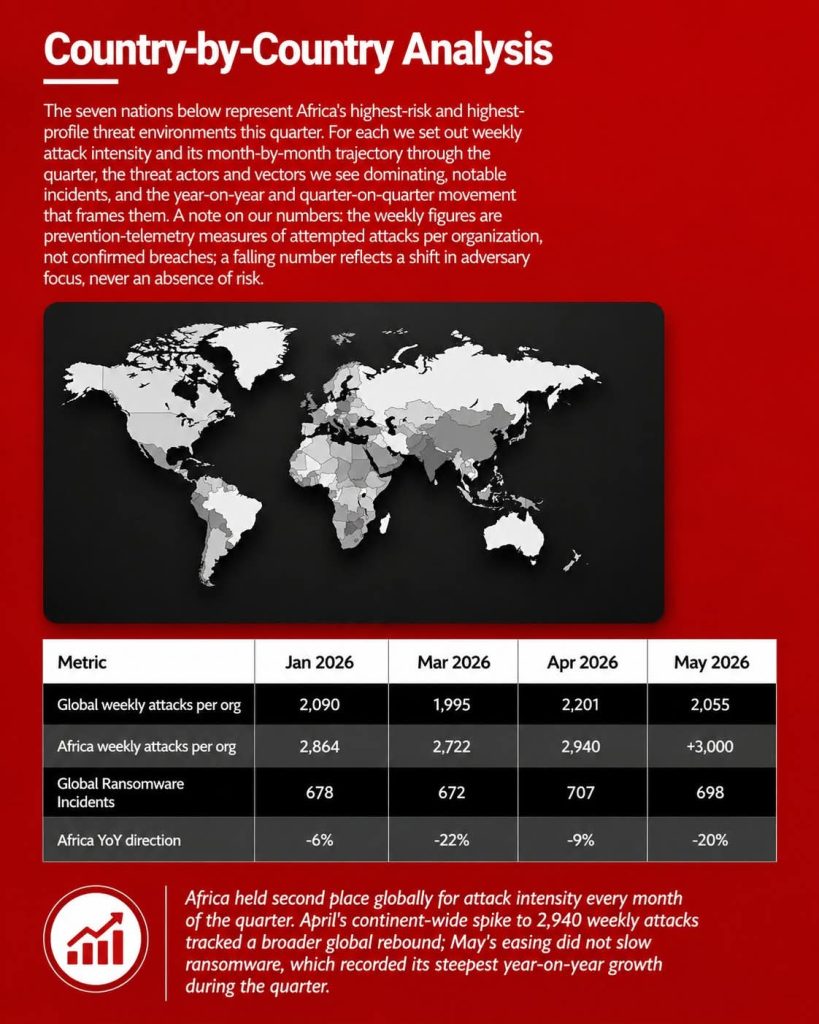
Ethnos experts warn against misinterpreting occasional dips in attack numbers, noting that a downward trend in local telemetry usually just means adversaries are shifting their focus to different targets or changing tactics—it never indicates an absence of actual risk.
Peter Ejiofor, Chief Executive Officer of Ethnos IT Solutions Ltd, emphasized that the scale of these threats means cybersecurity can no longer be treated as a minor headache insulated within corporate IT departments.
“Africa’s digital economy is growing at an extraordinary pace, but so are the threats targeting it,” Ejiofor stated. “Cybersecurity is no longer a technical issue confined to the IT department; it is a strategic business priority that directly impacts trust, economic growth, and organizational resilience. Through this report, we aim to equip business leaders with actionable intelligence that enables informed decisions, strengthens cyber resilience, and fosters a safer digital ecosystem across Africa.”
With digital adoption accelerating at a breakneck pace, regional security experts continue to advocate for a shift toward proactive “cyber resilience”—building networks that can absorb an attack and keep running—rather than simply reacting after a breach has occurred. They stress that continuous network monitoring, aggressive employee awareness campaigns, and heavy investment in modern defense technologies are no longer optional for organizations wanting to survive the current threat landscape.
The full breakdown of emerging attack patterns, cloud security risks, and phishing tactics is available in the complete Q2 2026 Cyber Threat Chronicle Report, which can be downloaded here: https://tinyurl.com/2026Q2CyberThreatChronicle