


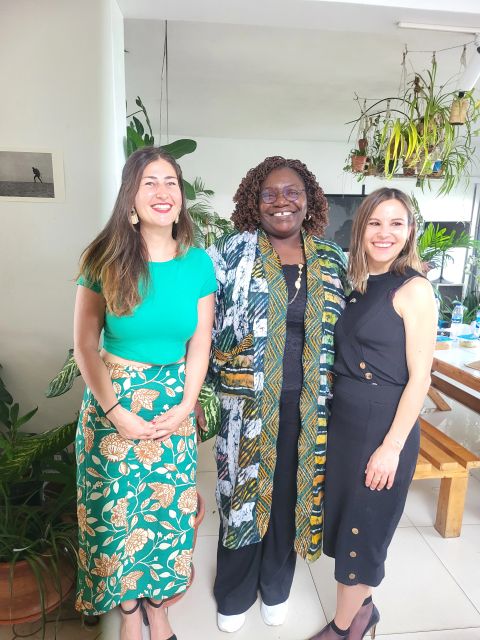






Dr. Helen Emore, venture builder and Managing Director of Scientia Partners Innovation Hub, has underscored the importance of structuring businesses for investment readiness, noting that many promising ventures fail to attract capital not due to a lack of investors, but because they are not designed to be bankable.
Speaking following her participation at Nigeria Circular Economy Week, Dr. Emore described a recent workshop on agricultural waste as a practical demonstration of how structured methodologies can transform concepts into investment-ready ventures. The workshop was convened by the Circular Business Platform as part of the broader Nigeria Circular Economy Week activities.
Working alongside the Moniya team led by Julia Venn and Vesna Lavtizar, Dr. Emore said the engagement focused on redesigning cassava peel waste into commercially viable products. The team applied a structured venture design approach aimed at turning sustainability-driven ideas into projects capable of attracting institutional capital.
“Sometimes, promising ventures struggle to attract capital not because investors are unavailable, but because projects are not structured to be bankable,” she said. “The discipline of investment-ready design changes that equation.”
The session also provided an opportunity to reconnect with founders participating in the WEIDE programme delivered by the International Trade Centre and the World Trade Organization. According to Dr. Emore, engagements such as these reinforce the need to align innovation, governance and financial modelling from the outset.
Circularity as a Capital Allocation Strategy
A central theme of the workshop was reframing agricultural waste as industrial feedstock. By treating waste streams as revenue-generating inputs, circular business models can unlock new margins, reduce operational risk and improve overall project viability.
“Circularity is not charity,” Dr. Emore emphasised. “Circularity is a capital allocation opportunity.”
She argued that when waste is reconceptualised as a productive asset, ventures can create diversified revenue streams, enhance cost efficiency and attract greater investor interest. This shift, she noted, represents a broader transformation in African enterprise development — one in which sustainability and profitability are no longer competing objectives but mutually reinforcing drivers.
Designing for Investability
At Scientia Partners Innovation Hub, Dr. Emore and her team focus on designing ventures and impact programmes that are commercially viable, scalable and governance-ready. She maintained that the future of circular enterprise in Africa will depend not simply on good intentions, but on robust project architecture — including financial structuring, risk mitigation frameworks and transparent governance systems.
“For us, the question is no longer whether circularity works,” she said. “It is how well your project is designed.”
As momentum grows around sustainable enterprise models across the continent, experts say structured venture design may become a decisive factor in determining which projects successfully transition from concept to capital-backed execution.