


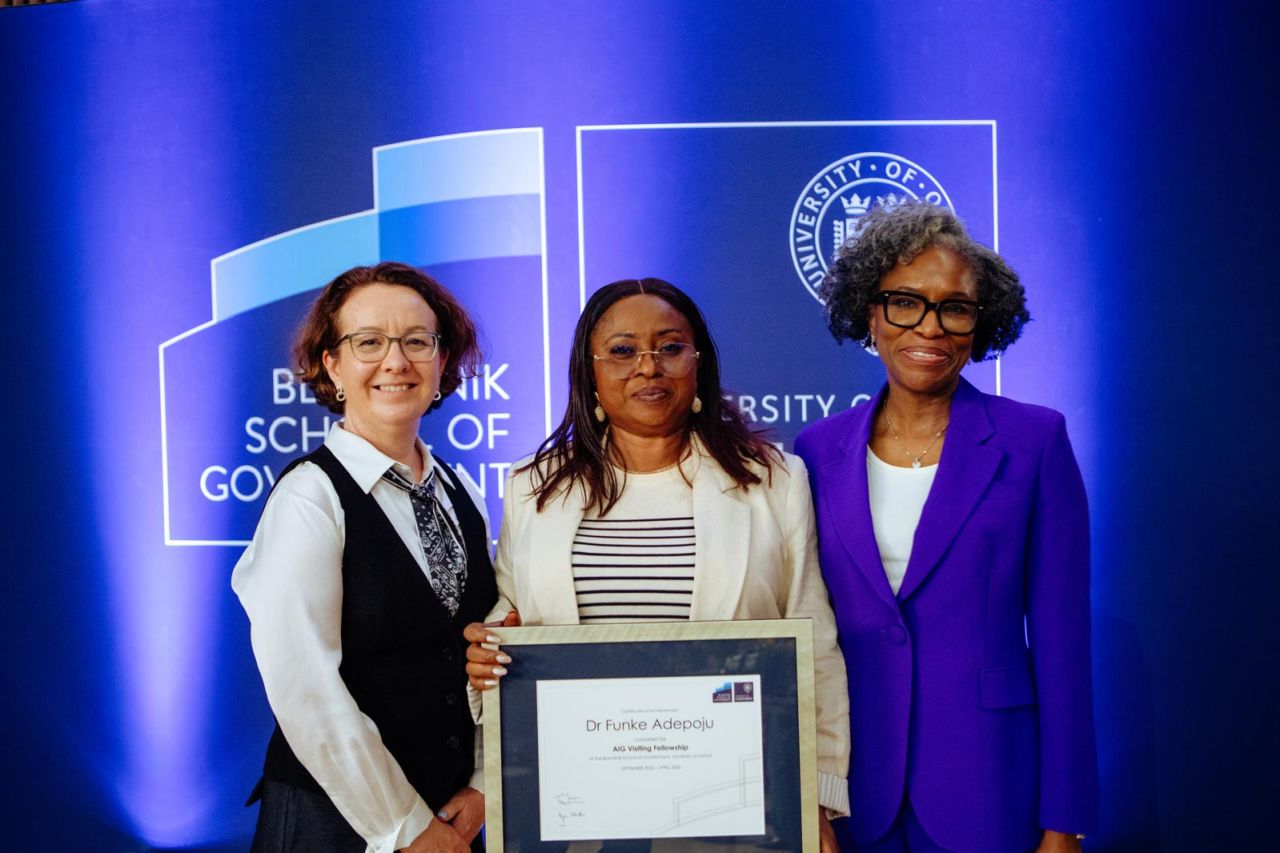






Funke Adepoju, Director General of the Administrative Staff College of Nigeria, has called for a major rethink of how governments approach public-sector training, arguing that capacity-building programmes must move beyond theoretical instruction toward measurable institutional reform and improved governance outcomes.
Adepoju made the remarks during her closing lecture at the Blavatnik School of Government, marking the completion of her tenure as an AIG–Imokhuede Foundation Visiting Fellow at the University of Oxford.
The lecture, titled “From Capacity Building to Reform Delivery: Reimagining Public-Sector Training Institutions,” focused on the growing disconnect between civil service training initiatives and actual government performance across many developing and advanced economies.
Addressing an audience of academics, policymakers, and governance experts, Adepoju said her fellowship research examined a central question: how public-sector training institutions can evolve from simply producing trained officers to enabling reforms that improve state effectiveness and service delivery.
According to her, findings from institutions across Africa, Asia-Pacific, and Europe revealed that despite significant investments in training programmes, many governments have struggled to achieve meaningful institutional transformation.
“What the research revealed was uncomfortable,” she noted. “Across institutions in Africa, Asia-Pacific, and Europe, we have invested heavily in training, yet produced too little transformation.”
She argued that the challenge is not necessarily a lack of learning among civil servants, but rather a long-standing focus on training as an end in itself rather than as a mechanism for achieving reform outcomes.
“We have treated capacity building as an end in itself, when the true measure should be whether government delivers differently as a result,” she stated.
Adepoju described the disconnect as the gap between “the training room and the reform room,” emphasizing that closing this divide is critical to improving governance performance and institutional accountability across the public sector.
As part of her proposed solution, she introduced the R.I.S.E. Model — Reform, Inspired Systems Execution — which she described as a practical delivery architecture designed to connect training directly to institutional reform and policy implementation.
According to Adepoju, the model is intended not merely as a theoretical framework but as an operational system capable of driving measurable improvements in government effectiveness.
She revealed that implementation of the framework would begin at the Administrative Staff College of Nigeria, Nigeria’s federal public service training institution, as part of broader efforts to strengthen public administration and leadership development within the country’s civil service.
The public-sector transformation expert also acknowledged the support of the AIG-Imokhuede Foundation for providing what she described as the intellectual freedom and rigour necessary to undertake the research.
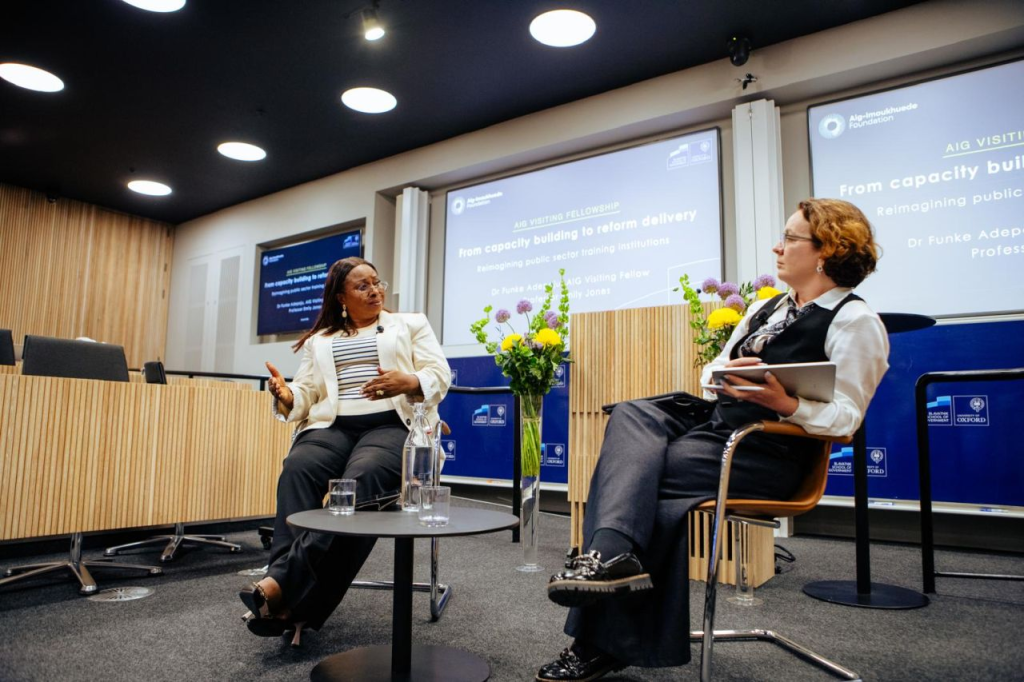
She further praised the Blavatnik School of Government for creating an environment where practitioners can engage meaningfully with policy research and governance innovation.
Observers say Adepoju’s remarks reflect wider conversations taking place across Africa on the need for stronger institutions, better policy execution, and more effective leadership within the public sector.
Governance experts have increasingly argued that strengthening institutional capacity alone may not be sufficient unless governments also improve implementation systems, accountability structures, and reform coordination mechanisms.
Adepoju concluded by stressing that while the fellowship year had come to an end, the broader mission of reforming public-sector performance in Nigeria and across Africa was only beginning.
“The lecture may be over,” she said, “but the work is just beginning.”