Immediate past Chief Executive Officer, CWG PLC, and Founder, Ixzdorelabs, an innovation hub and consultancy focused company, Mr. James Agada, has listed some factors that could lead to the premature death of a Startup.

Agada, who spoke to the theme: Sustainability and the company of the future, at Africa Tech Alliance Forum (AfriTECH 2.0) held in Lagos on Wednesday, listed the factors to include non-reporting of sales figures, issues around corporate governance, Court or Government interference, and inability to create new business.

A well-regarded, innovative, and versatile technology expert, Agada, while aligning with the views of economists said in his keynote address at the event that the only way to determine whether a company is alive or dead is to check whether they are reporting their sales figures.

“When a company stops reporting its sales figures, it means the company is dead. For a startup, three things are obvious: Sales, Cash and Profit. At maturity, the company’s sales, or what they call cash cow, typically flatten out. Before then, you see a steep growth in sales or what you call exponential growth.

“That sale has to translate into profit, and profit must have cash. The only thing that can kill a company is when it runs out of cash. Another thing though is that sales do not necessarily translate to cash; if you sell, you must also collect the money and make a profit. At any point the company starts declining because it’s not able to generate enough cash from the declining sales to maintain itself, death beckons,” he said.

He said that at any point a company decides to do a life extension, that’s what is at the core for the sustainability of the company, noting that between the sales a company generates and the cash it gets, it is the funding that determines where the company is going.

“At maturity, you have a lot of debt funding because you are generating enough cash and trying to minimize business risk. Kodak had misjudged where the technology it developed was leading to, leading to its decline. Customers left Blackberry and went for iPhone and Android, and that left Blackberry behind if not dead.

“Therefore, the issue of corporate governance is another thing that can kill a company. The court or government can also decide to close your company. And the inability to create new business even when you are struggling with that company can as well lead to the death of a company,” he further explained.

Agada stated that a sustainable company is one that has figured out how to balance its business risk and sales to ensure that decline does not put it in a situation where it is no longer sustainable, contending that once a company is not growing, it is dying.

In providing a solution to this, Agada opined that “the real thing is that you are looking for increased profit and increased cash flow. You have to look at what is happening around you and take those defensive and offensive actions to prevent collapse and eventual death.

In line with its strategic intent to always provide solutions and business support for its customers, leading financial institution, Fidelity Bank Plc (www.FidelityBank.ng), has announced plans to host the maiden edition of the Fidelity International Trade and Creative Connect (FITCC) in partnership with Invest Africa.


Scheduled to hold on Tuesday, 15 and Wednesday, 16 November 2022 in London, United Kingdom, FITCC will host leading businesses, entrepreneurs, investors and regulators operating in the commodity, service, creative, fashion and fintech sectors in Nigeria, the United Kingdom and the wider European market, to promote Nigeria’s Non-Oil Exports and facilitate integrations to global supply-chain networks via partnerships, co-creation opportunities and foreign direct investments.

We are delighted to have Invest Africa collaborate with us on this amazing journey as we connect local businesses to importers and investors in the United Kingdom and Europe

According to a joint press release issued by the two organisations, Managing Director/Chief Executive Officer, Fidelity Bank Plc, Nneka Onyeali-Ikpe stated, “FITCC is the next step in a series of activities we organized over the years to promote exportation in Nigeria. We started by investing in growing local capacity through our Export Management Programme in conjunction with the Lagos Business School and providing funding options for exporters. Over the years, we have remained committed to promoting non-oil exports from Nigeria, and through the FITCC, we are opening new opportunities in the international markets for Nigerian exporters and contributing positively to the growth of our economy. We are delighted to have Invest Africa collaborate with us on this amazing journey as we connect local businesses to importers and investors in the United Kingdom and Europe.”

Besides product exhibitions, FITCC will feature keynotes/plenaries, syndicate rooms for closed-door engagements with industry leaders, deal/meeting rooms, art exhibitions, themed theatrical performances, networking cocktails and side fashion shows.

“As a leading business and investment platform, Invest Africa is thrilled to be partnering with Fidelity Bank on their inaugural FITCC conference in London this November. With a global footprint of more than 400 member companies, comprising multinationals, private equity firms, institutional investors, development finance institutions, professional service organisations, government bodies and entrepreneurs, we are well placed to support the bank in bringing the right partners and delegates to the event. The Nigerian market is hugely important to our members and there is no better time than now to showcase the extensive export capacity that Nigeria holds.,” commented Alison Kingsley-Hall, Head of Membership, Invest Africa.

Interested businesses and participants are encouraged to register for the conference at https://bit.ly/3DrbrJZ .


The Minister of Information and Culture, Alhaji Lai Mohammed, has described as historic the hosting of the first United Nations World Tourism Organization (UNWTO) Global Conference on Linking Tourism, Culture and the Creative Industries at the National Theatre in Lagos.

The Minister made the remarks in Lagos on Monday at the opening of the Experts’ Workshops of the global conference.

“Today we are witnessing the making of history in two very important ways. First is the fact that this is the first time the UNWTO would be bringing stakeholders in tourism, culture and the creative industries together at a single forum to deliberate on issues of common interest. Secondly, this is the first event to be held since the completion of phase 1 of the 100-million-dollar renovation of the iconic National Theatre.

“It’s important to note that this is the first major renovation work on the National Theatre since it was built over 40 years ago. Many thanks to the Bankers’ Committee for this great job,” he said.

Alhaji Mohammed said the global conference, which opened on Monday with two experts’ workshops on tourism and culture, as well as tourism and the creative industries, comes at a time that Nigeria and the world over are seeking for industries that can stimulate socio-economic recovery, alleviate poverty, mitigate the effects of climate change, accelerate job creation and inclusive development and foster international peace and cooperation.

“Within these premises, tourism, culture and the creative industries therefore present a huge potential to bridge this gap, especially at a time of great economic challenges the world over,” he said.

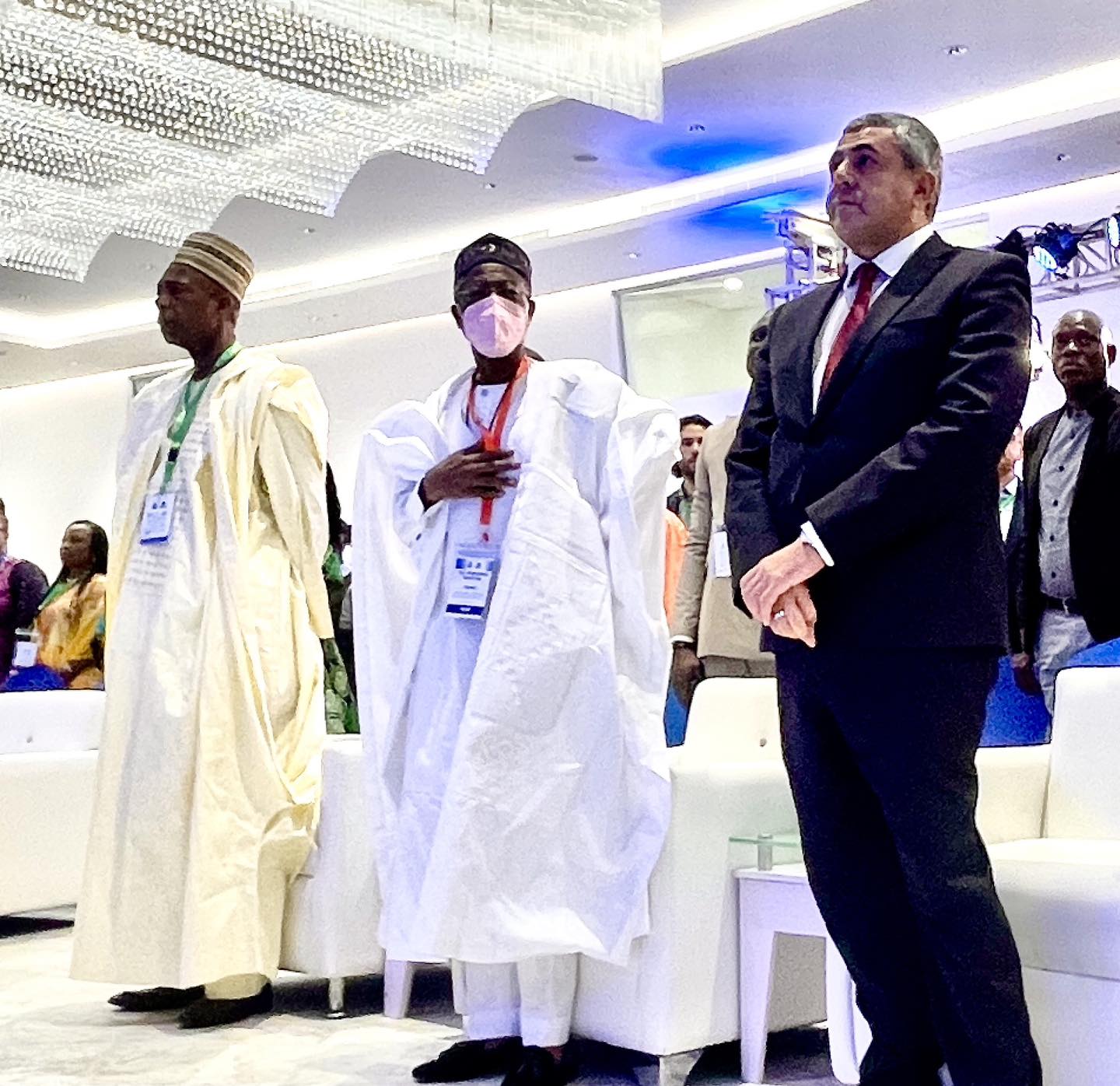
The highlight of the experts’ workshop was the discussion by the UNWTO Secretary General, Mr. Zurab Pololikashvili, and the Minister of Information, Alhaji Mohammed, with some primary school students on the importance of culture, tourism and the creative industries to national development.


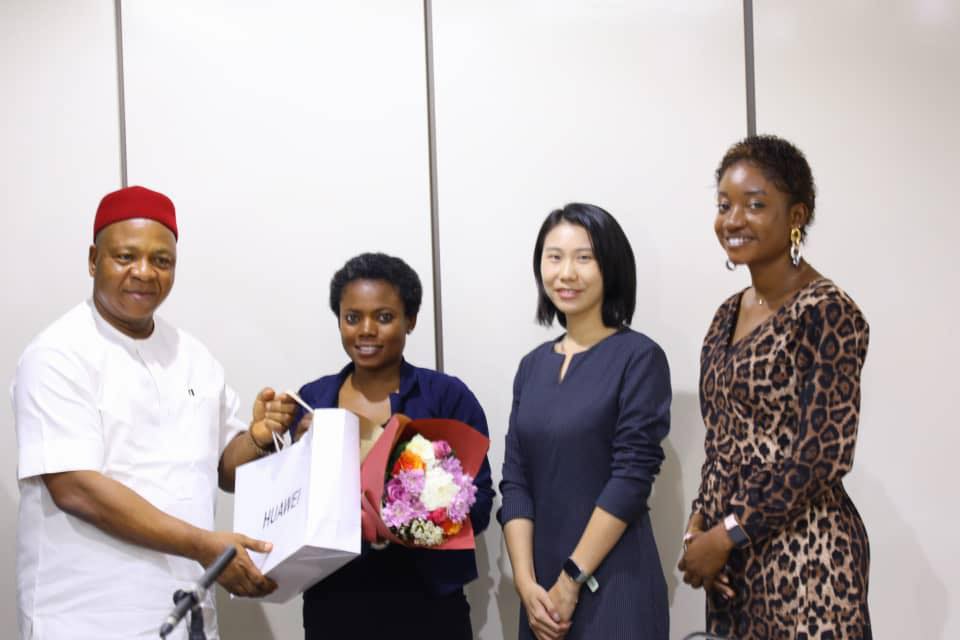
The Federal Government has awarded Federal Civil Servants with prizes following their excellent performance in the just concluded Batches 12 and 13 ICT for Change training programme organized by Huawei Technologies Nig. Ltd.

While presenting the prizes to the awardees in Abuja, the Secretary to the Government of the Federation, Boss Mustapha expressed appreciation to Huawei Technologies for impacting technological skills on the Civil Servants thereby improving their proficiency in Information and Communication Technology and by extension improves their performance in the discharge of their work schedules.
SGF, who was represented at the event by the Permanent Secretary, General Services Office (GSO), Dr. Nnamdi Maurice Mbaeri, said the multiplier effects of the training would go a long way in empowering civil servants and by extension, improving the nation’s economy.

He charged the awardees to imbibe the train-the-trainer model of training by also organizing similar training for their colleagues in their various Ministries, Departments and Agencies (MDAs) on the key thematic areas they covered during the ICT for Change training Programme.

SGF commended the awardees for distinguishing themselves out of more than 800 civil servants who participated in the training. He added that he had confidence in the selection process, saying their selection was an attestation of their hard work and passion for excellence.

Speaking earlier, the Public Relations and Communication Manager, Huawei Technologies Nig. Ltd., Sia Chen, appreciated the Secretary to the Government of the Federation for the support they have been enjoying in organizing the ICT for Change training programme. She congratulated the awardees for their excellent performance during the training and charged them not to relent in their efforts.

She added that she looked forward for more collaboration with other MDAs so as to upscale the ICT development in Nigeria in order to boost capacity of workers and all Nigerians at large.

Speaking on behalf of the awardees, an Assistant Director of the Public Service Institute of Nigeria (PSIN), Safi Mohammed, thanked Huawei Technologies for initiating the ICT for Change training programme which has built capacity of many civil servants across the nation. She also thanked the SGF for working hand in hand with the ICT Company in ensuring the success of the training.

She further said that the 5-day training modules which include ICT development trends, e-government, cyber security, 5G, Artificial Intelligence, cloud services, etc have added value in the discharge of her statutory obligations in the office. She urged her fellow recipients to ensure they cascade the lessons and experiences they garnered during the intensive training to their colleagues in their MDAs.

Among the recipients of the prizes, Jemima Adamu and Ibeleme Patience emerged as the overall best in the Batches 12 and Batch 13 categories respectively.

The highlights of the prize-giving ceremony include presentation of exorbitant prizes, wreaths and the cutting of cake. In attendance at the event was the Head of the Civil Service of the Federation, represented by Director ICT, Mr. Adeniyi Dada, Director ICT in OSGF, Mr. Wasa Isa and other Directors in OSGF.

Huawei’s “ICT FOR CHANGE” initiative is targeted at empowering Civil Servants with Fundamental ICT knowledge and skills. The training is aimed at equipping them with the rapid advancement of ICT technology and the increase demand for digital transformation, e-government and smart city capabilities, and to also improve the efficiency in public service and benefit to digital economic development.

Willie Bassey


My attention has been drawn to some of the tirades on social media following my frank response during an interview on Channels TV regarding the “investments” Mr. Peter Obi claimed to have made with Anambra state revenues. Sadly, several of the comments left the issue of the interview to probe or suggest motives, inferred from my response on “investment” that I am opposed to Peter Obi’s ambition and therefore committed a “crime” for which the punishment is internecine abuse and harassment even to my family. Some people even suggest that the gunmen who went to attack a checkpoint at my hometown on Saturday 12th November but were gunned down was part of the mob reaction. I used to think that for decent people, certain conducts are off-limits, and that in Anambra, politics is not warfare.

Of course, as a Christian, I know that telling the truth can be very costly, even suicidal. Our Lord and saviour was crucified simply for telling the truth the people did not want to hear. I promised that I won’t be the usual politician, and will not knowingly lie to the people. I am not an Angel but rather than knowingly repeat the same deceitful character that politicians are known for, I would leave public office. It is a vow I made to my God and to my family. Only God knows how many days I will be on this seat but whether I am on it or not I will always say it as it is— knowing fully the suicidal consequences of telling the truth in a political arena, especially in a country where lying and deceit by politicians have become culture and celebrated as being “smart”.

Ideally, I should just have laughed off the infantile exuberances as many friends advised (I am used to this, having been in the ‘Arena’ for a while). I always re-read the quote “The Man in the Arena…” by President Theodore Roosevelt (1910) to remind myself of the burden of public office. Several well meaning Nigerians and Ndigbo called to advise that I should just ignore them. A respected Igbo elder-statesman who called, advised that I should just ignore what he described as “Peter Obi and his social media mob”. According to him, “everyone knows that he is going nowhere, but they are looking for who to blame”. After some 20 minutes of discussion, he advised that I should personally author a response— just for the records.

Everyone knows that I don’t follow the winds nor one to succumb to bullies, nor shy away from a good fight especially when weighty matters of principles and future of the people are involved. One lesson I learnt from my former boss and mentor, President Obasanjo, is never to be on the fence. I learnt that one must always take a stand: for better or for worse. I do so with every sense of humility, and leave history to judge. Most people have commended me for “tactfully avoiding being drawn into the Peter Obi issue” until now. Since I am now being forced into the Arena on this matter, I have a duty and a right of reply, if only for the records, and to also give the social media mob something substantive to rant upon and rain their abuses for weeks. In this preliminary response, there are some things I will refrain from saying here because, in the end, February/March 2023 will come and go, and life will continue.

At the outset, let me state that this exhibition of desperation, intolerance and attempt to bully everyone who expresses the slightest of dissent is reprehensible. This is Hitler in the making. When the revered Arch Bishop Chukwuma stated that in Enugu State, they were not obedient, he was ferociously bullied on social media. Any dissent is tagged a saboteur or, in my case, it could be that I want to contest for president after office or that I am envious of Peter Obi. Soludo envious of Peter Obi? Totally laughable! But this is the same person I was asking to return to APGA in March 2022 and contest for president and yet envious or doesn’t want him to be president. This is madness! Seriously speaking, the obdurate attempt to muscle the republican Igbos to maintain the silence of the graveyard is antithetical to everything Igbo. It is not who we are. Insulting other ethnic groups and religions or denigrating others is certainly not the path to Aso Rock. If this is not checked, it may indeed endanger the future political and economic interests of the Igbos.

In his time, Dr. Nnamdi Azikiwe was the undisputed all time leader of the Igbos but he had his arch rivals and even independent candidates won landslide elections against his party, NCNC, in Igboland. Obafemi Awolowo had stiff opposition among the Yorubas while Ahmadu Bello had his share of opponents in the Northern region. Today, no one has accused Afenifere or other strong presidential candidates from the South West of being “anti Yoruba” because Tinubu is a frontrunner, nor has anyone accused Kwankwaso and several other Northern candidates of being “anti-North” for not supporting Atiku. As a full blooded republican Igboman and democrat, I reject this despotic intolerance.

Yes, I fully understand the anger of some urban and Diaspora youths and some Nigerians who are dissatisfied with the trajectory of the country or with the candidates of the major parties and wished other options. Not knowing much about others, some see Peter Obi as the contrast they wished for. I get the point. But this is a democracy: the minority will have their say, but the majority their way. Translating anger and social media agitation into political outcomes requires humongous work.

For full disclosure, let me state that Peter Obi and I are not just friends, we call ourselves “brothers”. But we have political differences: he left APGA for PDP after his tenure as Governor while I have remained in APGA since 2013. During the last two governorship elections in Anambra in 2017 and 2021, he led the PDP campaigns but APGA won landslide in both elections. By the way, in 2016, he visited and proposed that I defect to PDP and contest the 2017 election against the incumbent Willie Obiano, but I declined. After my victory in November 2021, he called to congratulate me as I did to him in 2010. That is the Anambra way: we fight fiercely during campaigns but share drinks at the next social events. After all, it was the great Zik of Africa who taught us that in politics, there are no permanent friends or permanent enemies but only permanent interests.

We sat next to each other during the Emeka Anyaoku lecture at Nnamdi Azikiwe University on 8th March, 2022 and I made an offer for him to return to APGA and contest as its presidential candidate. Yes, I did. In my mind, it was time for Igbos to organize their region politically before stepping out to bargain power with other organized coalitions. On his part, he tried to convince me that he expected APC to unravel while PDP would be the “only one” standing. We debated and he proposed that we could meet later to discuss further. He attended my inauguration on March 17. A few weeks later, he requested and I obliged him to use the Anambra State government house facility to launch his presidential bid under PDP. I was surprised to read in the news later that he had defected to LP (a party with literally zero structure), thereby attempting to weaken the same PDP he saw as the saviour a few weeks earlier. He paid me a courtesy call as the presidential candidate of LP, and we had frank discussions.

During our meeting, I reminded him of my proposal to him to come and contest under APGA. More importantly, I told him (possibly to his surprise) that I did not make the proposal in the belief that he will win in 2023 but that it would give us the opportunity to get our people organized as a bargaining force, with him leading the effort since I was busy as Governor (my immediate predecessor, Willie Obiano had indicated to me that he was not disposed to contest an election). We noted that we were in opposing political parties and in response to my direct question as to how I might help him, he requested that I should just ensure a “level playing field” and let the people decide. In fidelity, my government has provided the atmosphere for him and his supporters to operate freely in Anambra without any molestation (compare with treatments to LP even in other South East states), and allowed his billboards which are, in many places, wrongly placed almost on the roads. As a person, I have several shortcomings but being petty is not one of them. We have shown him tremendous goodwill—which he did not extend to the same Labour Party when he was Governor (Senator Ifeanyi Ubah, as LP governorship candidate in 2013 was denied the use of Ekwueme Square for his rallies).

Someone reminded me that a mob has no head and hence cannot reason. The same Peter Obi was one of those who told Ndigbo that APGA was the vehicle through which Igbos would organize to engage the rest of Nigeria politically. He was said to have sworn to Ojukwu and publicly that he would quit politics the day he leaves APGA. The rest is history. When he was the Vice-Presidential candidate under PDP in 2019, the emotive train then dubbed the ticket “the Igbo project”. As then chairman of planning and strategy committee of Ohanaeze Ndigbo Worldwide, I cautioned for a more pragmatic approach but the emotive blaze of the time held sway. We were vindicated afterwards.

By the way, APGA is Nigeria’s third largest political party today (after APC and PDP, it is the only other party with a state governor and third largest presence at the National Assembly). And some people have the temerity to suggest that APGA’s candidate should “step down” for Peter Obi as the “Igbo candidate”. I wonder when Igbos met to choose a candidate. They even argue that afterall APGA supported President Jonathan and did not field a candidate then. Well, the fact as I was told was that no candidate showed interest under APGA then. Besides, APGA’s unwritten rule then was to support the party at the centre — which, if we apply this time, should actually be APC. But we have our own candidate. Recall that all the political parties had their primaries during the same period. Once Peter Obi realized that he won’t get the presidential or vice-presidential ticket of PDP he ran to Labour Party (a political party known as a transit camp for aspirants who lost primaries in APC, PDP and APGA), and the chorus by a vociferous minority now is that LP has become the “Igbo project”, and the APGA candidate who emerged the same time as Peter Obi should “step down”. Ridiculous! Now I truly understand that a mob cannot reason.

When will Ndigbo understand and learn politics, especially of Nigeria? When Bola Ahmed Tinubu defied the political wind of the time and stood out as the “only man standing” in AD and later AC (before ACN) against a sitting president of Yoruba descent, no one accused him of being “anti-Yoruba”. Indeed, everyone recalls that both Tinubu and President Obasanjo disagreed politically, and probably still disagree—but none is being accused of being “anti- Yoruba”. Under Tinubu, the South West strategically organized under a different political party, the ACN and went into a formidable alliance that kicked out a sitting president (in Africa?), and that alliance is not broken yet. Igbos, in their frenzied Nzogbu nzogbu politics, have sadly found themselves in a political cul de sac. Tragic indeed! When will my people smell the morning coffee?

Let me now address the substance of my response during the interview, and I stand by what I said. On record, I doubt that any governor in Nigeria has paid as much tribute to his predecessors as I have done during campaigns and in office. I always said that ALL of them did well and to the best of their abilities. Yes, Peter Obi was governor for 8 years (2006 -2014) during a period of unprecedented oil boom and prosperity in Nigeria (Nigerian economy was growing at average of 6-8% per annum, and oil price was highest during this time). I have seen all kinds of funny comments and interpretations regarding what I said about the value of his “investments”. Some refer to SabMiller and bandy all kinds of figures as to how the investment of $12 million is now worth less than $3 million. Of course, there is room for legitimate debate about the logic or quality of the investments. For example, people might differ as to the propriety of using taxpayers money to promote a company in which one is a shareholder in the name of “investment”, or even whether so called “savings” are warranted when there were dozens of schools without roofs or classrooms, or local governments without access roads or hospitals without doctors/nurses. A Bishop recently publicly advised that I should please try to construct the “Ngige type of quality roads”, stating that the ones done by his successor (that is, Peter Obi) had washed off, while Ngige’s remained. I promised and we are delivering quality roads that Anambra has not seen before.

For sure, prudence in public resource management is desirable and we are opening new frontiers in that area. People will however differ as to whether saving money in the bank account is a KPI (key performance indicator) for a government where poverty is escalating except where its institutions for absorption are weak or where the government has no robust/big agenda for transformation. Governments exist to save lives, not to save money. We can debate and differ on this— (by the way, I know when/how it is appropriate to “save” as I built Nigeria’s foreign reserves from $10 billion I inherited to all time $63 billion, and even after paying $12 billion to pay-off Nigeria’s external debt and going through unprecedented global financial crisis, I still left behind about $45 billion— Go and verify!).

Funny, in the rabid frenzy to grab every straw, they cut a clip during our governorship debate where I was stating vital statistics and they claimed that I was “praising” Peter Obi then while committing a crime now by “criticising” him. Hahahaha! Well, it is true that I said during the debate that, according to National Bureau of Statistics, poverty in Anambra actually grew (from less than 25% in 2005) to about 53% under Peter Obi in 2010/2011 but fell under Willie Obiano to 14.78% in 2020. Yes, poverty more than doubled under Peter Obi and more than 50% of Ndi Anambra were in poverty under him. Go and verify! I am Governor, and sitting on privileged information which I will not want to use against a political opponent. But on matters of facts, I will always state same as is. As the saying goes, you can fool some of the people some of the time but never all the people all the time. Enough said for now!

Where do we go from here? I listened to my friend Gov El-Rufai on TV explaining why the northern governors decided that power should shift to the South. According to him, they asked themselves what would their founding fathers—Ahmadu Bello, Tafawa Balewa or Aminu Kano have done in the circumstance. Today, I ask my people, Ndigbo: do we ask what Azikiwe or M.I. Okpara or Akanu Ibiam would do in the present circumstance? I worry that Ndigbo as Nigeria’s foremost itinerant tribe and with the greatest stake in the Nigerian project does not yet have a strategy to engage Nigeria—politically! Every four years, we resurface with emotive Nzogbu Nzogbu political dance (“it is our turn dance” but without organization or strategy) and fizzle out afterwards while others work 24/7 strategizing and organizing.

Let’s be clear: Peter Obi knows that he can’t and won’t win. He knows the game he is playing, and we know too; and he knows that we know. The game he is playing is the main reason he didn’t return to APGA. The brutal truth (and some will say, God forbid) is that there are two persons/parties seriously contesting for president: the rest is exciting drama! That many Americans may not like the fact that Joe Biden (79 years) and Donald Trump (76 years) are two frontrunners for president in their parties does not remove the fact that if both of them emerge as candidates, definitely one of them will be president in 2024.

As my brother, I wish him well and even pray for him. I told him during his courtesy call that my prayer is that himself or Prof Umeadi of APGA would win, why not? That is from my heart, but I also told him that my head and facts on the ground led me to know that it’s probability is next to zero (what I cannot say before you, I won’t say behind you). So I already told him my opinion. Indeed, there is no credible pathway for him near the first two positions, and if care is not taken, he won’t even near the third position. Analysts tell him you don’t need “structure” to win. Fantasy! Of course, LP won governorship elections in Ekiti and Osun on social media and via phantom polls, while getting barely 2,000 votes on ground. Creating a credible third force for presidential election in Nigeria requires a totally different strategy and extreme hard work.

Of course, Peter Obi will get some votes, and may probably win in Anambra state— as “home boy”. But Anambra is not Nigeria. If he likes, I can even campaign for him but that won’t change much. From internal state by state polling available to me, he was on course to get 25% in 5 states as at August this year. The latest polling shows that it is down to four states, and declining. Not even in Lagos state (supposed headquarters of urban youths) where Labour Party could not find candidates to contest for House of Reps or Senate. The polls also show that he is taking votes away mostly from PDP. Indeed, if I were Asiwaju Tinubu, I would even give Peter Obi money as someone heading one of the departments of his campaign because Obi is making Tinubu’s pathway to victory much easier by indirectly pulling down PDP. It is what it is!

The current fleeting frenzy, if not checked, will cost Ndigbo dearly for years. The South East has the lowest number of votes of any region, but it is also the only region where the presidential race might be a 4-way race (it is a two-way race in the other 5 regions) thereby ensuring that our votes won’t count in the making of the next president of Nigeria. Afterwards, we would start complaining that we don’t get “what we deserve” or cry of marginalization. During the 2019 presidential election, the five South East States were united for PDP but contributed merely 1.6 million votes to PDP which was about the votes that Kano state gave to Buhari. The emotions might run to heavens but politics-power is about cold calculations, organization and building alliances for power. In a democracy, it is a game of numbers. So far, I don’t see any of these— and 2023 might again be a wasted opportunity for Ndigbo! What is our Plan B when Peter Obi loses in February 2023? Some people prefer that we should play the Ostrich while Peter Obi toys with the collective destiny of over 60 million Igbos. Yes, you pray that he wins, but what if he fails as he is certain to? The Bible says that my people perish for lack of knowledge. As the saying goes, only those who Plan can control the future. Ndigbo, wake up and smell the coffee!

What would Zik of Africa or M.I. Okpara do in this circumstance? Our founding fathers understood that in politics, you don’t get what you deserve but what you bargain/negotiate, and you negotiate with your organization and VOTES. Not social media militancy or bullying (where over 90% of actual voters are not on social media)! Our fathers built alliances with other major political parties in other regions (not with socio-cultural groups that don’t command any votes), and Ndigbo were in the reckoning in the first and second republics. After the elections, we will see how many votes any of the leaders of the socio-cultural groups will get for Peter Obi from their wards. Sometimes I even sense a conspiracy to nudge us on a path to nowhere thereby further pushing us into irrelevance, and I pray that I am wrong. Just my two cents!

It is not too late for Ohanaeze Ndigbo and progressive Igbo leaders to pre-emptively start charting a pragmatic future for Ndigbo in Nigeria after the elections. Armchair social media analysts can have the luxury of fantasizing with wild speculations. Right or wrong, they earn their pay and with no consequences. For us as leaders, the lives of tens of millions are at stake. We have a historic duty to act and being silent or politically correct is not an option. For starters, Ohanaeze should study the report of my committee (planning and strategy) in 2019. It may still be relevant today. Second, Ndigbo should seriously study the MoU signed at the Yar’Adua Centre in 2010. The leader of Igbo Political Association, Chief Simon Okeke and our members are still there. Thirdly and for me, Ndigbo should strategize and bargain especially with the TWO candidates likely to be president on at least four central issues:

A) Lasting peace and security in the South East, including the release and engagement with Nnamdi Kanu.

B)South East Economic transformation agenda and the FGN’s Marshall Plan for the South East as promised since the end of the Civil War (the post war ‘reconstruction’). We appreciate the Second Niger Bridge and recent contract for MTN to reconstruct the Onitsha-Enugu expressway. But the rail-lines to the five state capitals, speedy access to the sea, highways linking South East to the North and South South, addressing our existential threat as gully erosion capital of Africa, Free Trade and Export Processing Zones, etc.

C) Restructuring Agenda for Nigeria that devolves powers/resources to the subnational entities and in which it would no longer matter where the President comes from.

D) Levelling the playing field for the unleashing of the private sector and the full participation of Ndigbo in the economic and governance space; etc.

To conclude, let me once again wish my brother Peter Obi good luck. He should have fun and enjoy the fleeting frenzy of the moment. But he must moderate the desperation as exhibited by his social media mob. There is a limit to propaganda. A mob action often reflects the character of its leader. No one has a monopoly of social media violence, and no one should play God. Life won’t end by February/March 2023.

I hope that after February 2023, Peter Obi will return to APGA (the party that made him everything he is politically) as I offered him on 8th March, 2022 and begin the hard work, if he truly wants to be president of Nigeria. It won’t happen by desperately jumping from one party to another or by unleashing a social media mob on everyone who slightly disagrees with you. I decided to pen my views personally — again for the records. On this, I don’t mind being a one man minority. As history beckons, my conscience and sense of duty to my people dictate that I should never be silent. I will happily accept the judgment of history for standing by the truth!


Charles Chukwuma Soludo


At the outset, let me state that this exhibition of desperation, intolerance and attempt to bully everyone who expresses the slightest of dissent is reprehensible. This is Hitler in the making. When the revered Arch Bishop Chukwuma stated that in Enugu State, they were not obedient, he was ferociously bullied on social media. Any dissent is tagged a saboteur or, in my case, it could be that I want to contest for president after office or that I am envious of Peter Obi. Soludo envious of Peter Obi? Totally laughable! But this is the same person I was asking to return to APGA in March 2022 and contest for president and yet envious or doesn’t want him to be president. This is madness! Seriously speaking, the obdurate attempt to muscle the republican Igbos to maintain the silence of the graveyard is antithetical to everything Igbo. It is not who we are. Insulting other ethnic groups and religions or denigrating others is certainly not the path to Aso Rock. If this is not checked, it may indeed endanger the future political and economic interests of the Igbos.


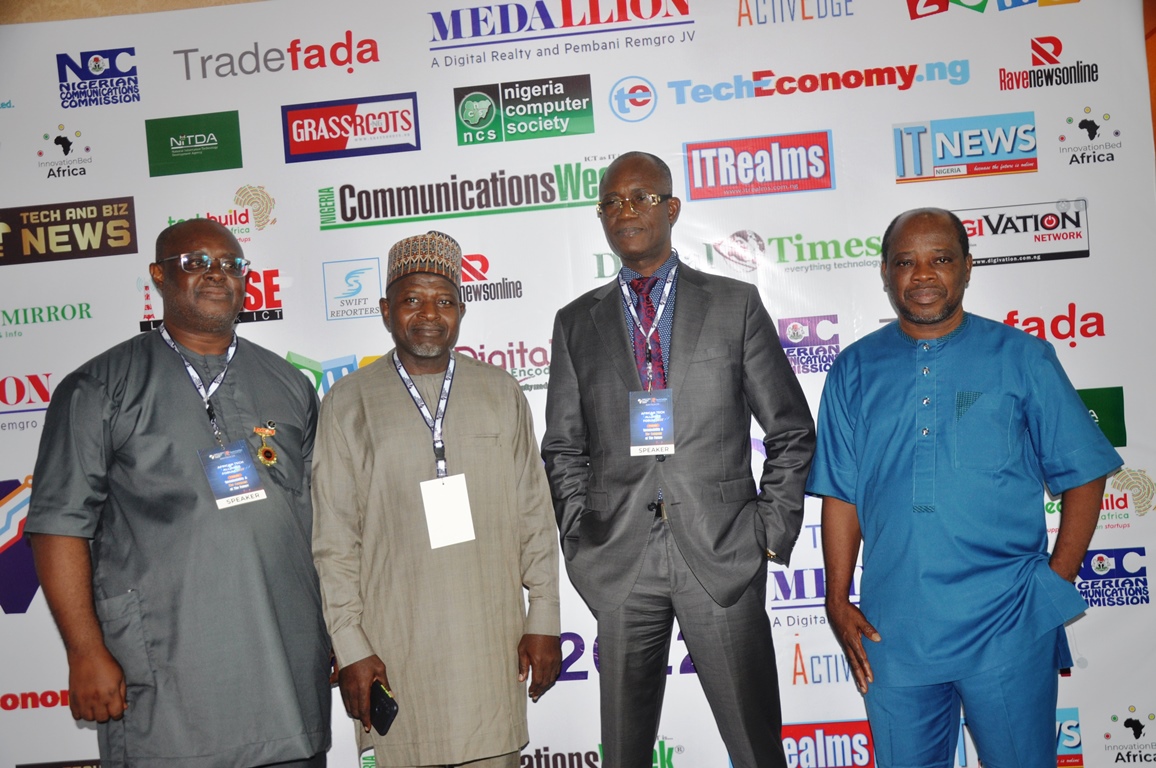
The Executive Vice Chairman (EVC) of the Nigerian Communications Commission (NCC), Prof. Umar Danbatta, has said in Lagos that the quality of life is now being measured in terms of digital connectivity that promotes businesses, social and economic wellbeing of the citizens.


Danbatta, who spoke today through NCC’s Director of Digital Economy, Dr. Augustine Nwulunne, in a keynote at the 2022 Africa Tech Alliance Forum in Lagos on Wednesday, said digital connectivity has a major role in advancing the gains of development and sustaining the future, as well as attaining the needed quota in attaining a sustainable future and actualizing the objectives of the Sustainable Development Goals (SDGs).


The EVC, who spoke on the theme, “Creating a Sustainable Future through Connectivity”, cited studies to buttress the centrality of digital connectivity to quality of life and stated that the NCC is dedicated to activating regulatory initiatives aimed at deepening connectivity for the overall economic development of Nigeria.


“Connectivity and development in Nigeria have not been fortuitous, rather they have been as a result of measured, painstaking and strategic policies implementation in the telecommunications sector by the NCC and relevant stakeholders, and we are committed to driving robust and vibrant telecoms sector to enhance further growth of Nigerian economy in all its spheres,” the EVC said.


According to him, telecommunications sector has become an enabler of economic growth, providing the necessary digital succours that bring greater efficiency in service deliveries in education, healthcare, transportation, commerce, financial services, and other sectors of the economy with greater impact on the nation’s Gross Domestic Product (GDP) as well as enhancing other sectoral growth correlating to each of the 17 goals on the SDGs.


The highlight of the event was the decoration of Danbatta with an award of “5G Core Leadership Award” while the Commission was named as the corporate organization with “Best Digital Economy Project of the Year 2022” for the regulatory efforts of the Commission in driving commercial deployment of Fifth Generation (5G) network in Nigeria.


Danbatta said the NCC, through various policies and initiatives, has provided an enabling environment for a fair and liberalized telecommunications industry, by emplacing appropriate regulatory tools and providing relevant regulatory services for mobile network operators (MNOs), who are the primary providers of telecommunication services in the country.


“The Commission has provided the enabling environment to stimulate the deployment of necessary infrastructure pertinent to the provision of universal and affordable connectivity. The resultant effect of this is that today, we now have over 210 million active telephone lines, representing 110 per cent teledensity; and over 150 million Internet subscribers as well as 45 percent broadband penetration which has enabled over 80 million broadband subscriptions.


“Telecommunications has been credited with lifting millions of Nigerians out of poverty; diversifying the economy and providing over $70bn to Nigeria’s GDP; it has also provided thousands of Nigerians with various employment opportunities. A glance at Nigeria’s historical data on its GDP portrays the upward trajectory of the country’s GDP since the liberalisation of the telecommunications sector. In 2001, Nigeria’s GDP was $74.03 billion, in 2005, it grew to $176.13 billion, and it currently stands at $440.78 billion, and telecom has been a key driver of this growth,” he said.


The EVC told the audience that the Commission is also driving implementation of various policies and frameworks including the Nigerian National Broadband Plan (NNBP) 2020-2025, the National Digital Economy Policy and Strategy (NDEPS) 2020-2030; and the ongoing deployment of Fifth Generation (5G) network and other digital interventionist projects aimed at driving universal service availability, accessibility, and availability


The Federal Government has affirmed its unalloyed commitment to supporting the Forum of Inter Governmental Action Group against Money Laundering in West Africa (GIABA) member states in the fight against financial crimes and other corrupt practices in all its ramifications in West Africa and Africa at large.

The Secretary to the Government of the Federation, Boss Mustapha, CFR, made the disclosure while receiving in audience the delegation from the Forum of GIABA Member States led by its President, Stanley Ford in company of the Executive Secretary of the Forum of FIUs of the GIABA member states (FIU of Nigeria), Hafsat Abubakar Bakari, in his office.

SGF, who was represented by the Permanent Secretary, General Services Office (GSO), Dr. Nnamdi Maurice Mbaeri said the Federal Government is committed to fighting financial crimes and ensuring fiscal transparency and accountability. In his words:

“He (SGF) asked me to reassure you of the commitment and dedication of Nigerian Government to support you at all times and to encourage your good works in fighting against financial crimes not only in Nigeria, but in Africa at large”.
He stated that the Federal Government has been committed in the fight against money laundry, terrorism financing, and the proliferation of weapons of mass destruction and small and light weapons in the country in order to ensure fiscal transparency and security of lives and property.

In its quest to fight corruption, the SGF said that the Federal Government has established several anti-graft institutions such as the Economic and Financial Crimes Commission (EFCC), the Independent Corrupt Practices and Other Related Offences Commission (ICPC), the Code of Conduct Bureau (CCB) and Code of Conduct Tribunal (CCT); with the mandate to curb money laundering and other illicit financial crimes. He added that the Government is ready to collaborate with the Forum in the actualization of its mandates in fighting against money laundering and other financial crimes.

He further indicated the commitment of President Muhammadu Buhari to the fight against corruption in giving his support for the location of its regional headquarters in Abuja.

The SGF added that with the calibre of personalities in the Forum, he is rest assured that they would bring all their expertise to bear in tackling the menace of corruption in Africa.

Speaking earlier, the President of the Forum of Inter Governmental Action Group against Money Laundering in West Africa (GIABA) Member States, Stanley S. Ford has expressed thanks and appreciation to President Muhammadu Buhari for the financial support and the plot of land for the construction of the Forum’s headquarters in Abuja.

He also thanked the SGF for being a pillar of support to the Secretariat of the Forum and promised to collaborate with his office in the fight against financial crime and other related crimes.

The Inter-Governmental Action Group against Money Laundering in West Africa (GIABA), which was established on 10 December, 1999 by the Authority of Heads of State and Government of the ECOWAS, is responsible for facilitating the adoption and implementation of Anti-Money Laundering (AML) and Counter- Financing of Terrorism (CFT) in West Africa. It is also a FATF-Styled Regional Body (FSRB) working with its member States to ensure compliance with international AML/CFT standards.

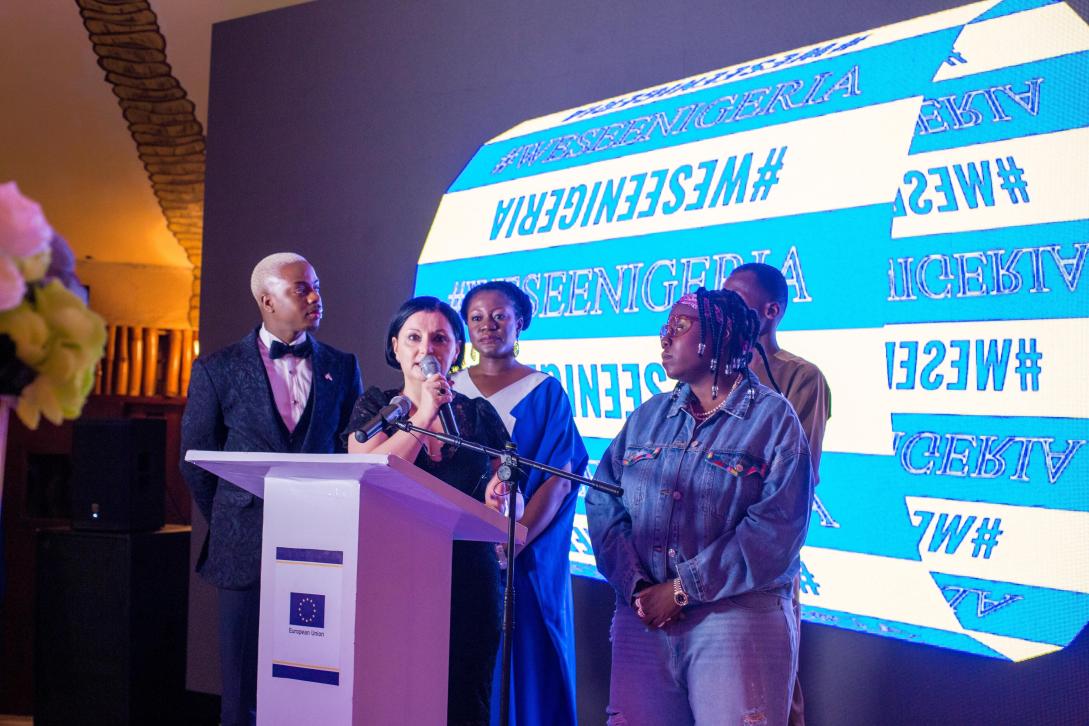
Ambassador Samuela Isopi, on Thursday 27 October 27, flagged off the Africa-EU Campaign in Lagos, Nigeria’s economic hub and biggest city. Representatives of EU Member States, European businesses (EuroCham Nigeria), Nigeria’s business community, youths, the civil society and other friends of Europe witnessed the lunch. Ms Isopi described the campaign as ambitious, the biggest of its kind undertaken by the EU outside its borders. It aims at celebrating the positive impact of the unique partnership between Africa and the European Union.


The campaign in Nigeria follows the inspiring stories of Ogola Lois Kange and Frederick Dike, who, leveraging the support provided by the EU, have unleased their transformational entrepreneurial skills to become multipliers and impact their communities.

Federick, 32, is a shoe designer and manufacturer based in Aba, Abia State, South-East of Nigeria. For the past 20 years, he and his team have been manually producing about 250 shoes a week. The EU saw what Federick was doing, and provided him with further knowledge and experience in manufacturing shoes, marketing and branding, as well as book-keeping. Together, the EU and Federick are supporting schools and the surrounding community with much needed shoes.  Frederick is already eyeing the larger West African market.

Ogola Lois Kange, better known as Madam Smiley, is a full time entrepreneur focused on processing healthy food by reducing post-harvest losses of tomatoes. She is the founder of Smiley Kitchen, a cottage tomato processing enterprise based in the North-West state of Kaduna. Ogola is actively supporting and empowering female farmers that provide her with the tomato inputs in an inclusive business approach.

Together with the EU, the potential of what her business could do for farmers and for food security was realised. She received a grant to develop food processing in a way that reduces post-harvest losses for tomatoes. Further funding for equipment, office space and rental for a factory was also given to aid in the success of the business. In light of the remarkable growth, continued support in the form of training, trade fairs and other support initiatives has been implemented.

Ogola has additionally trained over 200 women on entrepreneurship, and she has mentored them to go into cottage industry for agricultural products. Fifty of these women are now successfully starting their own businesses and have become independent.

The journeys of these two heroes underscore how the EU-Nigerian partnership is supporting the emergence of multipliers, who are impacting their communities

The journeys of these two heroes underscore how the EU-Nigerian partnership is supporting the emergence of multipliers, who are impacting their communities, inspiring hopes, and shaping the future.

“The partnership is allowing us to see life through a truly African lens. An Africa that is full of ideas. An Africa that is bursting with ambition, and an Africa that is changing the world by impacting creativity, education, tech, agriculture, healthcare, and entrepreneurship and doing it all sustainably. Through the lenses of Nigeria, we see Africa,” Ambassador Isopi said.

Influential music maestro and entrepreneur, Teniola Akpata (aka Teni), and youthful social media brand influencer, Enioluwa Adeoluwa, were unveiled at the event as the faces of the campaign in Nigeria. They will use their massive followership popularity among Nigeria’s vibrant teeming young population to drive the campaign partnership between the EU and the youths.

Whether it is pushing ahead the digital transformation, making farming more efficient and sustainable, building new infrastructure to reinforce connections between people or shaping the collective security of the continent, what is clear, as Ambassador Isopi observed, is that the EU-Africa partnership is expanding opportunities and reinforcing resilience and forging inclusiveness.

“The vibrancy, dynamism, motivation and resilience of Nigeria’s mainly young population reflect the uniqueness of a continent fired up by imaginative ideas and relentless optimism. From the prism of Nigeria, the EU sees Africa. Our long history of interaction and geographical proximity have over the years, inspired us to be creative and ambitious in the way we confront our common problems; preserve our shared values, and work towards our common interest and goals,” Ambassador Isopi said.

The Africa–EU campaign reflects on some of the initiatives that position the two continents as model, reliable, ambitious and dynamic partners. It also highlights the strength of the partnership, which has brought together peoples and institutions of both continents in pursuit of common goals for a better world.

“We will work with national influencers to express our shared values and aspirations; showcase local success stories generated by our partnership; and connect with a new audience of young Africans, leveraging the pop culture,” the Ambassador said of the initiative.

Africa shares a rich history with the EU, its closest neighbour. Collaborating with Africa to find solution to common challenges is, more than ever before, a key priority for the EU. By strengthening their multi-dimensional cooperation and promoting sustainable development, both continents can co-exist in peace, security, democracy, prosperity, solidarity and human dignity. In the face of big challenges such as pandemics, security, finding green and digital solutions, climate change and migration, Africa and the EU have already proven to be more effective working together.

“Our long history of interaction and geographical proximity have over the years, inspired us to be creative and ambitious in the way we confront our common problems; preserve our shared values, and work towards our common interest and goals,” Ambassador Isopi said.

Africa Data Centres (www.AfricaDataCentres.com), a business of Cassava Technologies, a pan-African technology group, is pleased to announce that enterprise cloud services provider Unitellas will be bringing Zadara’s global federated edge service to its new facility in Lagos, Nigeria. Unitellas is a Nigerian-based full-stack managed infrastructure-as-a-service provider and distributor of Zadara” – a renowned global leader of Edge cloud services.


According to Tesh Durvasula, CEO of Africa Data Centres: “West African enterprises are looking at cloud technology, but it will be vital to build trust to mitigate concerns around data sovereignty, security, and privacy. Addressing these issues will be vital if we are to onboard new cloud providers. Enterprises can take advantage of the cost, flexibility and scalability of cloud while local data centres provide the unique ability to control, localise and secure physical access to data. Through our ecosystem of partners, customers have access to multiple cloud onramps and connectivity options. Data centres and cloud technology provide a platform for effective disaster recovery, cloud migrations and hybrid solutions. Increasing the richness of the ecosystem by adding solutions like Zadara through Unitellas, makes our Lagos-based offering even more attractive to West African players.”

The move into Nigeria follows the announcement in July 2021 when Africa Data Centres (www.AfricaDataCentres.com) added edge cloud services to its Midrand marketplace in South Africa. However, where the Midrand deployment involved service provider Global Sense, in West Africa Zadara is distributed through Unitellas (www.Unitellas.com.ng).

Africa Data Centres has facilities across Africa’s major regional business and trade hubs and aims to help drive Africa’s digital transformation using that network. Both multinationals and large African enterprises are being attracted to these growing hubs of cloud-based business operation—all provided in highly connected, physically secure and efficient facilities that are designed, built and operated to the standards demanded by leading global cloud providers, carriers and enterprises.

Together, we are enabling customers to reduce cost, increase agility and drive productivity within their businesses

“Providing local access to world-class cloud technology aligns with our strategy of digitally transforming Africa,” continues Durvasula. “The partnership between Africa Data Centres and Unitellas means that West African customers have at their disposal fully-managed IT infrastructure-on-demand, can flexibly scale their solutions as business needs change, simplifying potentially complex IT deployments so that they can focus on their core business. We value our continued growing partnership with Zadara through our secure, cloud and carrier-neutral facilities.”

“With the African data centre market expected to experience a CAGR of 15% over the coming years, the time is now to bring these benefits to the continent,” says Smith Osemeke, MD and CEO of Unitellas. “This means enterprises can now take advantage of the cost, flexibility and scalability of the cloud, because having this presence in a local data centre provides the unique ability to control, localise and secure physical access to data, enabling data sovereignty, security and privacy.”

According to Osemeke, Zadara delivers superior turnkey solutions with the benefits of on-demand compute and storage services anywhere, in an existing on-premises data centre, in a private colocation facility, or in the cloud. This flexibility enables customers to develop, deploy, run and virtualise any application on a true 100% opex consumption-based model. Africa Data Centres owns and operates Africa’s largest network of interconnected, carrier- and cloud-neutral data centre facilities.

When critical data of businesses and citizens of Nigeria are stored locally, the risk of leaks or access by foreign agents or foreign nation will be eliminated thus promoting greater confidence in local technology and a boom in domestic tech ecosystems and economic growth for Nigeria, adds Osemeke. “Our presence in Africa Data Centres brings computing power and storage closer to the source of data generation and enterprises requiring data to make data driven decisions can effectively utilise real-time applications because latency associated with processing and analysing data is reduced.”

With this strategic partnership, Osemeke says major regional businesses and trade hubs are now empowered to drive Africa’s digital transformation using the network of Africa Data centre across Africa.

“We are proud to work with Africa Data Centres – their state-of-the-art data centres combined with Zadara technology will allow African organisations access to advanced, localised compute network and storage cloud services.  Together, we are enabling customers to reduce cost, increase agility and drive productivity within their businesses,” ends Osemeke.


Black Friday has gone from being a uniquely American event to a near global phenomenon, and, like all consumption at scale, it has environmental consequences. The upside: There’s a new way for online retailers and consumers to reduce their environmental impact, says Steffen Burrows CURBON Co-founder and Director.


In trying economic times, Black Friday offers some genuinely big discounts for consumers in search of a deal. For retailers feeling the pinch, 25 November is an opportunity to increase traffic and boost sales. The answer isn’t for people to stop buying the products and services they need and enjoy; rather, being more conscious of the impact those purchases have, and taking steps to lessen that impact is. Being a conscious consumer is now as simple as adding between 2 and 5% to your total purchase cost, to offset the carbon emissions of what you bought.


The cost of Black Friday bargains

Estimates* suggest 27 million South Africans will participate in Black Friday this year, spending an average of R1,735 per person online and in stores, resulting in a whopping R4.7 billion in sales. This correlates to roughly 8.4 million tonnes of Co2 emissions – the equivalent of driving 2.1 million cars for one year, in just 24 hours.


Online shopping has, on average, 17% lower emissions than brick-and-mortar shopping. Unfortunately, 17% less doesn’t make it exempt from adverse environmental impacts from the emissions involved in creating goods in the first place. From packaging to warehousing and delivery emissions, every product we buy has an environmental price tag – but as of now, there is something we can do about it.


Carbon offsetting consumerism

Over and above reducing the emissions of their products and their entire value chain, e-commerce stores can offer more sustainable shopping solutions like carbon offsetting, which directs funds towards climate change projects to reduce the emissions of their customers’ purchases. Ordinary consumers have the power to make more climate-conscious decisions this Black Friday by choosing brands that use locally sourced materials, by shopping at stores that are doing their part for sustainability, and by pushing their favourite online retailer to offer a carbon offsetting solution like CURBON.


CURBON offers e-commerce stores and customers the opportunity to easily offset the climate cost of the products they purchase at check-out. By contributing around 2 to 5% of cart spend, an individual can offset the carbon impact of the goods they purchase, as well as the impact of the delivery of their order.


Fast consumerism, fast consequences

For better, and for worse, fast consumerism suits a growing number of people across the globe. This demand from customers creates manufacturing practices that favour constant product iterations and upgrades within ever smaller time frames. The impact this has on the environment is far from ideal. Fast Fashion companies alone generate more pollution than international aviation and shipping combined​ and use around 93 billion cubic metres of water each year.


Clearly, we aren’t where we need to be in the fight against climate change and direct action is needed to prevent habitat destruction, biodiversity loss and other concerns not within the net of carbon offsetting. However, climate scientists around the world are calling for us to limit human-caused emissions that can impact climate change. We are on a deadline which means waiting for companies that produce the products and services we buy to do the right thing simply isn’t viable. The silver lining is that each of us is a consumer, we can demand the power to start curbing the effect our purchases have on the environment through carbon offsetting. If only 20% of South Africans contribute 2% of the value of their online carts towards carbon offsetting their purchases, R150 million would be raised for climate change projects annually.


Ends.

Note to the editor:

  • Black Friday emissions estimates are based on average consumer spending in South Africa and average e-commerce emission factors which are drawn from a leading emission database’s input-output data (https://black-friday.global/en-za/) and should appropriately be viewed as averages.