

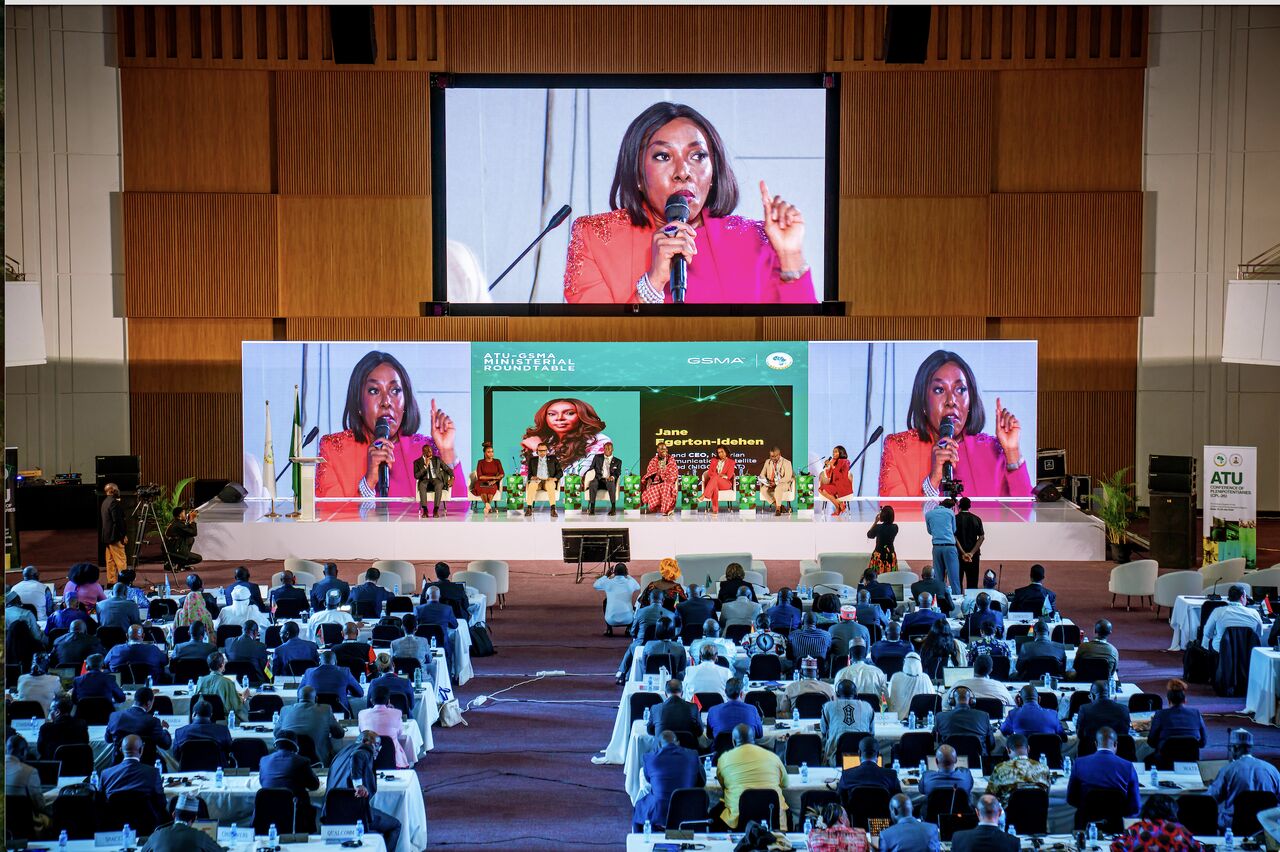
Managing Director and Chief Executive Officer of Nigerian Communications Satellite Limited (NIGCOMSAT), Jane Egerton-Idehen, has called for a fundamental shift in Africa’s connectivity policies, arguing that expanding digital access across the continent requires a stronger focus on economics, technology integration and forward-looking regulation rather than relying solely on infrastructure expansion.
Speaking at the Plenipotentiary Conference of the African Telecommunications Union (ATU), Egerton-Idehen addressed one of Africa’s most pressing digital development challenges after the organization’s Secretary-General, John Omo, asked why significant connectivity gaps continue to persist across several regions of the continent.
She challenged the widely held belief that Africa’s connectivity deficit is primarily a technology problem, arguing instead that it is fundamentally an issue of economics, integration and regulation.
According to her, the economics of extending connectivity to underserved communities differ significantly from those of densely populated urban centres such as Lagos, Abuja or Nairobi. Rural and remote communities have unique geographical, demographic and economic realities that make the traditional approach of deploying telecommunications towers and fibre infrastructure increasingly expensive and commercially challenging.
Egerton-Idehen stressed that economic activity does not end where population density declines. She noted that agriculture, mining, transport corridors, healthcare facilities, energy infrastructure and border communities continue to drive economic growth despite being located in areas that are often poorly connected. She argued that Africa’s definition of universal coverage must evolve to reflect these realities and ensure that strategic economic locations are not excluded simply because they are less densely populated.
The NIGCOMSAT chief executive also urged policymakers and industry stakeholders to move beyond the long-standing debate over whether satellite or terrestrial infrastructure offers the better solution. She maintained that Africa’s digital future lies in integrated networks that combine multiple technologies, with each deployed where it delivers the greatest value and efficiency.
She explained that the objective should not be to favour one technology over another but to use the right technology in the right place at the right time. According to her, combining satellite communications with terrestrial infrastructure will produce networks that are more inclusive, resilient and sustainable, particularly in regions where conventional infrastructure is difficult or uneconomical to deploy.
On regulation, Egerton-Idehen said the principle of technology neutrality is often misunderstood. She explained that technology neutrality should not mean regulating satellite and terrestrial networks in exactly the same way. Instead, regulatory frameworks should concentrate on achieving universal access, affordability, service quality and network resilience while recognising the unique operational and technical characteristics of different technologies.
She called for policies that create a level playing field where every communications technology can contribute according to its strengths, arguing that Africa already possesses much of the technology needed to close its digital divide. What is now required, she said, are policy frameworks that understand the economics of connectivity, encourage the integration of technologies and promote innovation rather than constrain it.
Encouraging policymakers to remain focused on outcomes rather than technological preferences, Egerton-Idehen remarked that the future would not be built by debating whether satellite is superior to terrestrial infrastructure. Instead, she said, lasting progress will come from combining both technologies to deliver reliable, affordable and sustainable connectivity solutions for all Africans.
She concluded that economics determines where investments are made, integration determines how networks are built, and regulation determines the speed at which digital transformation can be achieved. According to her, Africa’s digital future depends on getting all three elements right if the continent is to achieve universal and inclusive connectivity.