







Former Vice President of Nigeria, Yemi Osinbajo, has detailed a series of high-level engagements in Washington, D.C., where he joined global leaders and development experts to push for a fundamental shift in how international development is conceived, financed, and implemented.
Speaking on the sidelines of the ongoing World Bank/IMF Spring Meetings, Osinbajo described the week as both “purposeful” and reflective of the urgency confronting global development systems, particularly as emerging economies seek more sustainable and self-driven growth models.
Driving a New Development Agenda
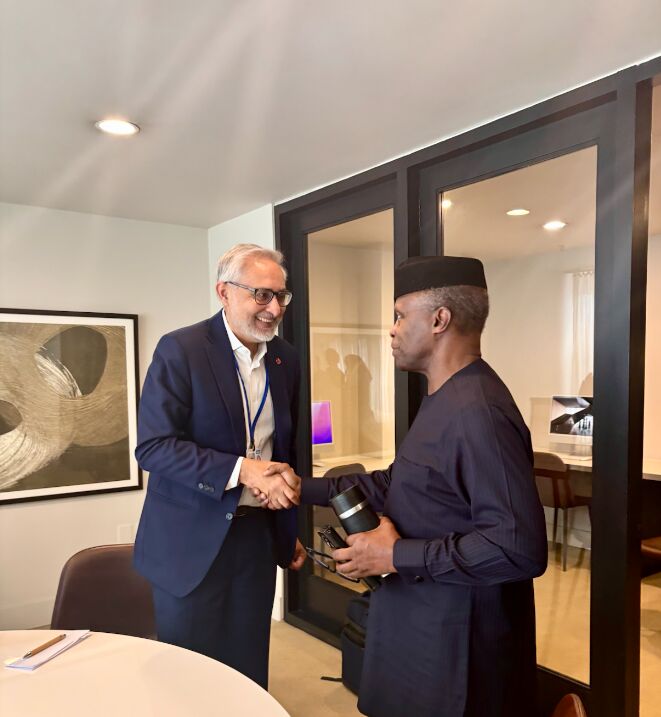
At the center of Osinbajo’s engagements were bilateral discussions under the Future of Development Cooperation Coalition (FDCC), where he met with Sidi Ould Tah and Moazzam Malik. The talks focused on charting the next phase of development cooperation, with emphasis on speed, efficiency, and practical outcomes in addressing global challenges.
The FDCC initiative, which seeks to rethink traditional aid structures, featured prominently throughout the week’s discussions, reinforcing calls for more adaptive and results-oriented partnerships.
Beyond Aid: Rethinking Global Cooperation
In a panel hosted by Devex titled “A Reset for Development Cooperation,” Osinbajo joined co-chair Arancha González Laya and FDCC Secretariat Head Alexia Latortue to explore what lies beyond the traditional aid era.
Participants argued that while legacy systems have played a role in global development, they are no longer sufficient to meet current demands. Osinbajo emphasized that the conversation is not about abandoning past frameworks, but about building a more effective blueprint capable of addressing modern economic realities.
Financing What Works
At a Geoeconomics Forum session, Osinbajo held discussions with Kalpana Kochhar of the Bill & Melinda Gates Foundation, focusing on financing strategies for women’s and children’s health.
He underscored that funding decisions must prioritize proven, impactful solutions, adding that national governments should take the lead in shaping and implementing such initiatives. According to him, sustainable progress in social sectors depends heavily on strong country ownership and accountability.
Strengthening African Innovation and Ownership
Osinbajo also participated in the UNDP Africa Innovation Fund ministerial co-financing roundtable, known as “timbuktoo.” The session brought together senior officials including Alexander De Croo and Ahunna Eziakonwa, alongside ministers from Rwanda, Angola, Lesotho, Nigeria, and Zambia.
The discussions highlighted progress in mobilizing resources for innovation across the continent and reinforced the importance of domestic ownership in development initiatives. Osinbajo noted that genuine progress occurs when African countries take the lead in designing and funding their own development pathways.
Africa’s Financial Future Lies Within
In a separate high-level panel examining Africa’s economic transformation, Osinbajo joined Samaila Zubairu, Tidjane Thiam, and Greg Guyett of the European Bank for Reconstruction and Development.
The panel explored strategies for mobilizing domestic capital at the scale required to drive long-term growth and structural transformation across Africa. A key takeaway from the discussion was the need for African nations to reduce dependence on external funding and instead unlock internal financial resources.
Osinbajo concluded with a firm message: Africa’s transformation will not be financed from the outside. Rather, it will depend on the continent’s ability to harness its own capital, leadership, and innovation to shape a sustainable future.