



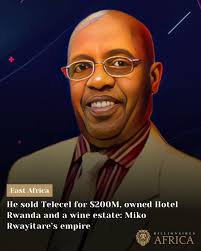
Mimi Kalinda, a renowned communications strategist and CEO of Africa Communications Media Group, has called for greater recognition of the late Miko Rwayitare—one of Africa’s most influential yet underacknowledged technology pioneers. In a detailed reflection, Kalinda noted that while millions of Africans rely on mobile phones daily, few know the story of the man whose early vision helped shape the continent’s digital future.
Rwayitare, a Rwandan-born billionaire and widely regarded as the “father of mobile telecommunications in Africa,” is credited with making the first mobile phone call on African soil in 1986. Born in 1942, he spent part of his youth in what was then Zaire (now the Democratic Republic of Congo) before studying engineering in Germany. Despite the opportunity to build a comfortable life abroad, Kalinda noted, he made a deliberate decision to return home—choosing a path that would ultimately transform Africa’s technological landscape.
Upon his return, Rwayitare worked with Gécamines, Zaire’s major mining corporation, before launching a technology distribution business that handled HP and Xerox equipment across Central Africa. According to Kalinda, this experience laid the groundwork for his ambition to build a large-scale telecommunications enterprise at a time when such an idea seemed impossible on the continent.
In 1986, Rwayitare founded Telecel International, becoming the first private operator to secure a cellular license in Africa after direct negotiations with President Mobutu’s government—a remarkable achievement at a time when telecommunications were strictly state-controlled. The same year, he made what is widely regarded as Africa’s first mobile phone call in Kinshasa, marking a historic moment that would eventually pave the way for widespread connectivity.
Telecel expanded rapidly into more than a dozen African countries, long before the emergence of modern innovation ecosystems, venture capital structures, or digital entrepreneurship support systems. Kalinda stressed that Rwayitare built his legacy without the resources or institutional support available to today’s tech founders.
His impact extended far beyond telecommunications. After moving to South Africa, Rwayitare founded Mikcor Investment Holdings and diversified into real estate, hospitality, agriculture, and wine production—becoming one of the first Black Africans to own a vineyard.
Kalinda emphasised that Africa’s digital economy—from mobile money and fintech to e-health and online learning—rests on foundations laid by pioneers like Rwayitare. She described his life as “a blueprint for pan-African ambition” long before the term became fashionable.
In her tribute, Kalinda urged Africans not only to remember Rwayitare’s name but to build with the same courage, innovation, and belief in the continent’s potential that defined his life’s work.
The post has sparked renewed conversation around Africa’s early telecom pioneers and the need to document and honour the figures whose vision helped shape modern African connectivity.