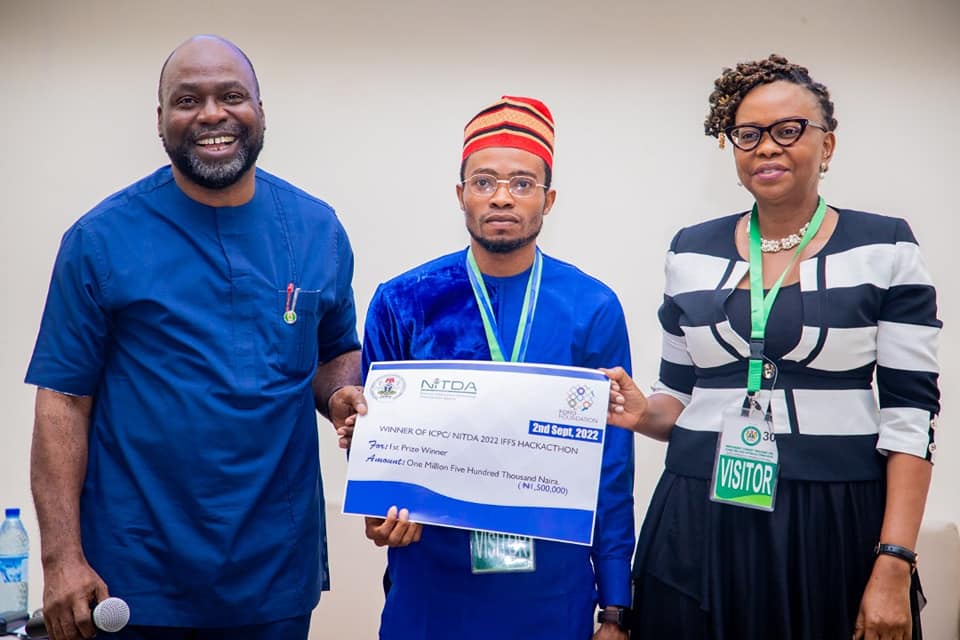
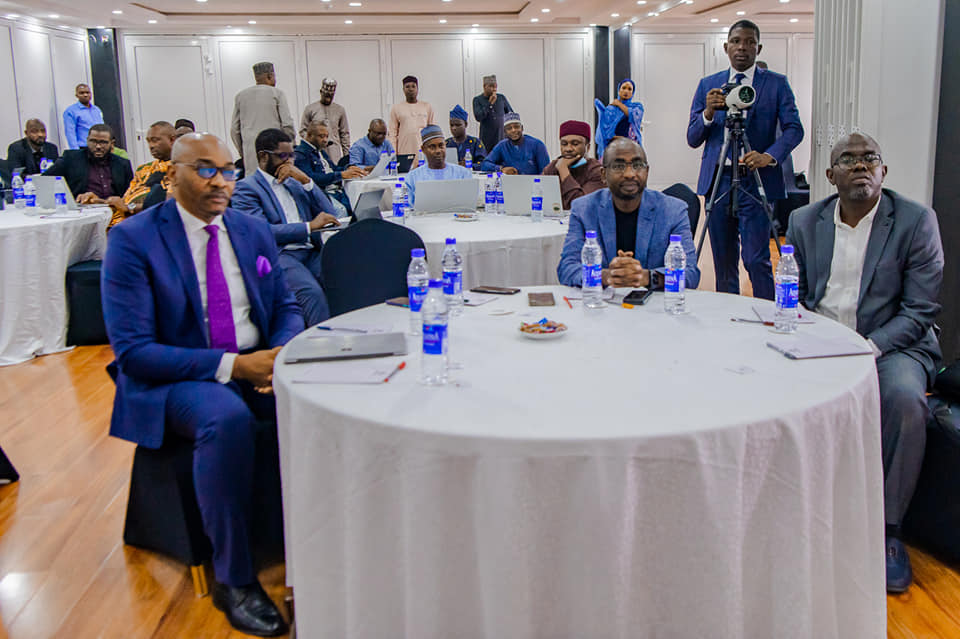
E-procure, IFFMER, and E-xpose emerged first, second third positions respectively among seven shortlisted innovators that pitched their innovations and ideas at the Illicit Financial Flows (IFFs) Hackathon Demo Day organised by the Independent Corrupt Practices and Related Offences Commission (ICPC) with the technical support by the National Information Technology Agency (NITDA) and in conjunction with the Ford Foundation.

The sum of 1.5 million, 1 million, and five hundred thousand naira cash prize were given to the three winners respectively

The hackathon with the theme “Innovative Technology Ideas to Curb Corruption and Illicit Financial Flows in Government Budgets and MDAs Procurement Process in Nigeria” took place at the ICPC Auditorium; was with the aim to develop indigenous solutions to curb Illicit Financial Flows (IFFs) in Ministries Departments and Agencies (MDAs) and check for indigenous movement of funds within Nigeria and across international borders to ensure the effective monitoring procurement processes.

The seven startups that pitched at the hackathon used the School Feeding Programme (SFP) as a case study.

Giving his remarks, the NITDA Director General, Kashifu Inuwa, CCIE represented by the Director Standards, Guidelines, and Frameworks Mr. Oladejo Olawunmi said the hackathon is captured under three pillars of the Agency’s seven Strategic Roadmap and Action Plan (SRAP 2021-2024) one of which are Indigenous Content Promotion, Digital Innovation, and Emerging technologies.

Inuwa while speaking on Indigenous Content Promotion said “we believe that we have to actually promote our content and have homegrown solutions here in Nigeria”.

He stated that “when we import technology only the technology is transferred and not the knowledge”.

He opined that it was not ideal to fight corruption with imported technology as there is always a back end.

For Digital Innovation and Entrepreneurship, the DG said that innovation or idea pitched at any hackathon NITDA is part of, does not end there, but that the Agency takes it upon itself to ensure that those ideas are incubated, young innovators are mentored and given the needed exposure both within and outside the country to attract investors.

“NITDA has taken startups to international exhibitions and has won prizes at the Gulf Information Technology Exhibition (GITEX)”.

He added that Emerging Technologies like Artificial Intelligence, Blockchain, Big data and many more are new technologies that will be useful in curbing corruption.
The ICPC Chairman, Prof Bolaji Owasanoye, SAN during his opening remarks appreciated NITDA for the technical support it has rendered to make the hackathon successful stating that “the School Feeding Funds investigation and experience has led us to today’s activities support by Ford Foundation.

“IFFs remains a major avenue for diversion of revenue both in the local and transnational transactions and activities and the deliverables from this event is to have negotiation guidelines that we hope will be adopted by the government, and those who have businesses to do with the government will have a template to guide them on how to act for the government.

Giving a brief of the IFFs hackathon selection process, the team lead from NITDA Dr. Zareefa Mustapha said there was a call for application and even there were over 2400 applications. She said for the screening processes hubs were engaged as consultants, as they know what is happening in the technology space and are in the best position to identify viable solutions.

Dr Mustapha said, “In the first stage of the selection process it was screened down to 50 and from, that it was screened down to 22.

“The 22 were interviewed and they did a demo of their technologies and that was how the top seven were selected”, she added.

Dr. Mustapha explained that the selected seven innovators were judged based on six criteria adaptability, originality, practicability, sustainability, accessibility, and technicality.

She said there was a booth camp for the selected seven at the Agency’s subsidiary National Centre for Artificial Intelligence and Robotics (NCAIR) and there were technical partners to guide them through.

The Regional Director, Ford Foundation West Africa Dr. Chichi Aniagolu-Okoye commended the innovators for intellectually tasking themselves to come up with their various innovations.

“Your technology may end up not being what the ICPC needs but it may be something that the Ford Foundation can take to the next level, “said the Regional Director.

He added further that, “Even if you don’t win you are a winner, the technologies that you have developed could always be used for something else.”
The other innovations at the demo day were DBlaze App, Blockchain Solution, CAVAS, and FoodySchool.

In attendance was the representative of the Minister of Education Mallam Adamu Adamu, Mr. Kashim Ibrahim a Deputy Director in the ministry.

 

Rising from a 2-day power-packed brainstorming session, the Management of the National Information Technology Development Agency (NITDA) annual Retreat held in Lagos, has resolved to consistently focus on prioritizing the needs of their stakeholders in formulating policies, programmes and regulatory instruments that will further boast developmental regulation role for a sustainable Digital Economy.
The management of the Agency also emphasized a bottom-up approach as a modified method to its stakeholders’ engagement going forward, and increase private sector contribution in the formulation of standards, guidelines and frameworks.

Speaking at the event, the head of the management team and Director-General/CEO of NITDA, Kashifu Inuwa, CCIE, stated the need to reshape the Agency’s future with collective leadership and individual accountability. He implores heads of departments and units to always work with their team rather than in silos for the best idea to emerge.

He mentioned that he has done a lot in democratizing the leadership by giving free hands for individuals to perform their tasks using their ideas and innovations.
He said, this is the only way to train and duplicate leadership such that everyone takes responsibility for their actions and decisions, adding that part of their role as management staff of the Agency is to enable subordinates to gain perspective and content as well as to think and behave rightly.

“NITDA is winning today no doubt, as we are among the top Agencies in the country but that is not enough, we need to shape our tomorrow. If we think we are winning today and we are comfortable, tomorrow we would be forgotten because what helped us to win today will not help us win tomorrow,” he asserted.

The need to develop collective leadership skills and strategically position the Agency to consolidate on the present wins for a better tomorrow, and continuous dedication to the implementation of Strategic Roadmap and Action Plan (SRAP 2021-2024), developed two years ago, was extensively discussed at the retreat.

The two-day management retreat with the theme “Connecting the dots for an Accelerated Digital Future” had resource personnel that addressed the management staff on “re-imagining NITDA’s role in Achieving a Sustainable Digital Economy in Nigeria”.

A stimulating presentation by the president of ISPON, Chineneye Mba-Uzokwu, wherein he applauded NITDA’s giant strides in so many respects while admitting that the interactions he had with the management has further earned the Agency his loyalty and respect being the first time he will come in contact with a public institution that operates with a private organization’s mindset.

The second presentation titled: “An Understanding of the Regulatory Function of NITDA as a Developmental Agency in a Digital Economy” by Kolawole Osinowo, tasked the management on creative thinking exercise where groups were given tools to build and create their perception of NITDA as a development organization. It was a thrilling exercise.

The annual retreat has become a tradition in NITDA, stemmed from the management’s decision to upscale the performance of the Agency through review of the past activities, evaluation of current programmes and initiatives while strategizing for future implementation.

Another presenter, Dr Nwachuckwu of Unilag and one of the resource persons took the health talk where he mentioned the importance of balancing the work-life approach for a healthy lifestyle, stating the need for regular checkups. He also disclosed the need for exercise because a healthy lifestyle consists of exercise, eating healthy meals and resting well.

At the end, the management resolved to continue to build trust with existing stakeholders while expanding frontiers of stakeholder’s engagement within the eco-system.

The Agency will continue to innovate, put people first and be professional in conduct as stated in its core value.


The Federal Government through the Federal Ministry of Water Resources under the Transforming Irrigation Management in Nigeria (TRIMING) Project supported by World Bank has handed over twelve additional rehabilitated Irrigation Sectors totalling 7,521 HA to farmers at Kano River Irrigation Scheme (KRIS), Hadejia
Jama’are River Basin Development Authority.

The hand over ceremony was performed today Wednesday 31/08/22 at the Shagari Briefing Center, Imawa town in Imawa Kina LGA, Kano State.

The Honourable Minister of Water Resources Engr. Suleiman H. Adamu FNSE, FAeng speaking via zoom informed that the Kano River Irrigation Scheme (KRIS) is one of the five existing irrigation schemes being rehabilitated and expanded where possible by the Federal Ministry of Water Resources under the Triming Project which is supported by the World Bank.

According to the Honourable Minister, the newly completed sectors covering an area of 5, 190 HA was the one being handed over to farmers today thereby making a total number of twenty five sectors which cover a total area of 7,521 HA that have been completed and handed over to farmers so far.

Engr Suleiman reiterated that in line with the principles of the TRIMING Project, the Water Users Associations (WUAs) have been supported by employing Officers to man the sectoral offices towards achieving proper Operation and Maintenance (O&M) of irrigation systems with the intention of empowering farming Communities around TRIMING Project Irrigation Schemes.

Speaking further, Engr Adamu added that consultative meetings were held severally at all the TRIMING Schemes to discuss extensively the guidelines on Irrigation Service Fee collection and its attendant relationship with the Treasury Single Account (TSA) system noting that some successes has already been recorded on this task and as such, would be replicated in all public Irrigation Schemes nationwide.

He therefore charged the River Basin Development Authorities (RBDAs) to ensure that farmers and their Associations take their new responsibilities with a steady grip by keeping the canals, drains, roads culverts and other infrastructure that are handed over to them in perfect working condition at all times thereby justifying the huge investment in terms of time and resources expended to train and empower the farmers, their associations and RBDAs staff.

He further reiterated that the entire TRIMING Project is an experimental exercise by the Ministry planned to be rolled out to other RBDAs across the Country on successful completion and reporting on the performance of the project at the first instance. The Honourable Minster added that the contribution of the Hadejia-Jama’are River Basin Development Authority’s management towards the performance of the management transfer process which is from Government controlled to farmer managed would therefore guide future decision of Government as regards the involvement of other RBDAs in transferring management of irrigation systems from Government owned and controlled, to farmer managed system.

Earlier, the Managing Director of Hadejia-Jama’are River Basin Development Authority, Maamun Dau Aliyu welcomed all to the handing- over ceremony. He pointed out the significance of the Federal Government irrigation farming system as a viable Project that would make farmers to be busy all round the year.

Also speaking at the handing-over ceremony, the National Project Coordinator for the TRIMING Project Engr. Peter Yakubu Manjok said “the project is a very ambitious intervention of the Federal Government, supported by the World Bank; a plan to provide facilities for dry season farming of about 37,000 HA in five schemes”. Engr Manjok said the project is seven years old


The Honourable Attorney General of the Federation and Minister of Justice, Abubakar Malami, SAN has said that the Federal Government of Nigeria has settled the long-standing contractual dispute with a foreign investor group in the steel space of $5.258 billion for $496m.

This was made known in a statement issued by Dr. Umar Jibrilu Gwandu, Special Assistant to the HAGF on Media and Public Relations, made available on Sunday 4th September, 2022.

The mediation proceedings, according to the statement, was under the International Chamber of Commerce’s (ICC) Alternative Dispute Resolution (ADR) framework led by Mr Phillip Howell-Richardson. The settlement agreement came into effect on 19 August 2022.

Nigeria succeeded in reducing the claim in mediation brought by the international firm of King and Spalding, legal representatives of the Global group, by 91%. A claim for over $10 billion was threatened in arbitration before the International Chamber of Commerce, International Court of Arbitration, Paris, in respect of five major contracts of 2004-2007 – covering steel, iron ore, and rail.

It might be recalled that the seeds of the disputes can be traced to five contracts entered into by the 1999 -2007 administration that gave complete dominance over the Nigerian steel space to one company group, the Global Steel group.

However, in 2008 a new administration proceeded to terminate these contracts contrary to legal advice supplied by the Federal Ministry of Justice, which cited the termination cost in the form of damages.

The statement noted that had the government of that day not terminated the Ajaokuta Share Purchase Agreement on 1 April 2008 and waited for just 55 days to terminate, it would have terminated lawfully and the Government would have collected more than 26 million USD from Global Steel.

“This was because the firm appeared unable to pay the first tranche for the Ajaokuta shares before the first anniversary of the agreement (25 May 2008). This failure would have given Nigeria a right to over $26m as liquidated damages under cl.12 of the Ajaokuta Share Purchase Agreement.

Global steel, in consequence, took the FGN to the International Chamber of Commerce, International Court of Arbitration, Paris, commencing arbitration in 2008. Although the Federal Government negotiated a settlement in May 2013, the previous administration failed to implement its settlement agreement”.

In May 2020, Global threatened a resumption of the arbitration and announced an anticipated claim in damages of over $10-14 billion against the Nigerian State in respect of the affected 5 contracts.

The administration of President Muhammadu Buhari, however, took decisive steps to resist this claim, rather than pass it on to a future administration with ballooning interest.

With this development, Malami said,“President Muhammadu Buhari has now rescued the steel industry from interminable and complex disputes as well as saving the taxpayer from humongous damages”.

The Minister also stated that, “one of the lessons to be learnt included that the future arrangements – sale or concessions – must be carried out in the national interest and in compliance with the law”.

The statement explained that the Office of the Attorney General of the Federation and Minister of Justice grappled with the inherited problem by adopting a blueprint of seven principles for the cost-effective resolution of contractual disputes wherever they occur. “They are the use of institutional mediation, choice of FGN counsel, the use of financial advisers with reputational capital, the importance of not discouraging foreign investment, fiscal responsibility, transparency, and the recognition that joined-up government produces superior outcomes”.

The FGN engaged PwCNigeria to do a comprehensive review to ensure taxpayers are protected. Also, Dr Tunde Ogowewo, a barrister (and senior academic at King’s College London), represented the FGN and advised the government throughout the process. The Attorney-General of the Federation and Minister of Justice, Abubakar Malami stated of Dr Ogowewo’s report:

“FGN Counsel’s Report on Case Reference 15539/VRO/AGF/ZF/TO/AZR/SPN)_ – of over 1,000 pages provided a guide on how to avoid such contractual disputes and, where they occur, how to reach cost-effective savings for the benefit of the Nigerian taxpayer.”

Malami, therefore, reiterated the commitment of President Muhammadu Buhari-led Federal Government of standing firm to continue to make assiduous efforts in protecting the public interest and ensuring that Nigeria is not denuded of its resources through whatever means.

The working world has changed drastically. Today, survey after survey shows workers want a hybrid work model. But what does the future workplace look like and how can organisations create a digital transformation journey that fits the new paradigm?

Marilyn Moodley, Country Leader for South Africa and WECA (West, East, Central Africa) at digital transformation specialist SoftwareONE, says the working landscape has changed forever. “While the idea of a digital workplace has been taking shape for several years, the start of the pandemic accelerated the trend where we witnessed over three years’ worth of digital transformation in just three months. Organisations across the globe are trying to fine-tune their hybrid work environment. Doing so often requires a faster transition to a digital workplace, so all employees are afforded the same experience regardless of whether they work from the office, at home, or on the go.”

In this shifting landscape, it can be tough for organisations to keep up and create a digital workplace that meets the needs of their business and employees.

Hybrid challenges

At first, hastily adopted remote working tools and systems were not properly integrated. This opened the door to bad actors and cyberattacks increased sharply. Over 7 in 10 employees need to access, share, and receive sensitive customer data in their day-to-day work, yet 1 in 4 homeworkers claim to ‘rarely or never’ consider data protection when sharing information. “Rather than perform high-level strategic work that enables the organisation to keep pace with change, experienced personnel are constantly being pulled into to fight security fires,” notes Moodley.

Even if IT teams now have remote security under control, many digital transformation issues remain. Far too many digital transformation projects either fail outright or don’t achieve their digital transformation aims. “Two of the biggest reasons for failure are unclear goals from top management and inadequate resources to scale projects. You cannot jump into a digital transformation journey and expect it to fix all your problems. Successful transformation is reliant on following a process, which starts with strategic planning, laying solid foundations, and then building new capabilities and ways of working that enable the business to grow and achieve its vision of success,” says Moodley.

Getting it right

Any organisation embarking on digital transformation must perform a ‘health check’ as a first step, says Moodley. “Assess where you are and what systems, platforms, and applications you have. Then, think about where your business is going and whether your current IT infrastructure can get you there. Identify gaps, duplicated efforts, and what you could do differently to reach a better outcome. With the right intelligence it becomes much easier to identify the opportunities to optimise your IT infrastructure, which has the potential to have a huge impact on your business.”

The benefits of a solid digital transformation plan are far-reaching, but two perks you’ll experience almost right away are reduced costs and improved focus on strategic direction. “Right-sizing your infrastructure, getting rid of technologies you don’t need, and consolidating vendors will all impact the bottom line. Then, using technology to automate processes will free up talent to focus on strategic initiatives and enable growth,” says Moodley.

Of course, this seemingly straight-forward assessment, not to mention the implementation thereof, can be an immense task to complete. Consider getting expert help. “Most organisations right now have application sprawl and technology debt due to hastily adopted measures during the pandemic, as well as legacy system issues delaying their journey to cloud. If you don’t take the time to properly integrate new systems into your existing environment, or fail to introduce its full functionality to employees, you won’t get a good return on your investment,” says Moodley.

“Microsoft 365 is a great example: According to research from Forrester, the ROI should be in the region of 163% over three years, with over half coming from business user automation and process improvements. Yet many organisations won’t achieve this because they adopted this application in a hurry before realising the setup and optimisation would be labour-intensive. On top of that, many organisations face a skills shortage right now. Outside experts with relevant, up-to-date skills can ensure that ROI is achieved, make the process much smoother and make the changes stick.”


Anchor (https://getAnchor.co/), a banking-as-a-service (BaaS) platform making it possible to seamlessly build financial products in Africa announces its public beta launch. The startup was also accepted into Y Combinator Summer 2022 Batch as the first African BaaS and embedded finance platform.


In recent years, there have been several reports about the size of the Africa financial inclusion opportunity (https://bit.ly/3pXguv2), particularly in reference to the provision of digital financial services.


These reports have brought about a spike in the number of companies and amount of investment activities in the fintech space in Africa. Yet, two things stand out; the minimal impact on financial inclusion, and the persisting difficulty in building and launching a fintech company on the continent.


For context, financial exclusion in Nigeria decreased by only one percent, from 37% in 2018 to 36% in 2020. Also, today, across Africa it takes an average of $500,000 and 18 months to build and go-to market with  financial products. This is because companies need to go through the hurdles of rigorous licensing and compliance processes, multiple integration layers, complex banking and third-party relationships, and invest in complicated core-banking infrastructure.


Anchor (https://getAnchor.co/) is launching its public beta API infrastructure to make it easier for African businesses to build, embed and launch financial products, starting in its first market, Nigeria.


Founded by Segun Adeyemi, ex-CEO of Amplifypay, Olamide Sobowale and Gbekeloluwa Olufotebi, Anchor provides API for offering accounts, money movement, savings and card products.


“We built Anchor to abstract away the complexities in building financial products, so businesses can get started in five minutes with a few lines of code”, says Anchor’s CEO, Segun Adeyemi.

We built Anchor to abstract away the complexities in building financial products, so businesses can get started in five minutes with a few lines of code


In May, Anchor released its private beta working with innovative start-ups like Outpost Health, Dillali, and Pivo. The BaaS platform has transacted millions, growing over 200% MoM, and is now set to launch its public beta (https://getAnchor.co/) for African businesses to embed finance into their offerings and for fintechs to build banking products. Already, the company has more than 40 other startups on its waitlist.


Anchor has raised over $1 million in pre-seed funding from Byld Ventures, Y Combinator, Luno Expeditions, Niche Capital, Mountain Peak Capital, and a host of angel investors including Emmanuel Okeleji (CEO, SeamlessHR), Ado Oseragbaje, Yinka Odeleye, and Sanmi Famuyide.


According to Ashutosh Desai, a Partner at Y Combinator, “Anchor’s embedded finance platform enables technology companies in Africa to build products that can rapidly expand access and improve quality of financial services. We’re excited to back Segun, Olamide, and Gbeke – a highly technical and experienced team – in building financial infrastructure that’s essential for Africa’s economic growth.”


“I believe BaaS will play a prominent role in the distribution of financial services in Africa. As a full stack baas provider, Anchor demarcates customer engagement from infrastructure – enabling its customers to focus on building differentiation as opposed to commodity infrastructure. We are really excited to be working with this determined and experienced team”, Founder of Byld Ventures, Youcef Oudjidane.


Anchor is a solution birthed by the insights garnered from the founders’ experience building and working with fintechs across Africa. The CEO, Segun Adeyemi founded Amplifypay; a payments company which he exited to Carbon (FKA OneFi/Paylater) in 2019. Segun proceeded to work with JUMO—a company that offers credit infrastructure to large mobile money operators across Africa.


Olamide, the CTO and co-founder, has worked at AppZone, TeamApt, Kuda, & Carbon. While at TeamApt he functioned as a Fullstack Engineer in the team that built the first virtual payments product in Nigeria. Gbeke, the Engineering Lead and co-founder, has been an IT Consultant and entrepreneur in Nigeria for over 10 years before joining Booking.com where he built financial operations software.


“We have seen first-hand the painful process of closing banking partnerships, negotiating third-party contracts, and obtaining regulatory approvals. And more generally, the extensive time and effort required to launch financial products,” Segun said.


He added that “considering the similarity in the underlying infrastructure, irrespective of the unique value propositions, companies should not have to wait for years and spend millions to go-to-market. That’s why we are excited to get Anchor into the hands of many more businesses via our public beta launch.”


South African businesses are at serious risk from rapidly increasing payments fraud – often from within their very own organisations. Ryan Mer, CEO at eftsure Africa,  a Know Your Payee™ (KYP) platform provider says while criminal syndicates behind ransomware and Business Email Compromise (BEC) attacks shouldn’t be ignored, it’s important for organisations, irrespective of size, to tighten the internal controls needed to prevent serious fraud.


“Taking preventative measures against internal fraud can seem daunting as employees occupy privileged positions of trust. With access to internal systems and knowledge of internal processes, employees know where the gaps lie in a company’s internal controls,” says Mer.


The cost of fraud is rising at an alarming rate. Respondents to PwC’s Global Economic Crime and Fraud Survey of 2022 reported total losses of US$42 billion – over and above damages to brand, reputation and market share. Another report from the South African Association of Certified Fraud Examiners found that a typical organisation loses at least 5% of its annual revenue to fraud. The same study also found that once victimised, an organisation is unlikely to recover the losses. “Internal fraud is often committed by a trusted employee and can go undetected for several years. External auditors may struggle to detect financial anomalies thanks to the many subtle ways employees can secretly profit at their employer’s expense,” notes Mer.


Common fraudulent activities include:

  • Changing supplier banking information
  • Colluding with suppliers to issue fake invoices
  • Submitting fake expense claims
  • Actioning illegitimate refunds
  • Diverting incoming payments to other bank accounts


Positions that involve administering payments to creditors and suppliers, overseeing and processing invoices and electronic payments, and capturing bank statement transactions present a higher risk for businesses. “Theoretically at least, many businesses do have the right controls in place to fight fraud, but there are gaps that need serious attention. Employers should also be able to identify the red flags that point to malicious activity,” adds Mer.


Top insider threat red flags:

  1. Requesting unnecessary access to systems and sensitive information

Sensitive information should be on a need-to-know basis. A member of staff snooping in confidential company files should be questioned.

  1. Disorganised or incomplete record keeping

Shoddy record keeping may be a deliberate attempt to hide nefarious activity. Maintaining high administrative standards is therefore a must.

  1. Employee doesn’t take annual leave

A reluctance to take annual leave may be a result of a fear of being uncovered while certain duties are handled by a colleague or superior.

  1. Conflicts of interest with suppliers

If an employee shows undue favour towards a certain supplier, it’s worth taking a closer look to establish whether the third party involves a friend or relative of your employee.

  1. Living a lavish lifestyle

Extravagant purchases and a sudden, drastic change in lifestyle are obvious indicators of a financial windfall and a sign to pay closer attention without jumping to conclusions.

  1. Signs of financial distress

While most people who find themselves in a tough spot never turn to crime, some employees may act out of sheer desperation. Keep lines of communication open and offer assistance if possible.

  1. Gambling addiction

Such concerns should be handled delicately by HR.

  1. Being rejected for a promotion

An employee who feels they are underpaid or deserves to occupy a higher position of authority may feel justified in defrauding their employer.

  1. Accessing network resources after normal working hours

Insiders may attempt to access files, applications, networks or intellectual property outside normal working hours.


“Robust risk management policies, data management controls and staff training can all go a long way in minimising insider threats. In addition, eftsure helps protect organisations against payment fraud by automating manual controls, placing less reliance on the manual and human factor, which gives those responsible for releasing payments the confidence that processes and controls are in place and working effectively,” says Mer.


Ends.

For more information contact:


With the volume of cyber-attacks threatening organisations daily, infrastructure and security teams are stretched, fatigued, and in many instances, operationally siloed, playing directly in the hands of the attackers. These factors, together with a deep understanding of the security landscape, prompted SLVA CyberSecurity, a leading provider of cyber security solutions to enterprises and managed service providers (MSSPs), to offer Seceon’s comprehensive artificial intelligence and machine learning-enabled cybersecurity solutions, which deliver transformative, predictable outcomes for MSSPs and their small to medium business customers.

Seceon is a global provider of the most advanced artificial intelligence (AI) driven cyber threat detection and remediation platforms for enterprises and MSSPs. Patrick Evans, CEO of SLVA CyberSecurity, explains that security challenges affect businesses of all sizes, but it’s SMBs that stand to lose the most. “Enterprise and large business suffer from the same security threats, but are better resourced to cope with the onslaught, although nowadays even that is not enough.”

Non-AI and machine learning (ML) solutions have a far higher customer-to-analyst overhead, typically 5:1 or 10:1. “In an environment that uses AI and machine learning (ML) to deploy, detect, notify and remediate, MSSPs can look forward to a far more economically beneficial customer-to-analyst ratio of 80:1,” explains Evans.

“SMBs face a double threat in that they are under-resourced and often don’t possess the necessary skills to apply a cyber security strategy to protect themselves, which is the opportunity that is presented to MSSPs,” says Evans.

“MSSPs routinely act as technology advisors to SMBs; with Seceon’s ease of implementation and onboarding, reporting and threat intelligence all out of the box and automated, MSSPs can take up the challenge of offering a total security solution designed to adapt to the constantly evolving threat landscape.”

SLVA’s Seceon solutions present a unique billing model, which is something SMBs require. Seceon solutions are deployed as a per-user per month cost rather than the traditional “per incident” model, providing predictability to for end customers, and better cost management for MSSPs.

Seceon’s aiMSSP product is a multi-tier, multi-tenant platform combining the power of a dynamic security operations centre with the advantage of advanced security information and event management (SIEM). There is also extended detection and response (XDR) in a single solution, which can be managed and monitored by an MSSP.

“Tool fatigue and the complexity of modern environments, coupled with the fact that very few SMBs and their technology providers have a single-pane view of threats, exploits, and attacks is leaving many environments at risk,” explains Evans. Seceon places essential tools, analytics, dashboards, controls, queries and reports at the provider’s fingertips, even if their core function is not cyber security solutions with a billing model tailored to SMBs.  AI-enabled SIEM and XDR operate across platforms, whether in the cloud, on-premise or in remote work environments; customers gain an elevated security posture, and MSSPs gain another revenue stream.

Using artificial intelligence for automated threat detection Seceon solutions can effectively identify and remediate threats within an environment with fewer analysts required – eight times as efficient in some cases – which would otherwise require significant chunks of time to fine-tune and analyse manually.  “The automated deployment and threat detection is so effective, a client discovered recently that they were compromised while Seceon solutions were being deployed,” says Evans.

The Seceon solutions uncover myriads of threat vectors lurking inside environments providing comprehensive visibility and shortening the mean-time-to-identify and mean-time-to-respond automatically.  “The net result is a dramatic reduction in operational backlog and human error while providing audit and compliance reporting against almost all data protection policies, and for MSSPs, there’s greater opportunity to build deeper relationships with customers,” says Evans. “And who isn’t looking for that, especially when there is so much at stake these days?” he concludes.


New research from international digital SME banking specialist, Pollinate,  reveals traditional banks’ servicing of SMEs does not correspond with the economic importance of this sector.


From talking to nearly 1,000 banking leaders around the world, Pollinate’s latest guide has plotted a path for how traditional banks can accelerate the pace of change by focussing on harnessing the power of data to become the single digital hub for SMEs.


At a global level the guide reveals how traditional banks need to:


  • Remove the causes of SME attrition. The guide shows that traditional banks need to build on their own product and distribution advantage by delivering digital experiences at scale. While 65% of traditional banks say a strength is data, more than one-third report losing customers through a lack of data and insights.


  • Focused investment for maximum impact. Acquiring could be banking’s sweet spot. For 60% of traditional banks that see ‘BigTech’ as a major competitor, owning customer data (particularly both issuing and acquiring) could position banks as a strong competitor against these tech giants.


  • Rethink “supplier” relationships. Traditional banks need to extend relationships with Fintechs from a supply arrangement to collaborating on a range of elements, from initial strategy to launch of new products and services. 36% of traditional banks are looking for partners that can provide strategic business advice, not just platforms or services.


SMEs across South Africa represent more than 98% of businesses, employ between 50 and 60 percent of the country’s workforce across all sectors, and are responsible for a quarter of job growth in the private sector. Despite this, Pollinate’s data reveals that traditional banks use only 20% of business banking budgets for SMEs. Furthermore, only 47% of banks across the board will be increasing their investment in SMEs in the next financial year, with 11% of banks expected to decrease their investment.


The rapidly changing SME landscape has seen fintechs rise to the challenge to provide the digital solutions this sector needs. Traditional banks, often constrained by red tape and legacy structures, have struggled to keep up – 22% of traditional banks say fintechs are the biggest competition when it comes to serving SMEs.


This has caused ripples across the industry, with banks often opting to partner or acquire fintechs instead of building their own solutions. In South Africa, 22% of traditional banks partner with fintechs collaboratively to build specific digital solutions from scratch, compared to 50% of challenger banks. Traditional banks are also more likely to acquire fintechs (25%) compared to challenger banks (17%).


Fiona Roach Canning, Co-Founder and President at Pollinate, said: “SMEs are fundamental to communities and economies. The race for customer primacy is about becoming the single digital hub for SMEs to manage and grow their businesses.”


“SMEs are fundamental to communities and economies around the world. Reducing the cognitive burden for these companies is key to their growth.  They need a central hub to manage and grow their business – and banks have all the assets to be that single place.  Banks are showing that, through partnerships, they can leverage these assets and leapfrog digital disruptors, and Pollinate is proud to be one of their partners of choice.”


The guide is available for download on the Pollinate website and is the latest in a series of publications from the in-house Horizons thought-leadership team.

After a four-month long competition, KPMG Private Enterprise awarded iiDENTIFii the top spot.


Following the incredible success of the inaugural competition last year, KPMG again called on tech innovators across the continent to bring their innovations to the table with the aim of not only highlighting new technology breakthroughs that transform and revolutionize businesses in diverse industries, but to identify those businesses truly leading the pack.

After a four-month long competition, KPMG Private Enterprise has announced the winner of their Tech Innovator in Africa Awards where iiDENTIFii took the top spot, followed closely by Chekkit Technologies Inc in second place and Troygold in third place.

iiDENTIFii stood out this year, given their level of innovation and disruption, long term potential (there are broad application opportunities for their solution) and the quality of their pitch.

iiDENTIFii will go on to compete in the global event taking place in Lisbon, Portugal in November 2022. The global competition is made up of 20 countries across key economies globally and while each region runs their own competition, the global platform allows for various players across the world to pitch their businesses’ products and services and be recognised for leading tech innovation and business model excellence, judged by a panel of local and global industry experts.

The entire iiDENTIFii team is honoured to have won this prestigious competition. We’ve been inspired by all the world-class innovators who were in the running throughout Africa,” said Lance Fanaroff, Co-Founder and Chief Strategy Officer of iiDENTIFii.

“As Africa’s representative for the global finals, we’re determined to make our continent proud when we compete on the global stage, at the Web Summit 2022 in Lisbon in November.”

“Our team has worked hard to make innovation a consistent thread throughout the business, and we are grateful for KPMG’s commitment to tech trailblazers.”

“Africa is ripe with innovation and this competition truly showcases Africa’s leading tech innovators on a local and global scale – demonstrating the impact that the fastest-growing tech innovators are having across the globe.

“We opened the competition in February this year and had an overwhelming response with 159 applications from across the continent – almost double compared to the number of applications received last year. This demonstrates not only the growing tech innovation in Africa but indicates the appetite for African tech businesses to be recognised and scale their operations for the greater good of the continent and its people,” said Alan Barr, Partner and Head of Private Enterprise at KPMG.

“It was great to see the shift in innovations this year and how African businesses have used the challenges of the past two years to truly define their strategies and ensure they have adapted to what the market wants and needs,” concluded Barr.