The Federal Government of Nigeria, through the Minister of Communications and Digital Economy, Professor Isa Ali Ibrahim (Pantami) today signed a Memorandum of Understanding (MoU) with the Republic of Gambia, represented by its, Minister of Communications and Digital Economy, Mr Ousman Bah.

The MoU signed at the Communications and Digital Economy Complex, Abuja, Nigeria aims to encourage, promote and facilitate cooperation and collaboration between the Federal Republic of Nigeria and the Republic of Gambia in the areas of Broadband Development, Spectrum Management, Research, and Development; Capacity Building, Internet Safety, Cyber security, Internet Governance, Infrastructure, Legal Frameworks, and Government Digital Services in accordance with the relevant laws of each Country.


Sustainable workspaces are so much more than a design trend. They are a critical component in the global response to climate change, says Steven Fish, Director at Tétris Design and Build.


Undoubtedly, businesses play a pivotal role in shaping our environment – for better or for worse. By envisioning and realising sustainable workplaces, they possess the power to significantly pare down their ecological footprint. Constructing eco-friendly workspaces isn’t about starting anew with solely eco-friendly fittings and furnishings. Rather, it’s about leaning into and embedding the principles of the circular economy. This is based on three principles, driven by design: eliminate waste and pollution, circulate products and materials (at their highest value), and regenerate nature. It is possible to make the economy work for people, business and nature throughout the design process. It’s also an active, conscious step towards green business practices, signifying a critical part of our collective journey to a sustainable future.


Mindfulness in creating a working balance

Consider that 17 billion pounds of office assets are discarded in landfills each year, according to the US Environmental Protection Agency, and that the manufacture of one standard office task chair results in an average of 72kg CO2e in carbon footprint or that a common visitor’s chair causes 36 kg CO2e and a standard office desk produces 45 kg CO2e. One of the most effective means of achieving sustainable workspaces is through mindfulness when designing and implementing furniture and fittings. It must no longer be a case of ripping out the old, to replace with the new. Instead, spaces should approached with the mindset of sustainability at every stage of development. At the forefront of the sustainable furniture movement, the Tetris Sustainability Code is a best practice methodology for applied sustainability measures based on leading global sustainable green certifications. It includes the repurposing and refurbishing of furniture as one of its key pillars along with the selection of environmentally-responsible materials and the consideration of individual wellbeing in the design and build phases. These are all measurable deliverables for achieving global green certification in the creation of sustainable business spaces that foster a balance in both productivity and wellness.


Sustainability is regenerative and locally-focused

In relation to sustainable furniture solutions, we focus on enabling a circular approach for the creation of furniture that is made from recycled materials, designed to be durable and long-lasting, and easily repaired or recycled when it is no longer needed. This can help to reduce the environmental impact of furniture production and consumption and create a more sustainable furniture industry. We source locally wherever possible, working with local designers and manufacturers to create feature pieces. Suppliers such as James Mudge and Houtlander produce beautiful items of furniture and the fact that they are produced locally means they have a lower carbon footprint, in addition to supporting local businesses and creating jobs for the craftspeople they employ.


Other benefits of embedding a circular approach include a reduction of waste, pollution and greenhouse gas emissions. Resource efficiency is increased by reducing the amount of resources that are needed to produce new products, which helps to conserve natural resources. Economic benefits are realised through the creation and support of new businesses and jobs in the recycling, repair, and refurbishment sectors, which helps to boost the economy and create a more environmentally-conscious future.


Practical, proactive approach to sustainable furniture solutions

When buying office furniture the important point to remember is that buying cheaper furniture eliminates the long-term use and refurbishment potential that comes with buying well-designed, engineered and manufactured pieces. For example, the average office task chair can have a life cycle of between 10 and 12 years, which provides excellent return on the original investment over a longer life cycle and ultimately prevents wastage.


Thorough furniture audits are required to go beyond just recovering and replacing missing or broken pieces. Through an application of design thinking and flexible manufacturing, furniture pieces can be repurposed, recoated, refurbished and reupholstered. New components can be engineered to integrate with the existing pieces. All of which contributes significantly to an active, thriving circular approach for office fittings.


Placing humans at the centre of work

Today, businesses are increasingly looking for ways to create sustainable workspaces that are both productive and human-centered. Sustainable furniture solutions can play a key role in achieving this balance. By using sustainable materials, designing furniture for durability, and providing maintenance services, businesses can create workspaces that are good for the environment and good for their employees. Sustainable furniture can also help to create more productive, human-centred ways of working. For example, furniture that is designed to be ergonomic can help to reduce stress and improve employee health. Furniture that is made from sustainable materials can help to improve air quality and create a more comfortable work environment.


A blended approach of recycling and refurbishing, sourcing locally and responsibly, and buying the best engineered and designed products that manufactured with best sustainable practice for substantial ROI and longevity of use is design-centred, human-centred, and perhaps most importantly – future-focused.

The Solar Africa Expo 2023 ended perfectly. HINEN (www.Hinen.com) achieved great success at the exhibition with the innovative concept “Bring the Sunshine at Night”, generating the sunshine and storing it in the battery system in the daytime, then outputting solar power at night.


During the exhibition, what drew people’s great attention was HINEN’s 3000W Portable Power Station PS3000

During the exhibition, what drew people’s great attention was HINEN’s 3000W Portable Power Station PS3000, which could totally replace small diesel generator sets, the savour for home users and small business owners.

As a whole-chain energy storage company, HINEN also showcased its latest solar energy solutions, which included LiFePO4 battery cell production and recycling, small storage systems, home battery systems, and C&I storage systems.


HINEN is actively establishing relationships with distributors and partners in Kenya, South Africa, and Nigeria to expand the practicality and impact of its energy solutions, thus helping to address Africa’s energy challenges in areas with power shortages. For more information about HINEN and its solutions, please visit www.Hinen.com.

Presight (www.Presight.AI), a G42 company and the region’s leading big data analytics company powered by artificial intelligence, and TOTM Technologies, a global leader in identity management and biometrics, today announced that they will be exhibiting together at ID4Africa 2023. The event will take place from May 23-25 at the Edge Convention Center in Nairobi, Kenya.


Presight and TOTM Technologies will be showcasing their joint capabilities in providing end-to-end digital identity solutions which enable agencies to verify users on-the-go based on AI matching of biodata. The companies will also be demonstrating how their solutions can help governments in the African region achieve their digital transformation goals.


We’re eager to showcase the partnership Presight x TOTM would bring to the largest and most significant digital identity focused event in the African continent

Thomas Pramotedham, CEO of Presight said, “We are excited to be participating in ID4Afrcia to showcase how, in partnership with TOTM, a robust and dynamic digital identity platform is an essential cornerstone to developing a stronger and more inclusive, safer and resilient digital society. We will support governments across the African Continent with the adoption of digital identity solutions to help improve the lives of citizens now and in the future.”


Pierre Prunier, CEO of TOTM Technologies Limited said, “We’re eager to showcase the partnership Presight x TOTM would bring to the largest and most significant digital identity focused event in the African continent. As a platform, ID4Africa advocates identity-for-all and TOTM Technologies, alongside Presight, would demonstrate how the IDaaS has helped governments build economic growth and accelerate digital transformation around the world.”


Founded in 2014, ID4Africa is the only Pan-African Movement that helps African nations build their strategic capacity needed for developing robust and responsible identity ecosystems in the service of development and humanitarian action. Since its inception, ID4Africa has advocated identity-for-all, not just as a legal right (consistent with SDG 16.9) but as a practical necessity for access to services. The Movement believes inclusive identity schemes built on the respect of privacy and human rights are essential for economic growth and government digital transformation.


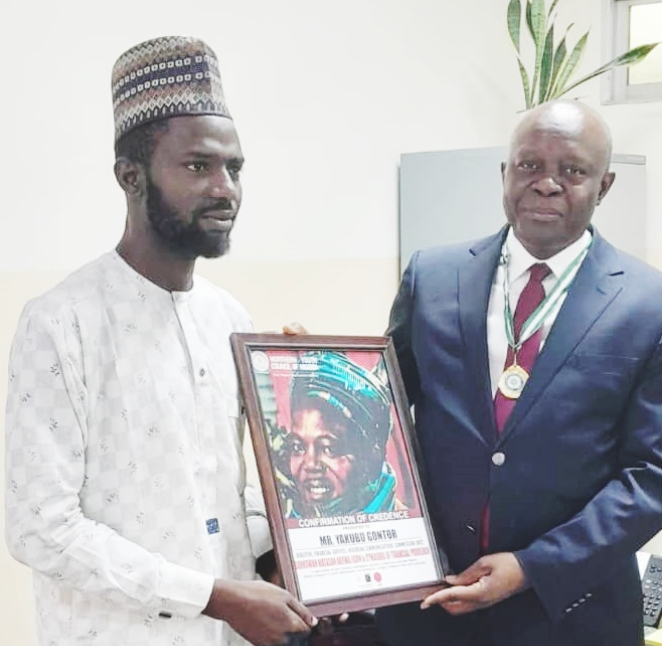
Director of Financial Services at the Nigerian Communications Commission (NCC), Yakubu Gontor, has been honoured the Northern Youth Council of Nigeria (NYCN) for his exemplary professional conduct.


NYCN is the umbrella body of youths across the 19 northern states including the Federal Capital Territory Abuja (FCT) with one of the objectives being the promotion of national integration and enhancement of investment in Northern Nigeria for sustainable development.


A delegation of the organisation led by the National President, Dr. Isa Ododo, presented a plaque for award of Garwuwan Matasan Arewa Nigeria (literally translated as ‘Shield of Nigeria Northern Youth’) during a visit to Gontor in his office at the Commission in Abuja recently.


Ododo said the recognition was based on Gonor’s professionalism and his standing as civil servant of repute that has made himself a role model to the Nigerian youth.


He said the NYCN promotes policy formulation and implementation on issues relating to youth development in Nigeria as well as identifying and recognising exemplary personalities whose conducts in their professional calling are worthy of emulation by the youths.


“The conferment of the title on our honoree was based on his visionary leadership in the industry as well as his selfless service and immense contributions that have enhanced youth development in northern states of Nigeria,” Ododo said.


Ododo also used the opportunity of applaud NCC Management for its efforts in enhancing digital skills in Nigerian youth through projects such as the Digital Nigeria centre (DNC), among other interventionist projects, which Ododo said, have been put in place to encourage youths to harness their digital skills for self-development.

In his acceptance speech, Gontor appreciated youth organisation for promoting the youths of northern extraction, urging NYCN executives to use their connections and network with the governments across the country to carry out more awareness on skills acquisition and functional education and need to be professional in all their dealings.

The recognition by youth council gives credence to the important role being played by Gontor not only as Director in charge of financial matters at NCC but also as a man of integrity managing all financial matters of the Commission, especially with respect to issue of revenue generation and financial prudency required to sustain the independence of the Commission as an impartial telecom industry regulator and arbiter.


Kashifu Inuwa Abdullahi, CCIE, the Director General, National Information Technology Development Agency (NITDA), has been conferred with an Honorary Doctor of Business Administration (Leadership and Management) by California Metropolitan University (CMU) during the Leaders Without Borders Annual Business (LWD) Summit, in London.

LWD Annual Business Summit is a global event that brings together business leaders, entrepreneurs, and thought leaders from around the world. The summit is designed to promote collaboration and innovation in the business world.

The award was presented to Inuwa in recognition of his outstanding leadership and contributions to the development of the Nigerian information technology sector in Nigeria.

Inuwa, a highly respected figure in the Nigerian tech community, has been instrumental in driving the country’s digital transformation agenda. He is also one of the strong advocates of promoting the use of technology in education, healthcare, agriculture, and other sectors in the country.

He has also worked to build partnerships between the Nigerian government and the private sector to accelerate the development of the Nigerian tech industry.
Under his watch, the Agency has developed several regulatory frameworks for IT development, which most of them have been published both on soft copy and hard copy by the Agency.

The Agency embarked on the development of many regulatory frameworks for Information Technology development in government establishment. The projects are to give rise to digital skills in educational institutions and rural areas of the country, to ensure IT knowledge is integrated into the underserved areas and cities so as to develop human capital and provide universal access to digital services with the aim of creating a knowledge-based economy.

In addition to making an effort in IT development as well as enhancing the IT capacity of the citizenry, hundreds of IT Hubs, IT Parks, and Community ICT Centres were established, furnished and equipped with world class facilities across the states of the federation.

The agency, through its strategic relations with techpreneurs, supported start-ups, IT hubs and ecosystems builders through Nigeria ICT Innovation and Entrepreneurship Vision (NIIEV). In the process, NITDA’s programmes have created employment for Nigerians youths.

To ensure Nigeria’s pool of talents were not left behind, the Agency under his thoughtful leadership, established National Centre for Artificial Intelligence and Robotic (NCAIR), to drive and support research, development, and adoption of Emerging Technologies in Nigeria.

The Honour from CMU is a significant recognition of Abdullahi’s contributions to the Nigerian information technology sector. It is a testament to his leadership, vision, and commitment to driving the country’s digital transformation agenda.

In his acceptance speech, Inuwa thanked CMU for the recognition and expressed his commitment to continue to work to promote the growth of the Nigerian tech industry. He said that he was honored to be recognised for his work and that he would continue to work tirelessly to ensure that Nigeria becomes a leading player in the global tech space.

“I extend my gratitude to the university, leaders without borders, and loved ones for their support. I am inspired to drive transformative change and make a positive impact in leadership and management,” he said.


Digital transformation offers enormous benefits, but equally increases the security threats faced. Continuous Threat Exposure Management, first coined by Gartner, is one of the most effective methods to combat these, says Patrick Evans, CEO at SLVA CyberSecurity


The past few years have witnessed a significant increase in digitisation across businesses and industries, driven largely by the changes wrought by the pandemic. Companies today are far more digitally interconnected than they were prior to 2020, as evidenced by the massive increase in remote working, as just one example.


While this has helped businesses gain new efficiencies and increase productivity, it has also opened these organisations up to new avenues of attack, as remote employees open up new potential vectors for cyber-criminals to exploit.


With hundreds of thousands of software vulnerabilities to manage in this digitally transforming world, it is simply impossible to protect a business from them all. In the past, remediation priority was often tied to Common Vulnerability Scoring System (CVSS) scores, which don’t consider what’s most important for your specific organisation, attack feasibility, active threats, and other aspects of security programs.


Now, research firm Forrester also suggests that relying solely on CVSS scores to prioritise remediations, is flawed because it is not only misaligned with the organisation’s strategic objectives, it also puts too much emphasis on potential, not actual, threats and inflates vulnerability severity.


The Forrester remediation prioritisation triad includes three primary elements you should consider when assessing vulnerability risk: threat likelihood, asset importance, and strength and effectiveness of compensating controls. Assessing each element improves the accuracy of assessing vulnerability risks and provides greater assurance that remediations are properly prioritised and not determined solely on CVSS scores.


Gartner recognised the need for a better approach, with the company’s Top 10 Security Projects for 2020-2021 report suggesting a risk-based vulnerability management approach. The best method of implementing such an approach is Continuous Threat Exposure Management (CTEM), as first coined by Gartner to describe a method that involves consistently exposing a company’s technologies – from networks and systems through to assets – to simulated attacks.


By continuously exposing the business assets to such attacks, CTEM is able to help IT managers identify vulnerabilities and weaknesses, enabling them to improve the enterprise’s overall security posture through the identification of security challenges, as well as the ability to act to address these – before the genuine criminals discover these weaknesses.


CTEM is even more critical when one understands that the sheer number of potential attack vectors and exploits means most organisations will likely only be in a position to remediate around 15% of their active vulnerability count.


Therefore, what is needed is a solution that allows security teams to obtain a view of all their current approaches, and help them to identify where the top 15% of these vulnerabilities lie. With this information in hand, businesses can prioritise these specific threats. And of course, when utilising a CTEM approach, this data is updated on a continuous and evolving basis.


Naturally, context is important. After all, while all businesses have vulnerabilities, their individual level of risk also depends on non-technological factors, like their specific industry vertical and even their geographical location. It is the understanding of such factors, within context, that is where the real threat intelligence lies.


With the right CTEM tool, IT managers are able to view a combination of external threat context, asset criticality, internal compensatory control and patch intelligence. Access to this data will enable them to proactively reduce their attack surface before it gets exploited.


A leading CTEM offering should be able to: show severe risks that might affect the organisation’s most critical assets and which require immediate patching; identify moderate threats to critical assets; indicate high risks to non-critical assets; and moderate risks to non-critical assets.


Ultimately, when looking to implement any kind of Vulnerability Prioritisation Technology (VPT) or Risk-Based Vulnerability Management (RBVM) solution, you should evaluate those vendor platforms that take telemetry data from other existing solutions such as vulnerability scanning data from Nessus, Qualys or Rapid 7.


After all, the missing component is the real-world threat intelligence around what active threat actor groups are doing now, or in the near future, and whether they are targeting your industry, or your geographic location, or both.


By offering a lens through which all these telemetry feeds can be correlated with your own patch intelligence – such as what has been patched and what hasn’t – it can provide your business with a risk-based view that bears no relation to the CVSS score, but rather considers the real world in which you operate.


A solution like this should be able to simulate the breach attack and test the efficacy of your compensatory controls.  In addition, this complete vulnerability management lifecycle approach will have the value of reducing your mean time to exposure [MTTE], an effective KPI for pre-emptive cybersecurity management.


In today’s digitally transforming world, ‘invulnerable’ is not a word any organisation can use to describe its security posture. While it used to be true that no single vendor provided it all, this is no longer the case. A good example of a vendor’s platform that delivers on the Forrester remediation prioritisation triad is Hive Pro’s Threat Exposure Management (TEM) solution, the value thereof can be quickly and effectively validated by submitting a dump of your organization’s vulnerability scan data as a proof of concept. You will be surprised at the vulnerability intelligence you receive back – it is eye-opening!


Faced with such a rapidly evolving threat landscape, it’s virtually impossible to address every risk. The best any IT manager can aim for is ‘well prepared’ – and utilising CTEM is currently the most effective means of achieving this status.


By Dr. Serigne Gueye Diop, Senegal’s Minister Advisor to the President

VIDEO
Partnerships are vital building blocks of effective universal healthcare systems


Sub-Saharan Africa has an especially urgent need to strengthen surgical care systems. Surgery has long been a neglected component of health care for people on the African continent, and equitable integration of surgical and anaesthetic care remains the key challenge to strengthening health systems and achieving universal health coverage in Africa. If we get this right, we can greatly reduce the rate of mortality and morbidity from surgically preventable and treatable conditions on the continent.

It is important to note that we have seen some progress over the years. There has been, for example, a 37% decline in mortality rates between 2000 and 2015, however Africa still lags in other health indicators, in particular, a patient’s ability to access doctors and surgical specialists. This is problematic, as one third of the world’s clinical conditions that require emergency care and essential surgical, obstetric, and anaesthetic services (EESOACS), occur in Africa.

In May 2022, H.E. Mr. Macky Sall, President of the Republic of Senegal and the Senegalese Ministry of Health hosted an international symposium on strengthening surgical, obstetric, and anaesthetic care systems by 2030 in Africa in Dakar. The event was held in collaboration with the international NGO Mercy Ships, the World Health Organization Regional Office for Africa, and the African Colleges of Surgeons. President Macky Sall promoted the importance of bringing African countries together to identify shortcomings, discuss healthcare gaps, and identifying how we, as a unified continent, can address them.

At this symposium, a roadmap was defined, to accelerate access to surgical, obstetric, and anaesthetic care across Africa by 2030. It is my desire that this roadmap, and the Dakar Agreement, is adopted throughout the African Union to see access to surgical care and surgical education significantly increased in this period.


Building towards the future together

The short-term surgery needs of the people must be addressed, but we also need to focus on the longer-term needs too by building surgical capacity through training of local people. Infrastructure-development, and securing of financing will also need to happen, if we are to succeed in achieving our goals.

Infrastructure-development, and securing of financing will also need to happen, if we are to succeed in achieving our goals

There is so much we can accomplish together as we build towards a future of safe and affordable surgery for all. Creating meaningful partnerships between different countries, and with service providers, where each nation benefits from shared resources, can go a long way to addressing the immediate needs of the people. This will allow time to implement sustainable solutions that will ensure the integration and scaling up of surgical care in the countries’ national health development strategies.

A good example of successful partnerships is the one between Senegal, The Gambia, and Mercy Ships. This initiative instituted by HE Mr. Macky Sall, in accordance with the President of The Gambia, HE Mr. Adama Barrow, has seen the Global Mercy docked in Dakar for the first half of 2023, where teams have provided much needed surgeries to citizens of both countries, and training to its surgical professionals.


We have work to do

If we are to create an effective universal healthcare system in Africa, we will need to focus on developing stronger partnerships among Africa Nations, and work together to develop implementable and sustainable solutions for surgical, obstetric, and anaesthetic care. We also must ensure that our surgical professionals will receive top-class, ongoing surgical education in Africa, which is based on the latest available scientific research. We also need to continue to partner with subject matter experts, such as the visiting surgical professionals in the Mercy Ships teams, as we work towards accelerating growth, and guaranteeing the quality of existing healthcare systems for our people.

Education of Africa’s people will also play a key role. We need to share knowledge and build trust among our population by sharing information about the individual’s right to access quality surgical care, the surgical solutions that are available for common health challenges, and we need to educate our local community healthcare professionals and carers so they can correctly direct their patients to the medical and surgical hospitals that can assist them in their time of need.

It does take a village to raise a child. In this instance that child is an effective universal healthcare system, in every country in Africa. By identifying and building strong partnerships that can address both the short- and long-term needs of each African nation, we can lay a solid, sustainable foundation on which the universal healthcare system can be built.

Africa Data Centres (www.AfricaDataCentres.com), a business of Cassava Technologies group, is pleased to announce it has formed a strategic partnership with The London Internet Exchange (LINX) (https://www.LINX.net), to explore growth and opportunities in current and new markets across the continent Africa.


Tesh Durvasula, CEO of Africa Data Centres, highlighted their Pan-African Interconnection partnership to explore opportunities continent-wide. The goal is to add value to local network communities, LINX membership and data centre facilities across Africa.


According to recent research (https://apo-opa.info/432m7Kv) by Accenture into the ICT ecosystem, it was revealed that Africa is on the brink of a tech explosion. The consulting firm says certain countries are on a particularly rapid trajectory. For example, by 2050, the share of the economy powered by the internet (the iGDP) in Kenya, Morocco, Senegal and South Africa will be approximately 6%, similar to where the US is today. While others, like Ghana, are set to reach between 4 to 5% iGDP, comparable to Brazils present level.


This new partnership is the recipe for great things to enhance connectivity and digital services in new and emerging markets across Africa

Data centres are the foundation of economic growth on the continent and without them, sustainable and self-sufficient ICT ecosystems cannot be developed. This is why the company announced the largest expansion plans Africa has ever seen in September 2021, that will see Africa Data Centres investing $500M into many new hyperscale data centres across the continent.


“Building new facilities is the one path that Africa can take to address the growing need for storage and networking that are crucial to digitising Africa and bringing digital services to its citizens,” adds Durvasula.


Africa Data Centres is Africa’s largest network of interconnected, carrier- and cloud-neutral data centre facilities and currently services nine facilities in six countries, he explains. As leaders in the market, the organisation is constantly announcing new builds in existing markets, as well as plans for facilities in markets that are currently under-serviced or have no facilities at all.


Similarly, LINX are experts in their field of delivering redundant and resilient interconnection solutions at their global Internet Exchange Points (IXPs). “This new partnership is the recipe for great things to enhance connectivity and digital services in new and emerging markets across Africa,” says Durvasula.


Nurani Nimpuno, Head of Global Engagement at LINX says: “We are excited to be working with Africa Data Centres on this journey into new markets across Africa. The data centre giant has the largest hub of interconnected facilities on the continent, making it the ideal partner to serve the growth and demand predicted in the ICT sector and opening up fantastic opportunities for countries across Africa, and making digital services a reality for hundreds of millions of citizens.”

As discussed during the recent Kaspersky Cyber Security Weekend – META 2023 (www.Kaspersky.co.za), for the first quarter of 2023 (Q1 2023) the share of users attacked1 with spyware in South Africa, Kenya and Nigeria increased steadily. Kaspersky recorded an increase of 18,8% in South Africa, 12,9% in Kenya, and 14,6% in Nigeria from Q4 2022 to Q1 2023. Spyware continues to be a threat to users of different types of devices, including thin clients.


Thin clients are used in corporate networks around the world to set up workspaces at a much lower cost than when using traditional laptop or desktop computers (thick clients). A thin client on a traditional operating system (OS), Linux or Windows-based, could potentially be targeted by different types of attacks, including spyware. A compromised thin client could serve as an entry point to the corporate network, and it could be used to gain access to confidential data, take control over other machines on the network, or run malicious software, etc. According to Kaspersky, there are over 60 vulnerabilities in thin clients that could be used by cybercriminals.


In response to advancing cyberthreats, Kaspersky promotes the Cyber Immune approach. The Kaspersky Secure Remote Workspace solution offers a manageable and functional thin client infrastructure that is built according to the secure-by-design principle and the Cyber Immune approach that makes them more resilient to cyberattacks in comparison to traditional thin clients. Together with Centerm, a global producer of thin clients, Kaspersky produces the KTC (Kaspersky Thin Client) – the world’s first thin client with Cyber Immunity that requires no additional antivirus protection tools. At the core of the solution lies KasperskyOS, a microkernel operating system. KTC excludes the possibility of exploiting a wide range of vulnerabilities common in traditional thin clients. Another component of the solution – the unified management console – solves the problem of managing and monitoring thin client infrastructure.


Kaspersky produces the KTC (Kaspersky Thin Client) – the world’s first thin client with Cyber Immunity that requires no additional antivirus protection tools

Kaspersky Secure Remote Workspace is suitable for many areas where a large number of workstations with similar tasks and a standard set of applications are used: the public sector, educational institutions, manufacturing and production plants, fuel and energy sector, healthcare, financial organisations, retail, and others.


“Thin clients have gained popularity over the last few years, especially after the pandemic, as organisations were seeking cost effective ways of setting up remote workplaces. It is also believed by many that they are secure to use and less vulnerable to malware than traditional machines. However, this belief is nothing more than a myth: thin clients running traditional operating systems are vulnerable, and our internal research shows that they can be hacked with a simple tool in under 10 minutes and be used to spy on users and/or access confidential data,” comments Victor Ivanovsky, KasperskyOS Business Development Lead. “We believe that the future of thin client development should be determined by Cyber Immunity. Attacks on a Cyber Immune system are ineffective – they continue to function even in an aggressive environment and stop potential attackers in their tracks.”