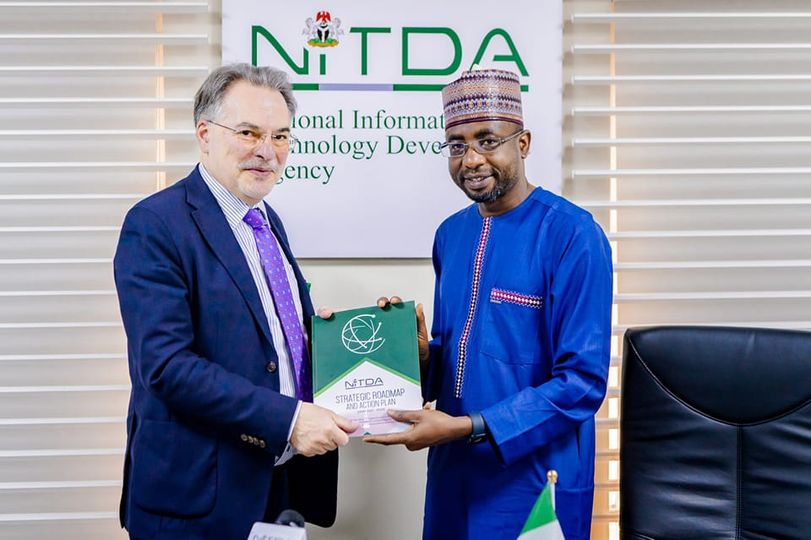
In line with one of the pillars of the National Digital Economy Policy and Strategy (NDEPS), aimed at achieving a safer cyber space, the National Information Technology Development Agency (NITDA), has thrown its weight behind the Avocats Sans Frontiers (ASF) France, on its move towards enhancing the digital rights in Nigeria, a project formally known as the e-RIGHTS, which also enjoys the support of the European Union.

The Director General of NITDA, Kashifu Inuwa, CCIE, while welcoming the delegation led by Ivan Paneff in his office, affirmed that, regulations need to evolve just as technology is evolving in order to establish an enabling environment for the enjoyment of digital rights in Nigeria.

Inuwa expressed the alarming rate of risk and threat humanity is exposed to through the advancement of technology, noting that technology is manipulating and controlling everything; according to him, it has become the human compass.
He said, “Data are being gathered on our lifestyles and choices are being profiled by the search engine we employ on the internet. This in turn is used to project options for our further searches.”

He argued further that big techs are more powerful than sovereign nations which is a threat to democracy.

“When the former President of the United State of America Benjamin Franklin was asked after a convention, what kind of government was agreed on? he said, “call it a republic if you can protect it.”

“What he meant by republic is not the Republican Party ideology, because at that time there wasn’t the Republican Party, but republic from the Greek means of ideology which is against a group of people having unaccountable powers over others”, he added.

He further stated that today, big techs have an unaccountable power over us because of the data they accumulate to influence decisions and actions. He opined that cyberspace cannot remain an ungoverned space, they need to be regulated.

According to the DG, connectivity should be a right, not a luxury, because if you are not connected, you will be forgotten. Therefore, it is the right time to have all the digital rights or the e-Rights, which means the human right in the internet era.

He added that, “NITDA is focusing more on how it can provide regulatory instruments that will help increase accountability. This is why we have the code of practice for interactive platforms,” he said.

Earlier, Ivan Paneff, elaborated on the project stating that the e-RIGHTS project is aimed at promoting the rights of Nigerians in the digital space, harnessing opportunities, and addressing challenges provided by new technologies. With the expectations that the project will respond directly to the needs of Nigeria youths, activists, journalists, online news platforms, bloggers, social media influencers, human right defenders, and active citizens to have access to a free and open internet.
He further noted that digital rights are human rights that are applicable in the Digital Sphere. He agreed with the NITDA boss that government, businesses, and individuals must demonstrate utmost respect for Human Rights offline and online.

“The e-Right will provide a safe online platform for human rights defenders to report and monitor issues of digital right breaches including data privacy breaches, cyber threat, internet shutdown and threat to social media space and to ensure prompt response to cases reported” he added.

Ivan disclosed that the e-RIGHTS project will be implemented in partnership with Spaces for Change and Center for Information Technology Development (CITAD), and the action will take place in four (4) implementation areas including the Federal Capital Territory- Abuja, Lagos, Kano, and Imo States.

Canon Europe announced today that the company’s interchangeable-lens digital cameras (digital SLR and mirrorless cameras) have maintained the number one share of the global market for 20 consecutive years1 from 2003 to 2022.


Canon develops the key imaging system components featured in its EOS series of digital interchangeable-lens cameras – CMOS image sensors, image processors and interchangeable lenses – under the core concept of, “Speed, Comfort and High Image Quality.” Putting together a wide-ranging product lineup – from high-performance flagship models that are highly trusted by professionals to entry-level models that allow users to enjoy high image quality shooting with easy operation, as well as a rich selection of RF and EF series lenses that make possible a wealth of creative expression – Canon continues to support the diverse needs of customers.


During the dawn of digital SLR cameras, Canon introduced its breakthrough EOS 300D (EOS Kiss Digital or EOS Digital Rebel in other regions) in September 2003. This groundbreaking camera, which was competitively priced and featured a compact, lightweight design, became the engine for growth in the digital SLR market, capturing the top share of the global market and heralding the age of digital SLR cameras. Since that time, Canon has continued to launch a range of groundbreaking products, including the professional-model EOS-1D series and the EOS 5D series, which paved the way for digital SLR video recording. Canon’s desire to further expand the boundaries of visual expression led to its next-generation EOS R System, launched in October 2018, that includes the EOS R5 – the first camera to feature 8K video recording2 – released in July 2020 and the EOS R3 in November 2021, which features tracking of fast-moving subjects and continuous shooting performance. In addition, Canon launched the EOS VR System, designed to record video for virtual reality content, in December 2021.


In 2022, Canon announced the EOS R7 (released in June 2022) and EOS R10 (released in July 2022) the first APS-C size models in the EOS R Series, and the EOS R6 Mark II full-frame camera (released in December 2022) that features advanced AF functionality and superb video capabilities, alongside six new RF lenses3. While further expanding its lineup Canon managed to secure the number one share of the global market for the 20th consecutive year.


Canon will continue to refine its proprietary imaging technologies while further strengthening and expanding the EOS series of cameras and lenses, opening new avenues of image and video capture.

Canon will continue to refine its proprietary imaging technologies while further strengthening and expanding the EOS series of cameras and lenses


[1] Based on a Canon survey and shipment figures published by CIPA.

[2] Among digital interchangeable-lens cameras released prior to 8th July 2020.

[3] In 2022, Canon released the following six digital interchangeable lenses: RF 800mm F5.6 L IS USM (May), RF 1200mm F8 L IS USM (May), RF-S 18-45mm F4.5-6.3 IS STM (June), RF-S 18-150mm F3.5-6.3 IS STM (June), RF 24mm F1.8 MACRO IS STM (August), RF 15-30mm F4.5-6.3 IS STM (August).

A global payment processing system is a network that enables financial institutions to process cross-border payments. It allows for currency exchange between banks and other financial institutions across borders. The system is used by businesses and individuals to make international payments, such as for goods and services purchased online.


Currently, this system is going through radical changes that are transforming how individuals and businesses send and receive money. Furthermore, there are several exciting trends emerging that will shape the way businesses and consumers process payments worldwide. From cryptocurrency and contactless transactions to artificial intelligence, these innovations are set to transform the industry as we know it.

What is a payment processor?

A payment processor is a financial institution that provides the technology and infrastructure necessary to facilitate global payment processing. Payment processors work with acquiring banks to provide merchants with the ability to accept credit card and debit card payments from customers around the world. Payment processors typically offer a suite of payment-related services, including merchant account management, payment gateway (https://apo-opa.info/42IetFv) and point-of-sale (POS) services, fraud prevention, and security solutions, and access to financing products. In addition, many payment processors offer value-added services such as loyalty programs, customer data analytics, and marketing assistance.

How big is the global payment industry?

A report by the Business Research Company suggests that the global payments market (https://apo-opa.info/3ZsekTH)  will record a growth of $612.04 billion in 2023 at a compound annual growth rate (CAGR) of 8.9%. Additionally, the report indicates that the global payments market will grow to $847.59 billion in 2027 at a (CAGR) of 8.5%. To begin with, new real-time payment platforms allow consumers and businesses to transfer money quickly, securely, and reliably across different banks and institutions. Again, there is an increased focus on security and data privacy (https://apo-opa.info/431uF4X) regarding payment processing. For instance, financial institutions are implementing more robust authentication processes to protect against fraud, as well as introducing new technologies such as biometrics and blockchain to strengthen security.

Trends reshaping payment processing in Africa

How we make and receive payments (https://apo-opa.info/3JVIxVx) is changing rapidly, and Africa is at the forefront. What’s more, new technologies and trends in global payment processing are reshaping the continent, making it easier for businesses to trade with each other and with the rest of the world. One of the most significant changes is the growth of mobile money. Equally important, more and more people in Africa are using their phones to send and receive payments, thanks to platforms like M-Pesa in Kenya and MTN Mobile Money in Ghana.

Additionally, payment gateways like Tingg (https://apo-opa.info/42IetFv) are reshaping how to send and receive money online in Africa.  This makes it easier for businesses to transact without going through a traditional bank. Another trend that’s reshaping Africa is the rise of blockchain technology. Blockchain allows for secure, fast, and cheap transactions without a middleman. This could potentially revolutionize African economies by making it easier to move money around without losing value through exchange rates or fees. These trends are just some ways that global payment processing is changing Africa. They’re making it easier for businesses to trade with each other and connect with the rest of the world.

Is cash declining?

The decline of cash has been a long time coming. For years, experts have predicted the death of cash as we know it, and while that hasn’t happened yet, the writing is on the wall. Moreover, several factors are driving this shift away from cash.

Perhaps most importantly, technological advances have made alternative payment methods more convenient and secure. At the same time, consumer behaviour is changing, with younger generations, in particular, preferring digital payments. Interestingly, a survey from McKinsey indicates that the domination of cash in Africa will be challenged soon as e-payments become increasingly popular (https://apo-opa.info/3JThrOT). Banks and nonbank organizations are trying to simplify domestic and international payments.

All of this is having a significant impact on the payments industry. Companies that process card payments are seeing rapid growth. Despite the digital revolution, adopting electronic payment methods in Africa is still not widespread. Although cash use is diminishing, it remains the primary means of transaction in African nations. This shift will likely continue in the years ahead as more consumers and businesses move away from cash.

Here are trends shaping global payment processing:

Mobile wallets

As mobile commerce continues to grow, so does the demand for mobile wallets. A mobile wallet is a digital wallet that allows users to make payments and access their funds using a mobile device. In 2023, it is estimated that there will be 1.31 billion proximity mobile payment transaction users (https://apo-opa.info/3ZpPcwV) worldwide, up from 950 million users in 2019.

The most popular type of mobile wallet is the smartphone wallet, which allows users to make payments and access their funds using their smartphone. Other mobile wallets include NFC wallets, which use Near Field Communication technology to enable contactless payments, and cloud-based wallets, which allow users to store their funds in the cloud and access them from any device. With more and more people using mobile devices to pay for goods and services, it is clear that mobile wallets are here to stay. As such, businesses must ensure they can accept payments via mobile wallets (https://apo-opa.info/3JVIxVx) to stay ahead of the competition.

Cryptocurrencies

The report indicates that the global payments market will grow to $847.59 billion in 2027 at a (CAGR) of 8.5%

Cryptocurrencies are digital or virtual tokens that use cryptography to secure their transactions and control the creation of new units. Besides that, Cryptocurrencies are often traded on decentralized exchanges and can also be used to purchase goods and services. Bitcoin remains the largest cryptocurrency by market capitalization, followed by Ethereum, Tether, Binance Coin, and Cardano.

Cryptocurrencies have seen significant growth in recent years, fueled by increased interest from retail and institutional investors. However, cryptocurrencies face scalability issues, regulatory uncertainty, and a lack of mainstream adoption. Nevertheless, the cryptocurrency industry is expected to grow in the coming years.

As digital currencies continue to grow in popularity worldwide, Africa is emerging as a critical market for these new types of payments.

Global payment processing companies are noticing this trend and investing in African countries to tap into this growing market. Blockchain is a distributed ledger system that makes it difficult for anyone to hack or tamper with transactions. Reports indicate that In 2023, more than two dozen nations (https://apo-opa.info/3JXb7po) are expected to take a giant leap with the piloting of CBDCs. Several countries, such as Australia, Thailand, Brazil, India, South Korea, and Russia, already have plans to begin or further their pilot testing.

The growth of e-commerce

The e-commerce industry is expected to overgrow in the coming years. In 2023, the global e-commerce growth rate is expected to grow by 10.4%, bringing global e-commerce sales (https://apo-opa.info/40GSsoK) to $6.3 trillion.

Several factors will drive this growth:

1. The continued expansion of the internet and mobile devices.

2. The rise of social media and mobile commerce

3. The increasing popularity of online shopping.


In addition to this overall growth, there are a number of other trends that are shaping the global payment processing industry. These include the rise of alternative payment methods, the increasing use of mobile apps for payments (https://apo-opa.info/40JQDY8), and the growth of cross-border e-commerce. Alternative payment methods, such as digital wallets, are becoming increasingly popular as consumers seek more convenient and secure ways to pay for online purchases.

Biometric authentication

The need for secure authentication methods grows as the world becomes increasingly digitised. Biometric authentication, which uses physical or behavioural characteristics to verify identity, is one of the most promising technologies.

Several factors are driving the adoption of biometric authentication in the payments industry.

  1. Consumers are becoming more comfortable with using biometrics for authentication. This is due to the widespread use of smartphone fingerprint scanners and facial recognition technology.
  2. Biometric authentication offers higher security than traditional methods like passwords and PINs. It is much harder for criminals to steal someone’s identity or to spoof their credentials.
  3. Biometric authentication is becoming more affordable as the technology continues to mature. This is important for financial institutions that must balance security concerns with cost considerations.
  4. Some major payment processors are beginning to support biometric authentication. Some companies like Mastercard notably unveiled fingerprint and iris scanning (https://apo-opa.info/3zdzyKa) into their global network and have embraced biometric authentication.
  5. Government regulations are starting to catch up with the times. This is likely to spur even greater adoption of biometric authentication in the payments sector in the future.


Global payment processing and regulation

The impact of regulation on payment processing (https://apo-opa.info/3lS4Kvu) is far-reaching. Compliance with regulations such as the Payment Card Industry Data Security Standard (PCI DSS) is costly. In addition to the financial impact, compliance with these regulations imposes significant operational burdens on businesses. These requirements are challenging for small and medium-sized companies in particular.

Despite the challenges, businesses need to stay compliant with payment processing regulations. Non-compliance can lead to severe penalties, including fines, reputational damage, and loss of business.

Conclusion

Global payment processing will be pretty different in the future from what it is today. As technology advances, we will see more secure and efficient payment methods. Additionally, the need for transparency and faster transactions are pushing forward global payment processing trends such as blockchain and fintech. With all these changes coming our way in 2023, businesses should stay competitive (https://apo-opa.info/3KdHdxx) in an ever-changing marketplace.

NEMA has received a total of 151 distressed Nigerians from Benqahi, Libya.


The Returnees were received by the Director General of the Agency, Alhaji Mustapha Habib Ahmed at the Cargo Wing of the Murtala Muhammad International Airport, Ikeja, Lagos.

The statistics of the Returnees after profiling indicates thay 71 adult females including 2 with medical issues, 10 female children and 7 female infants were brought back through the Assisted Voluntary Repatriation by the International Organisation for Migration (IOM).

Also the statistic shows that 54 adult males, 4 male children and 5 male infants were among the repatriated distress Nigerians

Also the statistic shows that 54 adult males, 4 male children and 5 male infants were among the repatriated distress Nigerians.

They arrived the airport aboard Al Buraq Air Boeing 737-800 with registration number 5A-DMG at about 1930 hours.

The Director General was represented by Mrs. Adenike OgunKunle, a Chief Executive Officer, admonished the Returnees to turn a new leaf by taking advantage of the second chance to make a meaningful life upon their safe arrival in the country.

The Director General enjoined youths to thread softly on the urge to rushing out seeking for greener pastures where it no longer exists

The NEMA Chief assured the Returnees of continuous of the Federal Government and other International partners in supporting them in reintegration programme to enable them recover fast.


National Institute of Security Studies (NISS) has engaged the Nigerian Communications Commission (NCC) to advance strategic collaboration that would enhance the application of Information and Communication Technology (ICTs) towards improving national security.


Speaking during a visit to the Executive Vice Chairman of the Commission, Prof. Umar Garba Danbatta at the NCC’s Head Office in Abuja recently, the Institute’s Director, Research Estimates and Library Services, Dr. Adegboyega Karim, said the visit was on a fact-finding mission to enrich ongoing research that focuses on globalization and regional integration for sustainable development in Africa.


Karim led to the Commission a team delegation of Executive Intelligence Management Course Sixteen Participants (EIM16), a study group with representations from various security agencies under the auspices of NISS, typically senior officers in security agencies, including the military, police, intelligence services, and other relevant agencies.


He noted that the Commission has made giant strides advancing the course of digital economy development in Nigeria, and that its regulatory processes provide a good opportunity for the collaboration to enable the group to research further into matters regarding telecommunications and national security.


Director, Special Duties of the Commission, Dr. Ikechukwu Adinde, who received the team on behalf of Danbatta, affirmed the readiness of the Commission to collaborate with the Institute, and, indeed, any private and public institution that is focused on national development.


Reiterating on the advancements made in ICTs, Adinde said it is within this context that the Commission continued to promote the deployment of robust digital infrastructure capable of supporting and improving the security of lives and property.


“As a way of consolidating on the tremendous successes that had been recorded in the telecoms industry through effective regulatory regime emplaced by the Commission, the Federal Government has formulated a number of policies such as the Nigerian National Broadband Plan (NNBP) and the National Digital Economy Policy and Strategy (NDEPS), among others, which serve as a compass for our efforts at building a resilient digital economy that supports security,” he said.


Adinde enlightened the visiting delegation on NCC’s efforts towards ensuring adequate protection for telecoms facilities, across the nooks and crannies of the country where it is treated as Critical National Infrastructure (CNI), the building of Emergency Communications Centres (ECCs) across states and Federal Capital Territory (FCT) as well as series of collaborations with relevant agencies to ensure effective connectivity to individuals and institutions.


The First Lady, Federal Republic of Nigeria, Dr. Aisha Muhammadu Buhari has reiterated that there is ability in disability, the First Lady was speaking while presenting a special bus to Nigeria’s Para Sports teams through the Federal Ministry of Youth and Sports Development, at the National Stadium on Friday 24 March 2023.

Mrs. Buhari, who was represented at the event by her Special Assistant on Health and Developmental Partners, Dr. Victoria Ogala-Akogwu further said that she is proud to associate with the Para-athletes who have won laurels for the country in many international competitions, she said this has confirmed the inclusivity agenda of the President Buhari led administration.

She further called on well-meaning Nigerians to liaise with the Federal Ministry of Youth and Sports development in order to ensure that Nigerian Para Athletes are encouraged through investment in them, this she said would help to boost morale and give them assurances of communal support and encourage them to win more laurels for the country.

Minister of Youth and Sports Development Mr. Sunday Dare, in his address, noted that sports in Nigeria are a veritable tool for national unity, cohesion, peace, progress, and international diplomacy, noting the passion Mrs. Buhari has for Para Sports having sponsored the 2019 World Para Powerlifting championship in Abuja.

He expressed confidence that with the establishment of the new National Sports Festivals and Para Sports department, his Ministry will achieve greater heights in the sector.

Ezekiel Elisha who spoke on behalf of the Para-Athletes and participates in the wheelchair race was also presented with a new Wheelchair.

Present at the ceremony were officials of the office of the First Lady, including SA Special Duties, Rose Audu, SA Media Adebisi Olumide- Ajayi, Executive Secretary, Future Assured, Mallam Saidu Suleiman and Head of Finance, Hajiya Laila Ribadu.

Suleiman Haruna


Federal Ministry of Information and Culture, Nigeria
·
Vice President Yemi Osinbajo lays foundation for the establishment of NASENI Headquarters Solar Cells Production Line in Gora, Nasarawa State.

Exploring innovation coupled with cutting-edge tech is on the up as brands and retailers consider what, when and how to ride the new wave of consumerism in Africa. With the future of digital retail in Africa an exciting and ever-changing landscape.


Africa Overview

Customer expectations are forcing retailers to reassess the service they provide, not just in terms of convenience and pace but also around engagement, service excellence and shopping satisfaction. Africa is playing catch up in a global sense – experiencing incredible change that presents both opportunities and challenges. According to Google Africa, the continent is home to 19 of the top 20 fastest-growing countries in the world, and its internet economy has the potential to grow to $180 billion by 2025. By the same year, more than half of Africa’s population will be under 25, creating an even more pressing need to generate economic opportunity. Done the right way, digital-first and data-led distribution is set to transform Africa.


To that point, (www.ITNewsAfrica.com) reported that, amidst limited infrastructure and a lack of skilled workers in Africa, ecommerce platforms such as Jumia, Konga and Mall of Africa and mobile payment offerings such as M-Pesa and Airtel Money, are already ringing in a new era of shopping for both retailers and consumers.


Drilling Down

Looking closer, small, and medium-sized businesses are under the microscope, making up 90% of all businesses in Africa. However, at a time when digital connectivity is more important than ever to small business resilience, not forgetting the unfolding age demographic, Africa has much to do to keep up with their global counterparts. The potential, however, lies in equipping people and businesses with tech tools to meet local needs and in turn unlock innovation.


Digitalization in Africa is changing quickly at a sales force, manufacturing, and distribution level but not as much at a retailer level

Warren Brett Cluster Executive, SEA Region, Smollan Tanzania shared his thoughts saying, “Digitalization in Africa is changing quickly at a sales force, manufacturing, and distribution level but not as much at a retailer level. On the most part it’s only scratching the surface. Traditionally the retailer must initiate the purchase of FMCG goods from wholesalers and distributors – sometimes having to physically close shop to collect stock and in turn losing out on potential earnings. Putting the power in retailer’s hands is the answer – building retailer databases and creating solutions enabling brands to reach them using technology to support the link between all parties.”


Solutions

Working to solve the digitalization gaps in Africa is an exciting challenge. A good example is the launch of Kyosk – an app that provides a seamless link for traditional retailers (providing them with market data visibility and last mile delivery), local eateries (access to quality products at competitive prices delivered directly to them within 24hours) and small-holder farmers (provide end-to-end digitization of their value chain). Currently operating over 40 fulfillment centres across Kenya, Tanzania, Uganda, and Nigeria.


So too, the Wasoko app works in communities in Kenya, Senegal, Tanzania, Rwanda, Uganda, and Côte d’Ivoire. Allowing shopkeepers ‘delivery on demand’ with free same-day delivery to stores when placing an order via SMS request or using their mobile app. Wasoko also offers ‘buy now pay later’ credit facilities.


Furthermore, different digital platforms are attempting to digitize the entire commerce value chain. Yoco for example, launched in 2013 in South Africa is a go-to platform that is successful in offering access to online payments. According to www.HowWeMadeItInAfrica.com Yoco filled an essential gap as 80% of their merchants had never accepted card payments before joining. Fast forward to 2021, Yoco served 150,000 of SA’s six million small businesses and are currently looking to reach at least a million SMEs across Africa and the Middle East within the next four years.


As a ‘watch this space’ side note of potentially robust proportions is ‘The Africa Digital Economy Initiative for Africa’ (DE4A) – an alliance created with the World Bank Group and the African Union to collectively think big on digital development. The aim is to ensure that every individual, business, and government in Africa will be digitally enabled by 2030 with their support.


“Partnering with NGOs, governments, or financial institutions to create sustainable employment and financial inclusion to entrepreneurs looking to grow their business is certainly an option and a step in the right direction. So too, creating the tech to support the link between retailer and supplier/distributor, a high priority. To create a solution for brands to reach retailers where there is a deeper understanding of how product moves to the retailer and into consumers hands. In turn, supported by a digitalized workforce to support this channel in Africa,” said Brett.

Fez Delivery (https://FezDelivery.co/), a leading logistics and delivery company, announced its $1 million seed round today.


Ventures Platform led the funding round, with participation from Voltron Capital, Acasia Ventures (formerly Cairo Angels), and other angel investors. This funding announcement follows Fez Delivery’s acceptance as one of the only two logistics companies in Nigeria to have received investment from Techstars Toronto, an elite global tech accelerator.


Fez Delivery was founded in 2020 by Seun Alley, as a pivot from her previous company which offered janitorial services to businesses but suffered from absenteeism of the janitors because they were running errands for employees. “We launched a janitorial service company in 2016. The following year, we observed a trend of janitors being absent from their duty posts because they were on errands for employees.”, says Seun Alley. “As a stop-gap, we introduced delivery services to the companies we were working with so that our janitors could focus on their work. It was wildly successful. This experience made us realise that last-mile logistics is a significant problem for SMEs and individuals. We decided to address this problem by creating a platform that allows businesses and individuals to easily track their items online in real-time, without using multiple logistics partners.”


The logistics industry is one of the fastest-growing industries in Nigeria, spurred by the meteoric rise in online shopping which generated an estimated revenue of $5 billion in 2019 with an expected CAGR of 20.5% from then till now. The size of this opportunity has led to the rise of many logistic businesses in the country. Yet, many struggle to differentiate themselves and run a sustainable business.


Fez Delivery distinguishes itself in the market by offering tailored and hybrid solutions that combine physical touchpoints with technology to serve its customers. “Our learnings over the last seven years have revealed that different business priorities exist regarding last-mile delivery”, says Seun Alley. “For FinTech, reach is critical. For Pharma, the estimated delivery time is a big deal, and the pricing must be competitive for SMEs. Therefore, we have built an array of tech-enabled solutions; mobile and web apps (targeted at individuals), dashboards and APIs (for businesses) alongside a wide physical reach that spans all the 36 states in Nigeria, including the FCT ”.

We’re currently focused on the $10 billion transport and logistics market in Nigeria, where we still have room to grow


The three-year-old startup makes money by charging individuals per delivery, and businesses a monthly subscription. In 2022, the logistics startup completed 200,000 trips and grew revenue by 20% month-on-month. Its clientèle includes the likes of Flutterwave, Kuda Bank, Moniepoint, OPay, Famasi Africa, and Red Bull.


Marketing Manager, Redbull Nigeria, Toheeb Azeez, says, “Fez Delivery has been a reliable and affordable delivery service for our company, since their inception. They have a wide reach across all the 774 local governments in Nigeria, which makes it easy for us to get our products to our customers quickly and efficiently. We are also impressed with their customer service, which is always prompt and helpful”.


Speaking on how they will deploy the capital, Seun Alley says that the company will continue its push towards leveraging technology to solve real problems. “With this funding, we are repositioning as a full-fledged tech company focused on last-mile deliveries. While the platform is currently in development, interested parties can sign up to join the waitlist (https://apo-opa.info/42Mqslb)”. The co-founder and CTO, Oluwafemi Jose adds that “our goal has always been to create something truly transformative. We’re excited to use this funding to accelerate our innovation; expand our team, deepen our development efforts and bring more value to our customers and partners.”


General Partner, Ventures Platform Fund, Dotun Olowoporoku says “We are excited to partner with Fez Delivery in their mission to bring efficiency to the logistics industry. This industry is characterised by high fragmentation, demand-supply mismatch, and lack of transparency, due to heavy manual processes. Seun, a second-time founder, is an excellent operator with a solid vision for the future of last-mile delivery. By developing technology to enable other market players to thrive, Fez Delivery is well-aligned with our investment thesis to support market-creating innovation in underserved industries.”


Fez Delivery will continue to deepen its work in Nigeria before considering other African markets. “We’re currently focused on the $10 billion transport and logistics market in Nigeria, where we still have room to grow. We plan to keep growing in Nigeria and expand to other markets starting in the last quarter of this year. Ghana, Kenya, and South Africa are on our list, but we haven’t decided on the order yet”, says Seun Alley.


As organisations across the globe contend with an increasing number of cyberattacks, schools and higher learning institutions are looking for innovative and cost-effective ways to protect their students, staff, and data from breaches and ransomware. “Unfortunately, cybercriminals don’t consider the ramifications of cyberattacks on schools. However, increasing cybersecurity awareness and allocating resources effectively can help the education sector become less attractive targets for cybercrime,” notes Steve Flynn, Sales and Marketing Director at ESET Southern Africa.


From the University of Mpumalanga experiencing an attack on its bank accounts to the University of Johannesburg accidentally leaking a student’s personal information to their email database, and Harvard University having to dismiss all hybrid classes after a ransomware attack compromised its network, breaches and cyberattacks can affect schools and universities irrespective of size or prestige.


A challenging sector to secure

According to Flynn this highlights the need for improved cybersecurity measures in the education sector to protect sensitive data and ensure the safety of students and staff, as well as the integrity of the institution’s digital assets and reputation. However, this is not easily achieved. The education sector faces numerous cybersecurity challenges, including:


  1. Limited budgets: Limited budgets and resources make it difficult to implement robust cybersecurity measures.
  2. Diverse IT infrastructure: Including legacy systems and a wide variety of devices used by students, faculty, and staff, which makes it challenging to secure the network.
  3. Human error: The education sector relies on human interaction which makes it particularly vulnerable to social engineering attacks, such as phishing scams and other forms of cyber manipulation.
  4. Student privacy: Handling a significant amount of student data, including personally identifiable information and academic records makes educational institutions a prime target for cybercriminals seeking to steal this information.
  5. Lack of cybersecurity awareness: Students, faculty, and staff may not be aware of the cybersecurity risks and how to protect against them, making them more susceptible to cyber threats.


The real costs of cybersecurity

While the cost of cybersecurity measures might seem prohibitive to schools and universities operating on tight, often non-existent budgets, it is important to point out that the cost of doing nothing is always regrettably higher. Nicolaas Liebenberg, Operations Manager at Sisonke Solutions – an ESET partner in the education sector, says “Cyberattacks in the education sector can be costly both in financial and reputational terms. The exact cost can vary depending on the type of attack, the severity of the breach, and the size of the institution affected. Some of the potential repercussions include financial costs for the educational institution, including the cost of investigating the attack, restoring systems and data, and potential legal fees. For example, the University of California, San Francisco paid a ransom of US$1.14 million to cybercriminals in 2020 to recover encrypted data.”


Prioritising cybersecurity

Given the potential costs of cyberattacks on the education sector, it is critical for educational institutions to prioritise cybersecurity measures to protect sensitive data and ensure the continuity of operations. Educational institutions can take various measures to enhance cybersecurity, which include encouraging regular password updates and implementing strong password policies that promote complex and unique passwords. Schools and governments can educate staff and students about cybersecurity best practices, implement multi-factor authentication for accessing sensitive data and systems, and regularly update their software and security systems to protect against known vulnerabilities and exploits.


They can also back up their data regularly to prevent data loss in case of a cyberattack or other data loss event. Furthermore, organisations can enhance their security measures by implementing access controls to restrict access to confidential information and critical system only to authorised personnel. “While such steps are essential in protecting schools and universities, using a reputable cybersecurity provider is possibly the most effective step that can be taken to prevent cyberattacks along with standardisation of IT policies, and engaging with cybersecurity awareness training for staff and students,” says Liebenberg.


Cybersecurity is an unavoidable necessity

“Although cybersecurity is often a grudge purchase for organisations, it should be viewed as a necessary investment, and money well spent. With this sector’s growing vulnerability in mind, ESET offers a generous discount to educational institutions, as well as free training guides* for educators and learners on how to be safer online,” explains Flynn. There are several products that have proven instrumental in meeting the cybersecurity needs of the education sector, including:


  • Endpoint Security:  Secure endpoints, such as laptops and mobile devices, from malware, phishing, and other online threats.
  • Secure Authentication: Provides two-step authentication for remote access to networks and applications to secure against unauthorised access and social engineering attacks like phishing.
  • Dynamic Threat Defense: ESET’s cloud-based solution provides proactive protection against zero-day threats and advanced malware.


“Cybersecurity has become a critical concern for educational institutions in this digital age. With the increasing amount of sensitive data stored and processed by institutions, it’s important to take steps to protect students and institutions so that learning can continue without disruption. Ultimately, investing in cybersecurity measures can help educational institutions protect their digital assets and safeguard the privacy of their students and staff,” says Flynn.


In a bid to boost National Food Security and wealth creation, the Federal Ministry of Agriculture and Rural Development in collaboration with F & A Engineering Construction Links Limited has organized a National Stakeholders Consultative meeting to stimulate the interest of stakeholders on the need to embrace Animal Welfare during emergencies and disasters in Nigeria, to prevent losses.


Speaking during the event that took place in Nasarawa State recently, the Director Veterinary and Pests Control Services/ Chief Veterinary Officer of Nigeria (CVON) Dr. Musa Inuwa said that the essence was to provide a platform for effective engagement and interaction among relevant stakeholders on the implementing policies on matters concerning the general care of animals during emergencies and disaster situations.

He added that the meeting would also serve as a medium for awareness creation on good animal welfare practices.

Dr. Inuwa pointed out that the Ministry had stepped up efforts towards introducing global best practices in the Nigeria’s Animal welfare strategy in line with guidelines and standards provided by World Organization for Animal Health (WOAH).

The meeting would also serve as a medium for awareness creation on good animal welfare practices

He, therefore, tasked the stakeholders to share their experiences and in turn serve as credible animal welfare Ambassadors within the spheres of their activities.

Earlier, the Head of Quality Assurance and Standards Division (QAS) of the Department of Veterinary & Pest Control Services, Dr. Abdulkareem Durosinlorun said that the department identified the need to develop a response strategy for animals during emergencies and disasters.

In her remarks, the National President of the Nigerian Veterinary Association, Dr. Oluwatoyin Adetuberu revealed that meeting was of great importance, noting that when there are disasters, only humans are rescued without taking cognizance of the animals.

She pointed out that the meeting was about rescuing and rehabilitating animals during disasters and emergencies, setting ways to include the animals into the National Emergency Management Agency and having Veterinaries that are trained on ‘rescue’.

The National President called on the Federal Government to set up committees that would involve Veterinarians and Animal Health components in the rescue and emergencies.

Highlight of the event was the interactive session by participants. In attendance were the representatives of the Para-Military, Standard Organisation of Nigeria, SON, Members of the Academia, States Ministry of Agriculture, Veterinary Council of Nigeria among others.