

As a consumer application, the web browser has long created security challenges for enterprises. The Enterprise Browser is set to change that, says Patrick Evans, CEO of SLVA Cybersecurity.


It is ironic to note that the browser has become the most commonly used application in the enterprise, considering that the consumer browser was never designed as an enterprise application. After all, it lacks the core elements any enterprise needs to work safely and productively, forcing enterprises to surround it with layers of additional security and management tools.


With basic governance, visibility and security all lacking, it turns out that the browser itself is perhaps the single biggest security challenge for businesses. The answer to this problem lies in turning the browser into the solution – and is what has led to the creation of the enterprise browser.


Having been in the industry since 1992, back at the advent of client server computing, and with experience at companies like Foster-Melliar and Symantec, I thought I was beyond being surprised in the ICT space. However, that is exactly what happened when I attended a recent conference that described the benefits of the enterprise browser, and the impact it is expected to have in the next decade. I believe this is one of the most exciting ICT developments in a number of years.


According to Gartner, an enterprise browser is defined as a stand-alone web access application with integrated security, centralised policy management, visibility, reporting, productivity and collaboration tools. Essentially, the enterprise browser ensures that security extends everywhere it’s needed, without getting in the way of work.


This is vital, as the consumer browser is the most commonly deployed application on the planet, with around five billion consumers using it today. Therefore, companies have been forced to protect everything around it, surrounding it with an endless security stack, DNS filtering, endpoint security, proxies, sandboxes, secure web gateways and more. This creates an additional issue, in that many of these tools come with agents, meaning you now need countless agents on your endpoint. And all of them require careful configuration and administration, adding to the burden of enterprise ICT teams.


On the other hand, with the enterprise browser, you have access not only to all the typical consumer browser features, but also the additional enterprise requirements that gives you the control you need to work securely.


Massive uptake anticipated

It’s worth noting that Gartner further suggests that by 2025, enterprise browsers or extensions will be featured in 25% of web security competitive situations, up from less than 5% today. By 2026, 25% of enterprises will be using managed browsers or extensions, up from less than 10% today.


By 2027, the enterprise browser will be a central component of most enterprise super-app strategies as productivity capabilities drive adoption. And by 2030, enterprise browsers will be the core platform for delivering workforce productivity and security software on managed and unmanaged devices, for a seamless hybrid work experience.


It is important to recognise that today, so much is being done through the browser that it could be considered the new endpoint. If you think about it, everything from Gmail to Salesforce, and from SAP to Workforce, is a browser-based tool, as are all the new financial apps.


In addition, employees who use standard consumer browsers also all use consumer products – whether it be their phones, laptops or desktop devices – add to the overall challenge of maintaining a strong security posture. In fact, something like 75% of attacks today occur via the browser.


The result of this is that organisations have had to deploy a myriad of controls to secure the environment, because the browser is the single most common point of entry into the business environment today.


Solving the security challenge

So how does the enterprise browser solve such challenges? To begin with, users need to authenticate themselves to the organisation’s identity platform (IDP). Through the IDP, the company is able to establish not only that you are who you say you are, but also what your specific role is. In understanding the individual’s role, the system is then able to determine which applications the user has access to, and which policies to apply.


It is a system that is just as effective for non-employees, such as contractors who enter the environment, but adopt the bring-your-own-device (BYOD) principle. In such instances, you have no control over that device. However, by controlling access to applications and resources through an enterprise browser, the business can ensure that their data is protected and contractors have only the access required for their job.


Of course, the one essential requirement for success is that the user experience must be good, and by my understanding, there are enterprise browsers that can be deployed in as little as 18 seconds.


It’s also worth noting that – while the enterprise browser appears to be ‘the next big thing’ – the next three years are likely to be critical for adoption. And that adoption is going to come down to key use cases.


For example, the enterprise browser should eliminate the unnecessary complexity and expense of VPN and VDI solutions and allows for the fastest deployment possible. This not only ensures that contractors can begin work in minutes, rather than days or weeks, but also solves the challenges associated with traditional BYOD solutions, by providing additional value in terms of security and privacy.


Another key use case will be configuring the enterprise browser as the only access point for software as a service (SaaS) and in-house web apps, also without any of the costs or complexity of a virtualised desktop.


The future

Looking ahead, I believe it will be beneficial in a number of other ways too, such as in a scenario where there is a lot of sensitive data flying around, such as in the case of a merger or acquisition. It will also assist in instances where a business utilises robotic process automation, or any kind of generative AI workflows.


With multiple capabilities that can be switched on and off according to your needs, the enterprise browser has been created to provide full last-mile control to businesses, allowing you to easily adopt a zero-trust approach to security.


I like to talk about the art of the possible, and the enterprise browser has opened a whole new range of possibilities for organisations to deliver high-quality, end-to-end security. In my mind, there is no doubt this should be on the radar of every forward-thinking enterprise, because the enterprise browser is the future of IT.



Minister of State for Health and Social Welfare, Dr. Tunji Alausa has said that the Federal Government is willing to support the Lagos State Government to ensure more affordable and accessible healthcare service delivery to its residents.

Dr. Alausa made this assertion when he paid a courtesy visit to the Lagos State Governor, Babajide Sanwo-Olu, at the Lagos House, Marina, to intimate him of his visit to health institutions in the State and also see how the Federal Government can further assist sub-national government like Lagos State in improving its healthcare delivery system. He said “what we have is not working the way it should. Our indictors are quiet appalling, but we have a mandate given to us by President Bola Tinubu to reshape, revitalize and get Nigerian healthcare system to where it should be, were citizens can have comprehensive healthcare”
.
“Lagos State has done reasonable well and that’s one of the reasons why I am here to see how we can assist you to do better, because if we are able to get it right in Lagos, we can begin to replicate this across other States in the Country. I urged the Lagos Government to further assist its resident’s key into the State Health Insurance Policies“.

The Lagos State Governor, Babajide Sanwo-Olu who congratulated the Minister on his well- deserved appointment said with the pedigree and background of the Minister, he is confident and believes that working with his colleague, Prof. Pate, they would do well, to raise the health level in Lagos and Nigeria.

Sanwo-Olu assured the Minister of the willingness and readiness of Lagos State to collaborate and foster in areas of expertise to help compliment what is being done in Lagos so that at the end of the day, the people can feel the essence and benefits of all the interventions by the Federal Government.


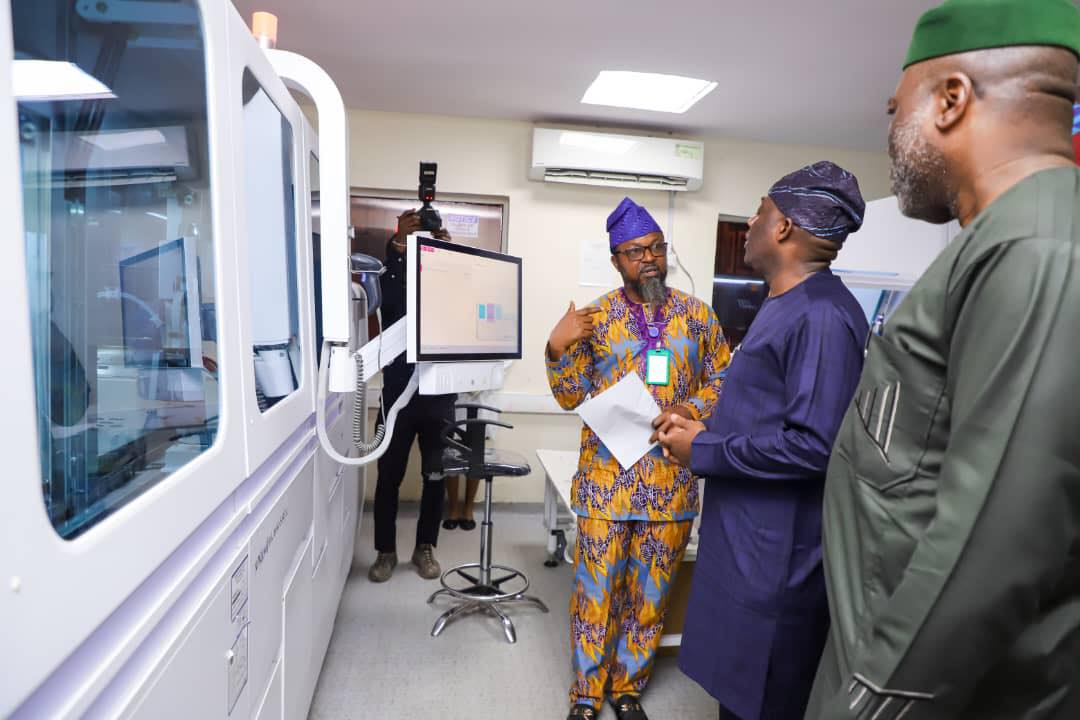
The Hon. Minister of State for Health and Social Welfare, Dr. Tunji Alausa recently paid oversight visits to some Federal Government Health Institutions in Lagos to assess the state of their facilities, see what they are doing well, know their challenges and how better these institutions can be supported to ensure better healthcare outcomes for the citizenry.

Dr. Alausa whose first port of call was to the Nigeria Institute of Medical Research (NIMR), was impressed with some of the state of the art equipment’s he saw at the institute and stated that research and innovation is one of the key priority area that this administration will be focusing on, owing to the fact that Mr. President is determined to fix the health care system.

He charged the Director General NIRM, Prof. Babatunde Salako and his team on the need to function effectively and diligently to strengthen research in the country. “To strengthen our healthcare system, we have to strengthen research, if we strengthen research we will innovate, any country that does not innovate remains undeveloped”.

The Minister said the issue of inadequate funding would be addressed to further enhance the capacity of the institute, he promised to ensure that the institute receives substantial budget to tackle critical areas. He went further to advise that NIMR source for funds from international research agencies and grant agencies to improve on research, noting that he is determined to resuscitate research infrastructure in Nigeria.

Addressing the Management of the Federal Neuro-psychiatric Hospital (FNPH) Yaba, led by the Medical Director, Dr. Olugbenga Owoeye, Dr. Alausa decried the increasing rate of the menace of substance abuse and reiterated government’s commitment in tackling drug abuse and strengthening mental health services.

“Substance abuse is a huge problem in Nigeria, we need to focus more attention on substance abuse issues, awareness, prevention, treatment and rehabilitation, and I am glad FNPH Yaba is taking a leading role here”.

He promised to look into some of the challenges highlighted by the helmsmen, especially the issue of human resource for health, which the Minister said is a global crisis. He assured of governments intervention in the enrolment of health workers especially doctors and nurses and beckoned on Nigerians to be patient because this government is committed to fixing the health system in the shortest period.

“I have meet with the Registrar of the Medical and Dental Council of Nigeria (MDCN) and in the next academic year we will double the enrolment rate of doctors and dentist from 5,000 to 10,000. I also had a meeting with the Registrar of the Nursing and Midwifery Council, they have done some good things in the past 2 to 3 years, it started with about 6,000 nurses graduating annually, and then it got to a point that we were graduating about 23,000 but that’s still small for the kind of population that we have. I have mandated him to put a plan together in the next 12 to 24 months to increase our production from about 50,000 to 80,000 nurses annually”.

On the issue of energy and high cost of power supply at the institutions, Dr. Alausa promised to look into it by involving the Office of the Senior Special Assistant to the President on SDGs who promised to support with alternative energy.

The Minister went further to say that, he would ensure that all pending waivers are approved and expedited at the Office of the Head of Service as well as meet with the Ministry of Budget and Economy Planning to make certain that the issue of overhead releases, gets better.
Patricia Deworitshe​


In line with the present administration’s policy on public health for Nigerians especially the youth, the Honourable Minister of Youth Development, Dr. Jamila Bio Ibrahim has called for the need to build a strong partnership with private organisations to discourage tobacco use by the youth.

The Minister made this call in her office while granting audience to a delegation led by the Regional Programme Director of the Campaign for Tobacco-Free Kids, ( CTFK), Bintou Camara Bityeki that paid her a courtesy visit.

Dr. Ibrahim said research has shown that tobacco kills about 8 million people annually, and most of them are not active smokers but passive ones. She stressed the need to take all necessary steps that will discourage the use of it.

The Minister added that the Ministry will focus on adolescent health as part of its functions, knowing that some of them already fall within the age bracket of the youth while others are going to grow to become part of it

Dr. Ibrahim promised to engage with the NYSC to see that the menace of public smoking in its camps across the nation is put to a stop.

Speaking earlier, the leader of the team, Bintou Camara Bityeki argued that tobacco is the gateway to other drugs that generate negative consequences such as mental health problems and early deaths among the youth.
She said that her organisation in partnership with World Health Organisation (WHO), is working towards enacting a strong tobacco control law.

She however noted that enacting the law is not the most important thing but ensuring its implementation and enforcement, especially among the young people who are targeted by the tobacco companies.

Speaking further on the activities of CTFK, one of the members of the delegation Mr. Michael Olaniyan noted that though there are existing laws such as the prohibition of smoking in public and work places, his prganisation is more focused on the ban on tobacco advertising, promotion and sponsorship especially in the entertainment industry.
He said, “We see alot of tobacco use in movies and musical videos that target the young people, encouraging them to take up this deadly habit, that is why we are doing a lot of work with the youth to discourage it.”

Another member of the delegation, Maryam Ahmed expressed concern over the flagrant smoking of tobacco in NYSC camps across the country in violation of existing laws and called on the Minister to take action against it.
Maryam Umar Yusuf


Picture 1: L- R: Dr. Jamila Bio Ibrahim; Hon. Minister of Youth Development; Bintou Camara Bityeki, Regional Director, Tobaco Control Program and Maryam Ahmed of GATEFIELD during the courtesy call on the Minister in her office today, 27th October.2023.


…Calls for Unity and Patriotism.

As a show of gratitude to Almighty God and President Bola Ahmed Tinubu for her appointment as the Honourable Minister of Youth Development, Dr. Jamila Bio Ibrahim has distributed 2000 packs of food items as parliatives to the less privileged in Abuja.

The occasion which took place serially at the National Ecumenical Centre and the National Mosque Yesterday, 28th October, 2023. was marked with prayer and lecture sessions with the theme: Unity and Patriotism.

Speaking at the occasion the Honourable Minister explained that she decided to share palliatives instead of organising parties because she believes that her appointment is a call to serve and there are a lot of less privileged people who are living below the poverty line due to the economic situation in the country.

She said, ” I reflected deeply and realised that it is not really time for me to celebrate because of the situation of the country, and because my appointment is a trust bestowed on me, sometimes I consider it a burden but I am delighted to serve as I represent 75% of Nigerias population many of whom are living under the poverty line”.

The Minister disclosed that she intends to donate a total of five thousand packs of food items to be distributed to beneficiaries in Abuja and her home State, Kwara.

Dr. Ibrahim urged Nigerians to continue to pray for the administration of President Bola Tinubu to be able to steer the affairs of the nation in the right direction so as to move the nation to greater heights.

She handed over one thousand packs of food items to the representative of the Christian Association of Nigeria (CAN), Apostle Samson Fatokun, to be distributed to the needy among the clergy, women and youth members of the church .
In response, Apostle Fatokun who is also the General Secretary of CAN, appreciated the Honourable Minister for her kind gesture and promised that the palliatives will be given to the people they are meant for.

At the National Mosque Abuja, the Minister reiterated the reason for her decision to reach out to the needy instead of a jamboree adding that as a Muslim, she knows that her creator will question her on the way she handles her appointment as a Minister.

She called on Nigerians to put aside their differences and come together to build a greater and stronger nation.
One thousand packs of food items were also donated to the Mosque for unward distribution to the needy.
Imam Adeyemi and Hajiya Maryam Lemu who spoke on leadership, called on the nation’s leaders to lead with the fear of God and asked Nigerians to pray for their guidance and success.


Employee monitoring, also called bossware or tattleware, is more popular than ever. Bossware is used to describe various tracking tools to monitor employee activity. It’s mostly used to track productivity and mitigate risk by monitoring email content, browser history, location, app usage and phone use through software, webcams, CCTV, GPS, fitness devices, and access control hardware.


Increased remote working driven by the pandemic has seen around 60% of companies with remote workers implement some form of bossware. Over half (53%) of those companies have found that workers are spending three or more hours per day on non-work activities.


Additional studies conducted support these findings. One study reported that up to 40% of employee internet usage was not work-related, while global analytics firm Gallup estimates that disengaged employees cost the world a jaw-dropping $8.8 trillion in lost productivity annually.


Bossware can help employers spot productivity issues and is often also used to monitor security. Between 88-95% of data breaches are caused by employee errors such as recycling passwords, clicking on links in phishing emails, or failing to update security patches. Humans are indeed the biggest threat in the cybersecurity space and bossware can shine a light on areas where security training and awareness may be lacking.


While bossware could be one way to boost productivity and examine security issues, it requires some forethought, says  Carey van Vlaanderen, CEO of ESET Southern Africa. “If implemented properly, bossware can help to protect your company against security and legal risks. But it should never be considered a replacement for robust security software and practices. Employers should nonetheless still respect the privacy of employees and be wary of potential privacy concerns that could demotivate employees and damage your relationship with them.”


What you need to consider when it comes to bossware


There are several benefits to bossware, including:

  • Discovering workplace practices that hinder productivity,
  • Identifying tasks that could be automated,
  • Building a fairer workplace by ensuring equal duties,
  • Mitigating security risks, and
  • Monitoring employee stress levels.


But there are also some potential cons, such as:

  • Limited insight into time spent problem solving and on non-digital tasks,
  • Increased performance pressure on employees,
  • Privacy and legal concerns,
  • Low employee morale due to feeling untrusted or undervalued.


Legal and ethical implications

In South Africa, employee monitoring is mostly legal as long as the employer complies with certain aspects of the law. The two applicable laws are the Protection of Personal Information Act (POPIA), which requires that an employee must be informed if they are being monitored, and the Regulation of Interception of Communications and Provision of Communication-related Information Act (RICA), whereby a business may only intercept communications as it relates to the business and during the carrying on of business.


So, employers may not access or seek access to employees’ private email or social media accounts, for example, or monitor them after hours. Typically, employers also stipulate any monitoring terms in the employment contract so that it is agreed upon by both parties in writing before any work commences.


Just because something is legal, however, doesn’t mean it’s always ethical. Van Vlaanderen says employers should take care to ensure monitoring is proportionate and doesn’t unnecessarily intrude in the lives of employees. “Take time to outline a framework that stipulates the extent of the monitoring and the reasons for tracking those activities. Make sure employees are aware of any monitoring and how it may be used, and encourage them not to conduct personal affairs on work devices.”


Good policies, she says, will strike a balance between business demands and privacy concerns. “Most importantly, transparency and dialogue will be key in maintaining trust between employers and employees, as is ensuring that any collected data is safe and only available to authorised users. Remember that monitoring on its own is also not enough – whether your concerns are security or productivity. Regular training, clear guidelines, and a robust software framework should always be the priority.”


Three companies, out of 81 companies that contested at the Nigerian Communication Commission’s inspired technology innovation talent hunt competition, shared the N30 million prize money equally.


Nine other shortlisted companies went home with N500,000 consolation prizes each.


Solaris GreenTech Hub, Knownow Africa Limited and Specxs Care Limited, came bright at the 2023 NCC’s Annual Hackathon Competition, adjudged by an independent Panel of Judges chaired by the President of Digital Bridge Institute (DBI), Prof. Mohammed Ajiya.


Solaris, whose team comprises Chiemela Anosike, Ineke Chinecherem and Onoh Chiemela, won in the Renewable Energy Solution category of the hackathon with their green energy solution that provides clean energy hubs for people in rural communities to be able to charge their phones and other mobile/electronic devices.


Knownow, with a team consisting of Abdulazeez Abiola, Dr. Mudasiru Taiwo and Dr. Oluwaseun Ojerinde emerged winner in the Blockchain Solution category for their fraud-detection and prevention solution.


Specxs Care Limited, also a winner, with team members comprising Isah Dahiru, Ameenat Bala and Musa Gambo, lifted the trophy also with their wearable devices called ‘Smart Bladder’, which can help manage urinary incontinence in elderly people and reduce the cost of their daily spending while ensuring proper personal hygiene.


Prof. Ajiya said the panel was painstaking in assessing all the submissions/entries, diligent in shortlisting the 12 participants and meticulous in determining the three winners through strict compliance with the requirements stated by the Commission for the exercise.


Earlier in his keynote address at the event, the Executive Vice Chairman and Chief Executive Officer of NCC, Dr. Aminu Maida, who was represented by the Director, Research and Development, Ismail Adedigba, said the event aligns perfectly with one of the core objectives embedded within the new Strategic Vision Plan (SVP) of the Commission for the years 2023-2025, which speaks to fostering the development of cutting-edge technologies through rigorous research to catalyse sustainable economic growth and overall development within Nigeria.


He noted that this year’s event focuses on three pivotal thematic areas that not only pertain to Nigeria but also resonate with global concerns. The themes, he said, are:  Blockchain-enabled Data Protection Solutions for Enhancing Regulatory Compliance; Assistive Technology Solutions for the Elderly and People with Disabilities; and Technology Solutions for Renewable Energy in Rural Areas


Adedigba said Talent Hunt Research through Hackathon is just the inception of the Commission’s unwavering commitment to nurturing innovation and nascent ideas, the way it has been doing for previous winning innovative solutions and ideas that had emerged through the annual hackathon.


“The culmination of this competition is not confined to the grand prize of N10 million awarded to each winner from these three thematic areas for the development of their solutions, but goes beyond this, as the Commission takes a holistic approach to support these promising innovations. We closely monitor the progress of these solutions as they evolve into full-fledged prototypes,” he said.


He added that in a world where innovation is paramount, NCC often witness the remarkable potential of Hackathons to showcase fresh perspectives on existing challenges, adding that the NCC’s annual hackathon serve as instrumental tools in sustaining innovation and mobilising the collective intelligence of the innovators to tackle pressing real-world issues, both in the business realm and within our social fabric.


“The ship Icon of the Seas, which is said to be the world’s biggest ship, will join the fleet of Royal Caribbean International in January 2024. The Icon of the Seas is a massive vessel, measuring 1,200 feet (365 meters) in length and weighing 250,800 tons.

Capacity: 5610 passengers and 2350 crew members.
This means that it is five times larger and heavier than the Titanic, weighing 250,800 tons, while the Titanic weighed 50,210 tons.

The ship has 19 floors with more than 40 bars, restaurants, and bowling alleys; it has 6 slides, 7 swimming pools, and 9 hot tubs.

Here in Africa, we are also not idle. In the same January, we shall be releasing our new year prophecies of financial and economic breakthroughs. Death will not be our portion.

Our “native doctors” will also have their own surprising packages for their clients. As the ship will be hitting the waters in January, bottles of Fanta from our ezenwanyis will be hitting our rivers.

As we are busy waiting for spirits to miraculously solve our problems for us, others are busy in various laboratories and workshops looking for the solutions of their own wahalas and seeking ways of making their lives easier and better.

When the story of the present crop of Africans is written, it will be captioned: THE STORY OF WASTED BRAINS, TALENTS, AND RESOURCES.

When you see this ship, what readily comes to mind is the results of teamwork. Without people switching on their brains and being guided by the spirit of teamwork, they will only be digging their own graves.

Angelo Chidi Unegbu

In today’s highly evolving and competitive world, the need to be smart and find the right vibe becomes imperative for anyone to survive. Ability to key into opportunities and rock solid network becomes imminent for everyone including Christians and going to churches in Sundays should only be about worshipping of God but create life changing networking experience.

Certainly, the role of a church in an individual’s life extends far beyond the act of worship, raising the question of whether your church can contribute to your personal and professional growth. Worshiping God is not confined to the physical church building, for God’s presence is believed to be omnipresent. In fact, according to religious doctrine, God has transcended the physical temple, like that of Jerusalem, and now resides within each of us, with his commandments etched into our souls.

In many cases, people attend church not only for spiritual devotion but also for the valuable opportunities it offers in terms of socialization and networking. Consider, for instance, the Catholic church near Falomo, in proximity to the Dangote Headquarters. Here, you may find a congregation that includes board members, managing directors, CEOs, and other influential figures. By consistently attending such a church for a couple of years, you may witness significant changes in your life, both personally and professionally.

What’s particularly appealing about certain churches, like the Catholic and Anglican denominations, is the quality of the congregation they attract. These churches often have a significant presence of individuals with substantial financial resources, which can provide you with valuable connections. Worshipping in such environments can lead to recognition and acknowledgment within influential circles. As an example, the CEO of Air Peace began his journey in my parish, St. Ferdinand. Even after moving on, he maintains a connection with the parish, and individuals within the congregation have secured job opportunities through their parish affiliations.

Therefore, it’s worth pondering what your church can offer you beyond the regular requests for offerings, tithes, and seeds. Can it provide you with the capacity to grow, facilitate meaningful connections, and support your business networking and development? If your church isn’t fulfilling these aspects, it might be time to explore other congregations that can better align with your goals, as doing so can foster personal and professional growth while complementing your faith with tangible actions.


Anthony Emeka Nwosu


Otitonijesu David, a rising talent in the music industry, has officially taken on a new role as the Music Licensing and Publishing Associate at Mavin Records. This announcement marks a significant milestone in her career as she joins the ranks of one of Africa’s foremost entertainment companies.

Mavin Records has garnered acclaim for its exceptional roster of talented artists, including notable names like Rema, who recently clinched the Best Afrobeats Award at the 2023 MTV Video Music Awards (VMA), and Ayra Starr, who secured the Best Female Artist award at the Headies Awards 2023. The label is also home to other outstanding artists such as Crayon, Johnny Drille, Ladipoe, Magixx, Boy Spyce, Bayanni, and Lifesize Teddy.

Otitonijesu David expressed her enthusiasm about her new position, stating, “I am happy to share that I am starting a new position as Music Licensing and Publishing Associate at Mavin Records!”

With her dedication and passion for the music industry, Otitonijesu David is poised to contribute to Mavin Records’ continued success and further bolster its status as a hub for exceptional musical talent in Africa.

About Otitonijesu David:
Otitonijesu David is a rising talent in the music industry, known for her passion and commitment to the field of music licensing and publishing. Her recent appointment as the Music Licensing and Publishing Associate at Mavin Records marks a significant milestone in her career, and she looks forward to contributing to the success of this prominent African entertainment company.

About Mavin Records:
Mavin Records is a leading entertainment company based in Africa, known for its exceptional roster of talented artists. With a history of producing chart-topping hits and award-winning musicians, Mavin Records has solidified its reputation as a hub for extraordinary musical talent. The label is home to artists such as Rema, Ayra Starr, Crayon, Johnny Drille, Ladipoe, Magixx, Boy Spyce, Bayanni, and Lifesize Teddy.