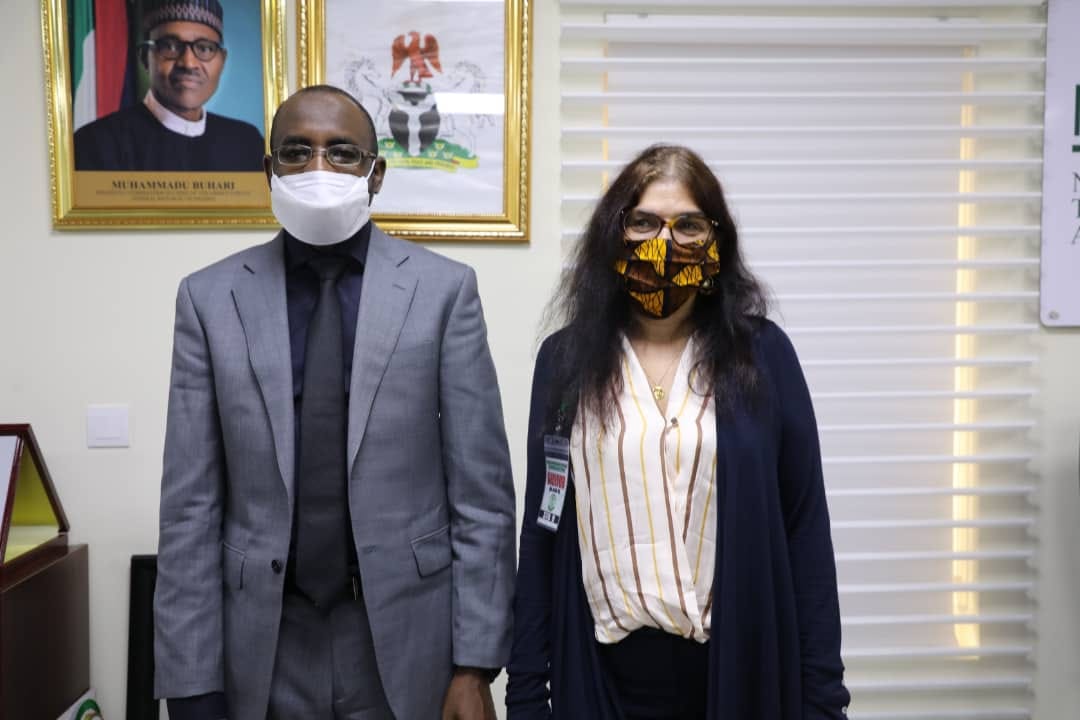
The Director General of the National information Technology Development Agency (NITDA) Mallam Kashifu Inuwa Abdullahi (CCIE) is convinced that partnership and collaboration are key ingredients needed in strengthening the IT ecosystem.
Mallam Abdullahi stated this when he received the Science and Higher Education Attaché to the French Embassy in Nigeria. Professor Leila Mathieu and Dr Ismail Ibrahim of University of Lagos on courtesy visit to his office yesterday.
The visit was to discuss mechanisms to facilitate partnership between the French government and NITDA in areas of Technical education that will enhance technological entrepreneurship taking one advantage of opportunities of information Technology (IT) especially for start-ups.
The Director General noted that with Covid-19 pandemic, the face of business, employment, social life and life opportunities has changed completely and survival of any Nation and her people rest in information technology. To this end, NITDA has no option other than to deepen opportunities in IT related deployment, thus assisting the government meets the yarning of the people.
The NITDA boss further noted that the idea of IT Hubs and Innovation Parks which are being pursued vigorously by NITDA is to provide platforms for key stakeholders to meet, brainstorm and exchange ideas.
Malam Abdullahi also noted that the IT hubs being established across the country is to enhance the start-ups thereby creating massive employment. A critical requirement to enhance this lies in providing mentorship for the start-ups. This he opined is of critical concern to NITDA.
The DG also expressed concern on a critical challenge in the IT ecosystem as the inability of Universities and their products to readily fit into the industry. This challenge which arose because of the nature of the university curriculum and the need of the IT world which are not in sync.
To this end, universities need to be close to the ever changing and dynamic IT industry, adding that, “it is better to establish graduates that are employers not employees.”
The visiting Diplomat intimated the DG that in recent years the French government had begun an IT driven programme named ‘’FAB-LABs’’ to provide access to start-ups entrepreneurs by providing a platform for like-minds to discuss and interact on new ideas and new businesses especially in IT.
The FAB-LAB is an IT hub with requisite IT infrastructures. FAB-LAB has so far been established in five institutions of higher learning in Nigeria. ( University of Lagos, Bayero University Kano. University of Jos, Ahmadu Bello University and University of Ibadan).
The Attaché noted that the French government deeply appreciates the giant strides of NITDA especially in Digital library, Data protection and thus is desirous of achieving close collaboration with the Agency so as to ensure that the FAB-LAB project is sustained and is sustainable while exploring new areas of relationship.
In his response, the Director General of NITDA noted that the visit by the French Diplomat could not have come at a better time than now and the request to NITDA is quite timely.
He particularly noted that NITDA in the fulfilment of its mandate has been engaged in building of IT hubs and Information Innovation parks around the country and on its own had began to implement FAB-LAB since the beginning of 2020. NITDA had built IT hub in Abuja and the Fabrication Lab is going to be used in partnership with MIT- REAP,” he said.
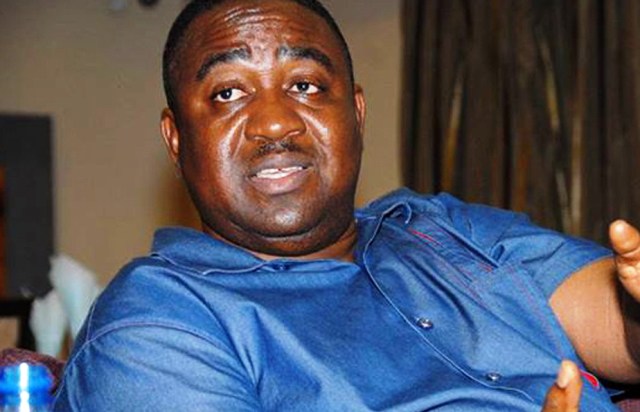
The trial of former governor of Benue State, Gabriel Suswam before Justice Ahmed Ramat Mohammed of the Federal High Court, Abuja was on Wednesday, September 30, 2020 adjourned till October 15, 2020.
Suswam and his then Commissioner of Finance Okolobia Okpanachi are being prosecuted by the Economic and Financial Crimes Commission, EFCC on a nine-count money laundering charge to the tune of N3.1 billion, allegedly being proceeds of sale of shares of Benue State Investment Company.
At today’s sitting, prosecution counsel, Rotimi Jacobs SAN asked for adjournment, having stated that he may not be able to go on with the proceedings because all his exhibits have suffered defacement as a result of being tendered from one court to another.
“All the exhibits have been retendered, changed to another exhibit in another court. They have been given a different identity. Some documents changed, were added and some excluded and so we need to meet to reconcile exhibits that were before my lord, before we can decide on the way forward.”
Jacobs also told the court that he intended to amend some aspects of the charge.Suswam’s counsel, J P Daudu SAN before conceding to the prosecution for adjournment, argued that the court clerk knows what to do “even if the exhibits have been defaced.”
He also noted that it was the prosecution’s right to amend charges at any time so long as such amendment did not conflict with the Administration of Criminal Justice Act ACJA 2015.Counsel to Okolobia, Audu Anuga noted that granting of adjournment was at the court’s discretion adding that “the court is enjoined to determine if the granting of the application is judicial or judicious.
“Justice Mohammed while granting the adjournment stated that although the case has been ordered to be given accelerated hearing, the court however will consider the prosecution’s application since the defence has also conceded to an adjournment in the interest of Justice.Suswam’s trial has been a roller coaster between two different courts.
The trial started in 2015 before Justice Ahmed Ramat Mohammed who had to recuse himself twice from the matter after four witnesses had been called due to an accusation that he had received bribe from Suswam and would therefore give the defendant a slap on the wrist.
Following the development, the case was transferred to Justice Okon Abang’s court and started afresh it progressed to the point where four witnesses were also called before Suswam’s counsel challenged the reassignment of the case to Justice Abang at the Court of Appeal.
The Court of Appeal in its ruling, ordered Justice Abang to withdraw from the case and for it to be returned to Justice Mohammed for continuation
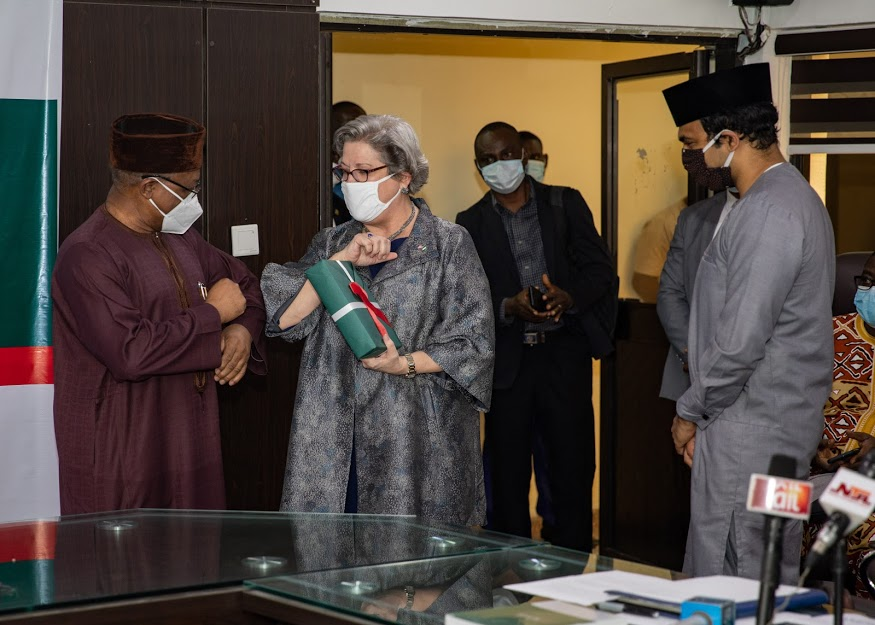
The United States Ambassador to Nigeria, Mary Beth Leonard, has presented the final technical report of the 2018 Nigeria HIV/AIDS Indicator and Impact Survey (NAIIS) to the Minister of Health, Prof. Osagie Ehanire. The report presentation was made after rigorous review and validation of the survey results and conclusions. It is the largest population-based HIV survey ever to be completed globally.
In her remarks, the Ambassador congratulated the Government of Nigeria for leading the conduct of NAIIS and rapidly using the results of the survey to guide its efforts toward achieving HIV/AIDS epidemic control and improving the health and well-being of the Nigerian people.
Ambassador Leonard commended the role of donors, including the Global Fund, President’s Emergency Plan for AIDS Relief (PEPFAR), the U.S. Centers for Disease Control and Prevention (CDC), and the U.S. Agency for International Development (USAID) for supporting the fight against HIV/AIDS in Nigeria and their contributions in the NAIIS survey. She recognized the collaboration managed by the CDC, which ensured that the NAIIS quality survey was conducted and concluded in record time. The survey findings greatly increased stakeholders’ understanding of the epidemic and provided critical data that informed programmatic decisions and interventions that have led to the provision of life-saving treatment to over 1 million Nigerians living with HIV.
She also recognized CDC’s implementing partner, the University of Maryland, Baltimore (UMB), for their tremendous efforts working with the Government and other partners to implement the survey and finalize the technical report. She reiterated that the U.S. government stands ready to continue its partnership with the Government of Nigeria and other international and domestic partners to support Nigeria, as it builds upon its successes in fighting HIV/AIDS.
In addition to funding from Global Fund in 2018, the U.S. Government, through the U.S. President’s Emergency Plan for AIDS Relief (PEPFAR), provided $71 million to support the implementation of NAIIS. The survey provided detailed epidemiologic data on HIV, Hepatitis B, and Hepatitis C in the country and assessed the impact of 15 years of PEPFAR investment in Nigeria.
The Nigerian Stock Exchange (“NSE” or “The Exchange”) is set to host a financial services webinar on Thursday, 8 October 2020. With the theme, The Future of the Financial Services Industry Post COVID-19, the webinar will bring together market stakeholders to share valuable experiences in managing the impact of the pandemic, as well as discuss the future of the Nigerian financial market, with the goal of charting a route to a sustainable future. Interested participants can register to attend at http://bit.ly/nse-financial-webinar.
The event will be headlined by the Governor of Central Bank of Nigeria (CBN), Mr. Godwin Emefiele, CON, and the Director-General of the Securities and Exchange Commission, Mr. Lamido Yuguda. It will feature a stellar line-up of speakers across the public and private sectors to discuss emerging financial stability risks, the evolving public policy response, and long-term challenges for the financial system.
Speaking about the webinar, the Chief Executive Officer, NSE, Mr. Oscar N. Onyema, OON, noted that, “The world is facing unprecedented challenges occasioned by the COVID-19 pandemic. Considering this, the global financial system remains an area of potential risk, with record levels of market volatility and growing concern around credit losses and its attendant impact on overall asset quality, capital, and liquidity. Governments, regulators, and international organizations have moved rapidly to address the economic collapse and financial fallout, but questions remain around how policy should continue to evolve to preserve financial stability. With this webinar, we envision that the insights gathered will lead to actionable solutions, policies, and measures that can mitigate current and emerging financial stability risks.”
Some of the other confirmed speakers for the event include Ms. Aishah Ahmad, Deputy Governor, CBN; Mr. Mitchell Elegbe, MD/CEO, Interswitch; Mr. Bolaji Balogun, CEO, Chapel Hill Denham; Mr. Kunle Elebute, Managing Partner, KPMG Nigeria; Prof. Yinka David- West, Academic Director, Information Systems & Digital Transformation, Lagos Business School; Mr. Chinua Azubike, MD/CEO, InfraCredit; and Mr. Eric Idaihi, Partner/Co-Founder, Verod Capital.
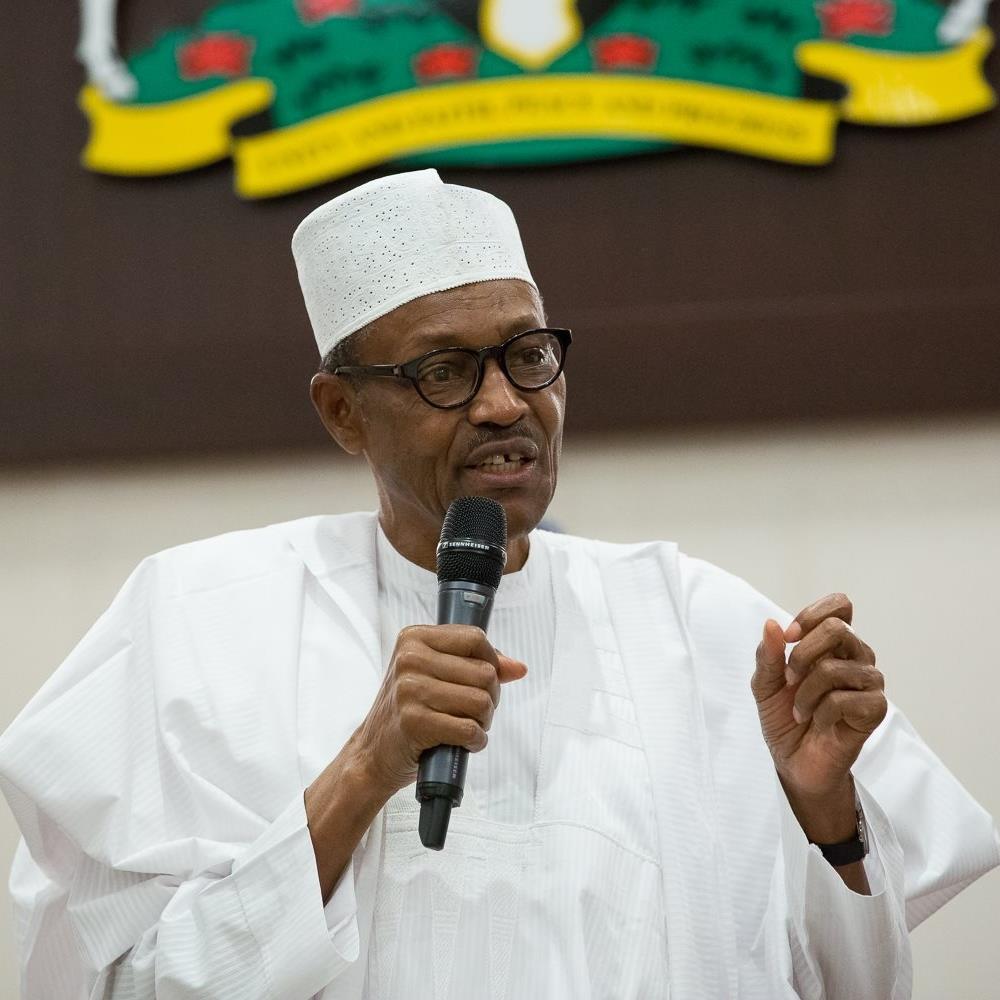
I speak to you today as your President and fellow citizen on this epoch occasion of our country’s 60th independence Anniversary. As President, I wish to renew my appreciation to Nigerians for entrusting me with your hopes and aspirations for a better and greater Nigeria.
2. Today, it is my unique privilege to re-commit myself to the service of this great country of great people with profound diversities and opportunities. We are bound by destiny to be the largest and greatest black nation on earth.
3. At this stage in our nationhood it is important that we reflect how we got here to enable us work TOGETHER to get to where we aspire to be as a strong indivisible nation, united in hope and equal in opportunity.
4. On October 1st 1960 when Prime Minister Alhaji Abubakar Tafawa Balewa received the constitutional instruments symbolizing Nigeria’s independence, he expressed his wish that having acquired our rightful status as an independent sovereign nation, history would record that the building of our nation proceeded at the wisest pace.
5. This optimism was anchored on the peaceful planning, full and open consultation and harmonious cooperation with the different groups which culminated in Nigeria emerging as a country without bitterness and bloodshed.
6. Our founding fathers understood the imperative of structuring a National identity using the power of the state and worked towards unification of Nigerians in a politically stable and viable entity.
7. That philosophy guided the foundation that was laid for our young nation of 45 million people with an urban population of approximately 7million occupying an area of 910,768 square kilometers. These demographics led to development challenges for which major efforts were made to overcome.
8. Today, we grapple with multiple challenges with a population exceeding 200million occupying the same land mass but 52% residing in urban areas.
9. Sixty years of nationhood provides an opportunity to ask ourselves questions on the extent to which we have sustained the aspirations of our founding fathers. Where did we do the right things? Are we on course? If not where did we stray and how can we remedy and retrace our steps?
10. Upon attaining independence, Nigeria’s growth trajectory was anchored on policies and programmes that positively impacted on all sectors of the economy. However, this journey was cut short by the 30-months of civil war.
11. We came out of the civil war with a focus on reconstruction, rehabilitation and reconciliation that enabled the country to put in place world class development structures and a strengthened public service that well served the government. This positive trajectory continued with a return to democratic government which was truncated by another round of military rule.
12. For a cumulative 29 of our 60 years existence as a nation, we have been under military rule.
13. My summary of our journey so far as a nation is necessary to appropriately chart where we need to go and how to get there TOGETHER.
14. Today, I am aware that our economy along with every single economy in the world is in crisis. We still face security challenges in parts of the country, while our society suffers from a high loss of moral rectitude which is driven by unbridled craving for political control.
15. An underlying cause of most of the problems we have faced as a nation is our consistent harping on artificially contrived fault-lines that we have harboured and allowed unnecessarily to fester.
16. In addition, institutions such as civil service, police, the judiciary, the military all suffered from a general decline.
17. We need to begin a sincere process of national healing and this anniversary presents a genuine opportunity to eliminate old and outworn perceptions that are always put to test in the lie they always are.
18. The stereotype of thinking of ourselves as coming from one part of the country before seeing ourselves as Nigerians is a key starting point to project us on the road to our deserved nation’s evolution and integration.
19. To start this healing process, we are already blessed with the most important asset any nation requires for such – OUR PEOPLE – and this has manifested globally in the exploits of Nigerians in many fields.
20. It has been demonstrated time and time again that Nigerians in the diaspora frequently excel in science, technology, medicine, sports, arts and many other fields.
21. Similarly, the creativity, ingenuity and resourcefulness of the Nigerian at home have resulted in globally recognized endeavours.
22. I am convinced that if we pursue our aspirations TOGETHER we would be able to achieve whatever we desire. That informed our adopting the theme TOGETHER to mark this epochal event.
23. Together we can change our condition for the better and more importantly, together we can do much more for ourselves and for our country.
24. I chose the path of self-reflection because this is what I do on a daily basis and I must confess that at most times, I always felt the need for a collective reflection as I know that the foundation for a solid future which this administration is laying can only be sustainable if there is a collective commitment by Nigerians.
25. Nigeria is not a country for Mr. President, any ruling or opposition party but a country for all of us and we must play our part, irrespective of challenges we face, to make this country what we desire.
26. To achieve this, we must focus our minds, TOGETHER as a people, on ways of resolving the identified critical challenges that underlie our present state. These include: a. Evolving and sustaining a democratic culture that leaves power in the hands of the people; b. Supporting the enthronement of the rule of law, demanding accountability of elected representatives and contributing to good governance; c. Increasing our commitment to peaceful co-existence in a peaceful, secure and united Nigeria; d. Harnessing and Optimizing our tremendous human and natural resources to attain our goal of being in the top twenty economies of the world and in the process; e. Lifting 100 million Nigerians out of poverty in 10 years; f. Strengthening institutions to make them stronger in protecting National Interests; and g. Imbibing tolerance in diversity.
27. I am a firm believer in transparent, free, fair and credible elections as has been demonstrated during my period as a democratically elected President.
28. The recent build-up and eventual outcome of the Edo State elections should encourage Nigerians that it is my commitment to bequeath to this country processes and procedures that would guarantee that the people’s votes count.
29. The problems with our electoral process are mainly human induced as desperate desire for power leads to desperate attempts to gain power and office.
30. Democracy, the world over and as I am pursuing in Nigeria, recognizes the power of the people. However, if some constituencies choose to bargain off their power, they should be prepared for denial of their rights.
31. This call is made more urgent if we realise that even after a transparent, free, fair and credible election, desperation leads to compromising the judiciary to upturn legitimate decisions of the people.
32. It is necessary to, therefore support the enthronement of the rule of law by avoiding actions which compromise the judiciary.
33. Fellow Nigerians, our history has shown that we are a people that have the capacity to live peacefully with one another.
34. As a government, we remain committed to our constitutional oath of securing the lives and properties of the citizenry. I, however, call on the citizenry to also support government by providing the necessary community level intelligence in addressing these challenges.
35. In moving forward together, it is important to strengthen our economy to provide sustainable means of livelihood for as many Nigerians as possible so as to eradicate absolute poverty from our midst.
36. I want to re-emphasize my dedication and commitment, a dedication and commitment that propelled my public service career and informed my quest to continually seek for an opportunity to improve the lives of Nigerians, set the country on the path of prosperity and lead the country to a better future.
37. This administration has been focused on rebuilding and laying the foundations for a sustainable Nigeria. Of course, we have met and are still meeting the challenges inherent in any rebuilding initiative – more so that of a nation like Nigeria that has undergone avoidable levels of deprivation – but can be surmounted if we all work together.
38. I wish to re-iterate that our people and our spirit of excellence remains our most important asset.
39. In this wise, the need to return to our age-old ethical and high moral values would be necessary and this informed my launching of the National Ethics and Integrity Policy on Monday 28th September, 2020.
40. The policy would not implement itself and the first contact of the visibility of its implementation is the Public Service whose on-going reforms would be expected to be sustainable and give a radical re-direction in providing services to all Nigerians.
41. Fellow Nigerians, in addition to public health challenges of working to contain the spread of the Coronavirus, we have suffered a significant drop in our foreign exchange earnings and internal revenues due to 40 per cent drop in oil prices and steep drop in economic activities, leading to a 60 per cent drop in government revenue.
42. Our government is grappling with the dual challenge of saving lives and livelihoods in face of drastically reduced resources.
43. In this regard, sustaining the level of petroleum prices is no longer possible. The government, since coming into office has recognized the economic argument for adjusting the price of petroleum. But the social argument about the knock-on effect of any adjustment weighed heavily with the government.
44. Accordingly, in the last three years, we have introduced unprecedented measures in support of the economy and to the weakest members of our society in the shape of: a. Tradermoni b. Farmermoni c. School Feeding Programme d. Job creation efforts e. Agricultural intervention programmes
45. No government in the past did what we are doing with such scarce resources. We have managed to keep things going in spite of the disproportionate spending on security. Those in the previous Governments from 1999 – 2015 who presided over the near destruction of the country have now the impudence to attempt to criticize our efforts.
46. In the circumstances, a responsible government must face realities and take tough decisions.
47. Petroleum prices in Nigeria are to be adjusted. We sell now at N161 per litre. A comparison with our neighbours will illustrate the point;
a. Chad which is an oil producing country charges N362 per litre b. Niger, also an oil producing country sells 1 litre at N346. c. In Ghana, another oil producing country, petroleum pump price is N326 per litre.
48. Further afield, Egypt charges N211 per litre. Saudi Arabia charges N168 per litre. It makes no sense for oil to be cheaper in Nigeria than in Saudi Arabia.
49. Fellow Nigerians, to achieve the great country we desire, we need to solidify our strength, increase our commitment and encourage ourselves to do that which is right and proper even when no one is watching.
50. Fellow Nigerians, let us collectively resolve to continue our journey beyond the sixty years on the clear understanding that as a nation we are greater together than being smaller units of nationalities. By the special grace of God we shall come through any transient challenges.
51. It is my sincere hope that by the end of this anniversary on September 30th 2021, we will all be proud of taking this individual and collective self-assessment for the progress of our great Nation.
In a bid to broaden and enhance the efficacy of the Federal Government’s whistleblower policy, there should be an expansion of the scope of the current framework to include issues of public safety, security, gross mismanagement of the rights of people, and waste of resources, among others, according to Vice President Yemi Osinbajo, SAN.
The Vice President stated this Tuesday in a keynote address delivered virtually at the National Conference on Whistleblower Policy. The Federal Government Whistleblower Policy was developed as a tool for the exposure of corruption and corrupt actors in Government and to validate controls and ensuring compliance with public finance management principles.
According to the Vice President, “It is clear that under the current whistleblowing policy, it is only with respect to acts of corruption that whistleblowing is considered lawful. However, there are a whole range of issues that may not endanger public finance directly but may constitute public safety or security risks. Reporting such may save lives and or property.
“The scope may then cover such matters as a violation of law, gross mismanagement of the rights of people and waste of public resources, or acts inimical to public health or safety.”
Speaking on the need to enhance the whistleblower policy, the Vice President said “although, some progress have been achieved through this policy, especially at the Federal Level – with recoveries, prosecutions, and convictions; it is essential that the policy operates widely in States and Local Governments as the tiers closest to the people and overseers of about half of the nation’s revenues.”
He said: “Exposing corruption is for the good of our nation. Our goal in this regard is to harness the huge potential of the people to deliver on their moral obligation to report cases of corruption within their immediate environments.”
Continuing, Prof. Osinbajo said, “as we deliberate on the finer details of implementation of this policy, we must consistently remind ourselves of the importance of the task at hand notwithstanding the difficulties.”
Calling for a legislative backing for the policy, Prof. Osinbajo said an Act of the National Assembly to back the policy is a necessity.
“Such a law should also provide for comprehensive protection of whistleblowers, including against reprisals from their employers and those whose activities they expose. These may include witness protection type provisions and this will give the whistleblower some protection where they may have to appear in court,” the Vice President explained.
Underscoring the importance of his proposal for adjustments in the policy, the Vice President said ‘‘certainty and clarity of the reporting processes and adequate protection of the whistleblowers would improve confidence in the initiative.
“Similarly, enhanced transparency and accountability in the implementation of the policy will result in more discoveries and recoveries,” Prof. Osinbajo added.
The conference was organized by the Federal Ministry of Finance, Budget, and National Planning in collaboration with agencies and departments involved in the anti-corruption battle.
The Nigerian Communications Commission (NCC) has considered lifting the suspended Spectrum Trading Guidelines (STG), 2018, pending the conclusion of the ongoing review of the Guidelines.
The lifting of the suspension followed deliberations on the subject by the Board of NCC at its Special Board Meeting, which held on Wednesday, September 16, 2020.
The Meeting was preceded by the suspension of the STG by the Board at its 96th Board Meeting held in May 18, 2020.
“The Board was satisfied that, given the state of the consultation, it was possible to lift the suspension of the STG pending the conclusion of the review,” NCC said in a public notice signed by its Director, Public Affairs, Dr. Ikechukwu Adinde.
“Accordingly, the Board resolved that the suspension of the STG be lifted and that relevant stakeholders continue to operate the STG while a new/revised STG is finalised in consultation with the industry,” the public notice added.
The Commission had, in a statement issued on May 27, 2020, announced the suspension of STG 2018 for the Nigerian telecommunications industry and informed all licensed telecoms operators, prospective investors, industry stakeholders and the general public of the regulatory decision.
The Board of NCC had earlier taken the decision for Spectrum Trading in response to telecommunications global dynamics, as well as the efforts to optimally utilise and maximise the benefits of Spectrum as a scarce resource.
Spectrum is a limited resource, which, when inefficiently utilised, greatly limits broadband coverage and speed. The current Spectrum Trading Guidelines were developed in 2018 after industry-wide consultations and this instrument allows that the Spectrum resource be traded on the Secondary Market through Transfer, Sharing or Leasing (TSL) upon satisfying stipulated regulatory conditions.
According to the Commission, the Nigerian National Broadband Plan (NNBP), 2020-2025 launched by President Muhammadu Buhari in Abuja in March 2020, requires that these Guidelines be reviewed to ensure that unutilised Spectrum is fairly traded to facilitate rollout by other operators amongst others.
The Guidelines will also help to address the need for ubiquitous broadband deployment to accelerate penetration and access in line with the economic Agenda of the Federal Government.
As the world marks the Cybersecurity Awareness Month this October, the Honourable Minister of Communications and Digital Economy, Dr Isa Ali Ibrahim (Pantami), FNCS, FBCS, FIIM has called on Nigerians to embrace healthy practices on Cyberspace.
Cybersecurity awareness has become imperative due to the attendant risks that emanate from the appreciable migration of several transactions, meetings, lectures and other forms of interaction to online and digital platforms due to the COVID-19 pandemic. The importance of cybersecurity awareness is emphasized in Pillar #6 (Soft Infrastructure) of the National Digital Economy Policy and Strategy (NDEPS) for a Digital Nigeria. The Soft Infrastructure pillar aims to ensure that Nigerians are secure online.
Furthermore, Section 106(1(c)) of the Nigerian Communications Act (NCA) 2003 states the role of the Nigerian Communications Commission in the protection of consumer information. Similarly, the National Information Technology Development Agency (NITDA) Act 2007 Section 6(l) states the role of NITDA in promoting the development of information technology to enhance national security. The Nigeria National Cybersecurity Framework also prescribes guidance for public and private sector organizations for instituting measures for enshrining cybersecurity culture and enthrone cyber-resiliency in Nigeria.
Cybersecurity is essentially about awareness and the Honourable Minister has directed parastatals under the purview of the Ministry- NCC, NITDA, NIMC, Galaxy Backbone and NigComSat- to embark on a nationwide Cybersecurity Awareness Programme. This 31-day awareness drive, throughout the month of October, will enable Nigerians obtain the knowledge required to embrace the digital economy and its many benefits, while protecting themselves against the tactics of cybercriminals.
The Honourable Minister urges everyone to be extra-cautious and reinforce security measures while interacting online, especially when it involves sensitive information. The Federal Ministry of Communications and Digital Economy is committed to keeping Nigerians safe online and wishes citizens a successful Cybersecurity Awareness Month.
Dr Femi Adeluyi Technical Assistant (Information Technology) to the Honourable Minister of Communications and Digital Economy
Happy independence, we are 60! This is my nation and I must say the truth, we are a big nation and we must start viewing things differently. Though I am writing this with noights on but we must have a reason to celebrate, even if we don’t celebrate becuase the economies is in tatters (apologies to Covid 19 and dwindling Brent crude and those global oil guys ) which has made us to be broke we must celebrate for being together. That is if the Oduduwa folks don’t protest for their new country and the biafra folks decide to come out and drink beer. They must either come out or go in. We want the biafra folks and their IPOB to drink beers outside why stay indoors when we celebrate and we want the Oduduwa guys to stay indoors and not carry placards , why come outside while we celebrate , going us inside to drink beer. So anyhow we must celebrate
Now back to the issue of celebration, what are we celebrating? Independence! Independence from what again? Are we free from colonialism? Don’t we still have neocolonialism here with our people going to churches to give Thanksgiving for getting visas to UK, USA etc… What does this show? It shows that folks are leaving in droves and this isn’t a good sign, brain drain is real !
Let’s bring it home, are we yrully independent? With citizens looking down on indigenous products and solution calling it local made? How is that mentality independent minded and the most annoying is calling them igbo made.
A nation that the economy is somehow dictated by the guys in Brentwood, IMF and lately China, you know there are critical things we can’t do without their concept just like the french held the francophones in their scrotum , ours (scrotum) isn’t made of titanium (apologies to death race ) they still held us ! We still go to their hospital to be treated, go their schools to be educated and try as much as possible to either dress like them and eat like them! Please how are we independent? We must start looking inward and we have to create that capacity.
We try to outdo others, we try as much to be more Christian than the pope or Westminster anglican church head… We take pentecostalism to a new hieght that the Americans who invented it shudder. We hate and discriminate ourselves beecuase of faith the dichotomy in Shitte amd Sunni is a clear case and we forget in one way or the other that these are foriegn religions and we shouldn’t let them out a wedge ! Yet we must celebrate.
Celebration is amazing, a nation where a couple of folks get to the national TV have sex and rewarded with millions in cash and endorsement while the little boy that made great strides in maths and physics are left with let’s say 20,000 as a gift and we say we must celebrate.
At 60, most men would have issues with erection and they might not sustain it more than 2 rounds and as a woman, monopause is there though with modern technology they can imagine if Nigeria is a nation!
Coming to TV, we have DStv, a south african company running the affairs and we have Startimes a Chinese firm with tiny stake of Nigeria.. and we must celebrate while these foriegn firm run amok.
Bring it home, as we are deploying cloud solutions and computing, alot of Nigerian firms are hosting abroad and they don’t care what it means to have data sovereignty and the issue of latency isn’t their forte… They just believe that once you host on Ukraine, California or Brisbane you are good but they forget that we can host in Nigeria, they don’t like .Ng and .com. Ng domain names they feel it’s not cool it would be .com yet we must celebrate .
Telecoms are out of it, MTN and Airtel have taken the larger chunk of our market and we are taking of over 80% and guess what? We must celebrate as a nation while our critical data is in hands of the foriegn ones.
Don’t get this twisted! I am not anti globalist I am not but I tilt towards protectionism! Protectionism is when the state governors give contracts to local engineers though striking university lecturers have made them watery. I am particular about leaving Toyota as a brand for Innoson or Nord , it is worrisome when some people in estate legislative reject these brands.
Do we celebrate oh yes, we must but we must revist bileteral agreement and get ourselves out of many association… What are we doing as a member of Commonwealth, what are we doing in OIC, what are we doing in these places ? Not all nations abide by these and membership is binding and this limits us.
What about the tribal independence? With the Oduduwa folks firing from all cylinders and the Biafra folks loosing their chills, the need to engage and tete a tete with these groups becomes imminent and chitchat becomes imperative. They might not be given 100% independence but they can be looked into a confederacy setting where the states are collapsed into regions and the regions take care of their internal affairs from policing to economic policies… These would be a form of scaling . This model is being employed in UAE, USA, Uk ans even Germany. A whole lot of regional autonomy to the extent they have 90% autonomy while the union have 10 which is defence , internal (passport, money ) and external relations . It is doable and the template is there for us all to borrow. If some want to be a full islamic region, it is their perogative .
Recurrent and exclusive list, that shouldn’t be forgotten. States should be allowed to generate their energy and sell excess to others. Why must a state like Anambra take permission to build a rail that is linking Onitsha to Awka and Nnewi? Why must Abia find it hard to dregde the Azumini blue river that is few nautical miles to Atlantic? Why must Uyo that is heavily oil not invest in electricity generation and sell to Benue ? These are few impediments to full independence.
Yet, we have done a lot in keeping the country together and that must be celebrated but is togetherness the only basis of celebration rather we must start ezcahning notes and looking at how this togetherness can change the prosperity narrative.
Happy birthday to Naija,I refuse to be forlon or give up. There is hope and it is salvable only if we want to salvage ! The market is huge ,it is worth over 300 million people buying and the need to keep this market is imperative and the need to revisit this market setup is more important. Nigeria is the market!
It is yet another Independence Day celebration in Nigeria. Very many people like me now hold the opinion that Nigeria needs and merits no celebration of any kind. A nation long gone to the dogs and jackals.
In 1960, I think I was in the Enfant Class – a step before Standard 1, when we were distributed a flag, a commemorative plastic light brown cup and 3 pence to each pupil. I think some people in the higher classes received 6 pence in celebration of the Independence Day October 1. It was a public holiday and my 3 pence found its way into my mother’s purse. Honestly, I was oblivious of what Independence was or its full meanings. In 1963, there was another celebration and public holiday. But this time, no money, flag or cup were shared. I heard that we have become a Republic. The only significant thing I noticed was that Queen Elizabeth II bust no longer featured on our currencies. Another significant thing I noticed was that, having followed my mother to the market carrying a second basket of palm nuts she would sell, the eventual proceed was below what she previously earns from palm nuts of such quantity. She wondered aloud why the loss of value. Somebody said that Government has lowered the price of locally derived farm produce. I took that away and that has remained solidly tucked into my head ever since.
I had begun to discern or understand a few things in 1965 when I was in Elementary 5 and sometimes when I visit classmates whose parents were teachers and had radios – Grundigs whose battery power pack was a separately housed Berec power ensemble neatly behind the grand Grundigs. They took minutes to come on with deep loud volumes. They were said to be circuited by semiconductors and cathode ray tubes of varied wire entanglements. We always peer to see if we can see the head of the man garrulously chatting away on end. Transistor radios were a new invention struggling to catch on.
The Nigeria I met in company of age mates everywhere held great promises. My parents did not bend over much in order to feed us in the family. I could buy 2 balls of Akara for half a penny. 4 balls mean 1 penny. A wrap of Elele (moi-moi) cost 1 penny. 1 shilling gets you 24 cups of garri. We heard that at Umuagwo near Ohaji it was measured 38 cups to a shilling. The standard cup measure was an untinkered cigarette cup of Craven A or Rothmans. In fact, with one shilling, you can buy garri for 6 pence, fish and soup condiments with the remaining 6 pence. It was like Paradise on the Equatorial coast lands and beyond. My classroom exercise books cost some 3 pence or the bigger notes of 40 or 60 leaves at 6 pence. In our classes, one teacher taught all subjects and he was a Master in all of them. From Elementary 3 I have begun to borrow books from the mobile Eastern Nigeria Library Board buses shuttling and rotating books to us in the rural areas. One of the books I borrowed then – The Arabian Nights – remained engraved in my heart till today. In it I read the classic, Sinbad the Sailor.
By 1966, the Sun began to rise from the West and the harmattan began to blow from the South. My First School Leaving Certificate read “Eastern Group of Provinces of Nigeria.” It was issued in 1966. I was lost actually not aware of which road one was actually travelling. Then the Exodus of the Igbo from everywhere back into the Igboland. The lands changed, the sky turned crimson, gloom and fear appeared on every face. Celestine Ukwu then waxed “Ije Enu”, ushering in the descent of Darkness.
The story of Nigeria as it stands today is not a cheering one. A story of lost opportunities, squandered Riches. Human destabilisations, Pogroms and massacres that almost raised another Mfecane reminiscent of the days of Shaka the Zulu in the Southern stretches of the African continent. Nigeria – a nation in Africa endowed with almost every known natural resource has clobbered down to the jelly floatsam of the Namibian wastelands.
The principal pulley that subdued and kept the national nose below the waters has remained its Leaders. Leadership has anchored over the decades on primitive tribal allegiances. Thus the nation has refused to climb onto the world stage. Every new leader after a few flickers of hope and then drifts out of the stereotype soulfully sliding into the very ailment and befuddlement that has made a supposed emerging African Giant to recline into the recessive doldrums of under-achievements of tribal potentates.
The end of the Civil War in 1970 offered the most golden opportunity of a resurgent modern Nigeria. A nation that would have been retooled into the 2nd or 1st World of Nations of reckon. The Curse of the Blackman prevailed. Gowon had sewn a 5 Year National Development Plan with his band of technocrats. It was a band of trained and exposed policy executors. Names as Hayford Alile, Rasheed Gbadamosi, Phillip Asiodu, Eghagha, Ejieyutchie and very many others were outstanding. They were not perfect but they had some good knowledge of statecraft and economic management.
The Murtala coup of 1975 shattered the glimpses and shadows of an emergent industrial nation. You may disagree but it marked the beginning of the Decline of Nigeria. A jamboree called the Festac 77 ushered the beat and rolling drums of the Decline. Although conception, planning and staging had gone considerably under Gowon, the new Murtala Government and their henchmen proceeded with the squander of the Festac. Monies that would have been deployed to gigantic Industrial and economic blueprints and takeoffs were strewn across the world to watch with glee the rolling butts and bosoms of African dancers from across the world. The spate and choking blanket of military rulers gave no impetus for any to vent constructive alternative ideas. The military drilled and harvested the entire national landscape with intolerant jackboot.
When Babangida mounted the horse, the decline was rapid and speedy. IMF and World Bank modulated economic plans sliced Nigeria into a mash of ill-diluted plans. State enterprises which in the main were social safety nets, bouyed and hoisted began to disappear. Unemployment steadily began to creep in. Nigeria Airways, National Shipping Line, the Refineries, Aluminium Extraction complexes, Ajaojuta Steel Mill, Sugar mills, Paper Mills etc. The private sector were not left out. We no longer saw or heard about the Palm Line Agencies, BEWAC, VYB, Elder Dempster, the 5-Star mills, Enpee, Atlantic Textiles, Abatex, Michelin, Dunlop, Asabatex, Double Crown breweries, the Top Beer, Skol, ANNAMCO, Peugeot, Volkswagen, Steyr and very many others. Not forgetting Chanrai, Bhojswani, the UAC, CFAO, SCOA, Westinghouse, Kingsway, Carrier etc. The numbers and names could stretch beyond the Milky Way.
Why would there not be a Decline and economic strangulation in Nigeria with these industrial closures and economic downturn. Till today and this moment, there is no flicker of hope in the horizon. The population is leaping in great bounds. The economic stretches are closing the more with nothing tangible being propounded or drawn up in expectations of any future succour. It is a hopeless situation.
If we can draw a little lesson from the Covid 19, its effect economically across the world, the near irrelevancy of oil, one should be realistic enough to smell the creeping Armageddon. As we stand today, the vagaries of oil supply, oil politics and clear plunge into alternative energy sources clearly indicate a doomed future. Yes, a doomed future. Given the manner and quality of our leaders over time and in the foreseeable future, one needs no trainings to divine this..
Just think about this:allegedly, a humongous sum of N3 tr was said to have been used to feed school pupils across the Nation as Covid 19 was at its peak. Pupils were at home. Nobody could corroborate such an insane tale. Nobody saw any pupil being fed. But the humongous sum has disappeared.
But the anti-cortuption body ICPC is telling us that some of the feeding monies have been traced to private bank accounts. This is a good move and we commend the presidency for speaking up and pointing this out.
And you think that a nation saddled with these heinous Andromedian folkways would survive two more decades into the future? We pray that it survives. We want it to survive but we must review
Do I have my doubts. The Independence Day is it worth any celebration? Is it merely a Review of the Curse and Decline of Nationhood, since 1975?