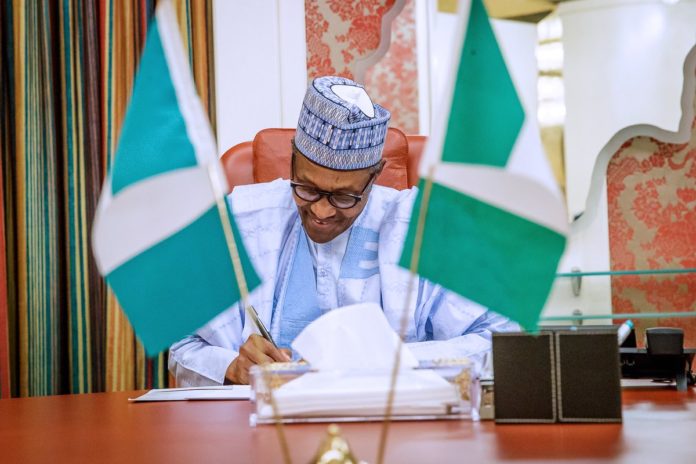
President Muhammadu Buhari Tuesday in Abuja pledged that Nigeria will continue to support the African Peer Review Mechanism (APRM) process in the country because of its benefits to good governance and democracy.

The President gave the assurance at the launch of Nigeria Second Review Country Self-Assessment Report and Flag–off of the Validation of the Report at the six geo-political zones of the country, including the Federal Capital Territory (FCT).

Describing the review as ‘‘timely and handy’’, President Buhari explained that the present administration with its change mantra agenda, has overhauled, revitalized and institutionalised its machinery for a successful conduct of the second peer review of the country.

The President recalled that Nigeria was first peer reviewed in 2008 and since then has recorded tremendous success in the implementation of the National Programme of Action as recommended.

He reiterated the commitment of his administration to the implementation of the new National Programme of Action that will come up after the review process.


‘‘Agenda 2063 is a strategic framework for the socio-economic transformation of the African continent over the next 50 years with a strong mandate on NEPAD and APRM.


‘‘This is in an attempt to build on and seek the acceleration of the implementation of past and present continental initiatives for the growth and sustainable development of the African Continent.

‘‘This exercise will be a strong reference point in the nation’s history, a source of courage and positive drive for this initiative that is aimed at consolidating the strides of this present administration.

‘‘In addition, this administration has been very supportive and will continue to support the APRM Process in Nigeria knowing the importance of the process which enhances transparency and good governance, strengthens our democracy, identifies and addresses critical challenges as well as promotes all-inclusiveness,’’ he said.

The President therefore urged all stakeholders to come up with more vital strategies, mechanisms and measures that would enable diligent implementation of the new National Programme of Action for accelerated Economic Growth and Sustainable Development in Nigeria and Africa.

In her remarks, the National Coordinator/Chief Executive Officer of AUDA-NEPAD Nigeria, Hon. Gloria Akobundu thanked President Buhari for his transparency, courageous leadership and consenting to the conduct of the Second Peer Review of Nigeria and his consistency in achieving the desired goal.

‘‘African Peer Review Mechanism is a mirror for Member States to encourage each other and build resilience to challenges and foster solutions to under development and promote good governance in the continent,’’ she said.

Akobdundu explained that after the Validation of the Country Self-Assessment Report, there are other activities to be effectively accomplished to ensure effectual completion of the Second Peer Review Process.

She listed them as follows:

‘‘The Issue Paper, New National Programme of Action, Presentation of the Report and Peer Review of Nigeria at the APR Forum of Heads of State and Government, Institutionalization of the Country Review Report (CRR), Launch of the Country Review Report (CRR) and Continuous Assessment of the Progress and Presentation of Progress Report to the AU-APRM.”

She pledged that the agency will leave no stone unturned to ensure that a smooth process is attained.

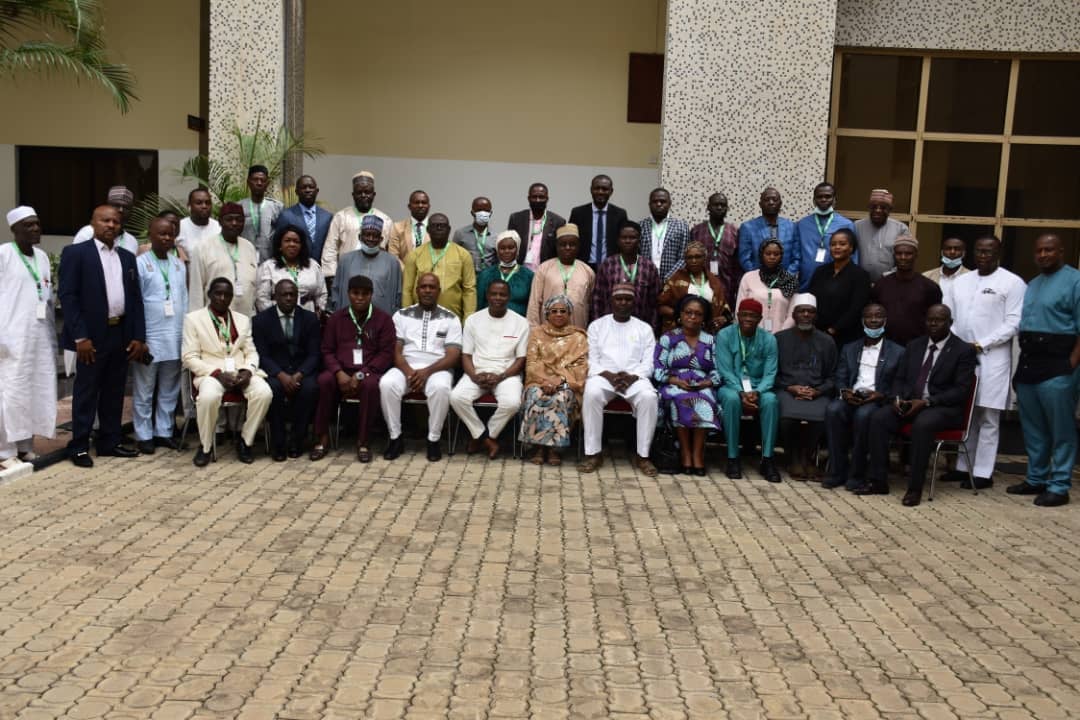
The event was attended by the Country Self-Assessment Mission led by Dr. Abdoulie Janneh of Gambia, a former Executive Secretary of the UN Economic Commission for Africa, the Chief Executive Officer of AU-APRM Secretariat, Prof. Eddy Maloka

The Nigerian Communications Commission (NCC), under the leadership of its Executive Vice-Chairman, Prof. Umar Garba Danbatta, has been commended for its ongoing initiative in building Information and Communication Technology (ICT) parks across the six-geo political zones of the country.

The latest commendation came from the Kano State Governor, Dr. Abdullahi Umar Ganduje, when he visited the site of an ongoing construction of an ICT Park by the Commission for the North-Western zone located in Kano State, recently.

The governor acknowledged the efforts and commitment of the Danbatta-led NCC in ensuring increased digital access for fast-tracking digital innovation across Nigeria and the North-West in particular, saying the initiative will trigger socio-economic transformation of the area in no distant future.

Ganduje said, “Realising that a major project that resonates with the global vision for the 4th Industrial Revolution (4IR) is being vigorously driven by NCC leadership, shows the kind of socio-economic transformation we should expect through ICT across Nigeria in the next few years.

“For the ICT Park being built here in Kano to serve the North-West zone, the government and citizens of Kano State are grateful to Prof. Danbatta and his team for bringing development to the state and the zone at large.”

He also applauded the quality of the construction work being undertaken by the NCC on the ICT Park and expressed appreciation for the foresight of the NCC for accommodating an expansion plan at the project site.

The ICT Park in is an initiative of the Executive Vice-Chairman of the NCC, Professor Umar Garba Danbatta, to provide Innovation Labs and Digital Fabrication Laboratories (Fablabs) for use by ICT innovators and entrepreneurs to turn their ideas into products and prototypes.

The Tier-4 Digital Industrial Complex (DIC) will provide a Commercial Hub for ICT capacity building and digital skills, create employment and entrepreneurial activities and facilitate smart city deployment across the Digital Industrial Complex.

The ICT Park consists of laboratories for ICT innovations and Commercial Hubs providing capacity building to ICT startups and entrepreneurial activities, in Kano State.

The parks are designed to provide fast internet service (broadband) and constant power supply.

ICT park comprises an area or location with concentration of all ICT facilities, which enables a concerted leap into the digital age by creating a dynamic environment in which local talent is incubated, cultivated, and shared. ICT park is best tested and trusted institutional mechanism to address the needs of technology-intensive, knowledge-based Micro, Small and Medium Enterprises (SMEs).

The NCC ICT Parks, which are being built across the six geo-political zones of the country, involve the construction and equipping of fully-functional Tier-4 Digital Industrial Complex (DIC) in each of the six geo-political zones of the country.

The ICT Park consist of laboratories for ICT innovations and Commercial Hubs providing capacity building to ICT start-ups and entrepreneurial activities. The Parks are designed to have fast internet service (broadband) and constant power supply.

The digital parks are to provide Innovation Labs and Digital Fabrication Laboratories (Fablabs) for use by ICT innovators and entrepreneurs to turn their ideas into products and prototypes.

The parks will also provide a Commercial Hub for ICT capacity building and digital skills; create employment and entrepreneurial activities; and facilitate smart city deployment across the Digital Industrial complex.

Speaking on the ICT Parks project recently, Prof Danbatta stated that the project was conceived and designed to support the federal government’s ICT-related policies and programmes by facilitating the availability and accessibility of ICT services across the country, promote their usage across all sectors and ultimately address youth unemployment in the country.

Designed to propel socio-economic transformation in the country, the EVC said the ICT Parks will help build capacity for the teeming population of Nigerian youths in the area of skill acquisition and innovation by complementing existing initiatives geared towards accelerating socio-economic transformation of Nigeria.

“The whole idea of putting these two things (i.e. skill acquisition and innovation) at the forefront of this very important initiative is to produce youths that can be self-reliant, generate employment for themselves and for other Nigerians,” he said.

Danbatta said based on its national structural spread, no part of the country will be left out as beneficiaries of the initiative. “The NCC ICT Parks Project is another move by the current leadership of the Commission to boost youth digital skills acquisition, promote innovations, provide jobs for the teeming Nigerian youth and ultimately support the overall digital economy agenda of the Federal Government,” he said.

He said the parks will support software development, incubation and hardware development. “We also hope to see innovative technologies that will leverage the broadband network, which the Commission is deepening in order to socially and economically transform our communities and societies.”

Danbatta urged the potential and would-be beneficiaries of the project, especially the youths, to be ready to leverage the initiative as it promises to empower them socially and economically.

“I would like to send out a very important message to our youths, especially those who are currently occupied with various innovative applications, those who have acquired the skills but are looking for where to put the skills fruitful engagements, by incubating them, commercialising them, or giving publicity to these excellent initiatives, to be ready to leverage the facilities,” he stated.

The ICT Park in Kano is expected to be completed and inaugurated at the end of the year.

SOURCE

Why the name Patricia and also why Bitcoin?

In 2015,I received Bitcoin from his uncle, but he could not find a place to sell them online or offline. He ended up on a peer to peer (P2P) platform and got ripped off. This made him realize that there are many other Nigerians and Africans like himself, who have a hard time exchanging their Bitcoin for value. This birthed the dream to create a trusted ecosystem for users like himself, known today as Patricia. Patricia is the name Hanu’s grandfather always teased his grandmother with even though her name was Patience. It was always fun for him (Hanu) watching his grandfather get under his grandmother’s skin. Having his dream child (Patricia) bear the name is one way to keep those memories alive and carry home with him anywhere he goes.

Patricia; How long have you been in Nigeria?

Born out of Nigeria, for three years and counting (August 16th, 2021 will be our fourth year), Patricia shares a special bond with the Nigerian market. We will always try to ensure that our features and builds can cater to the bubbling and ever-growing crypto market base in the country, a very healthy percentage of our users are in Nigeria. We intend to strengthen that bond by listening to the customers and trying to solve their problems by making crypto trades as easy as washing your hands.

Bitcoin and cryptocurrencies are a bit dicey in Nigeria considering the government position, how are you handling this?

 What we are trying to do is simple. We are building simple and convenient solutions to rewrite people’s financial experiences in simple and accessible ways. Although due to the regulations we’ve been forced to scale faster than we planned. The first thing we thought of when we got wind of the CBN love letter in February 2021, was the safety of customers’ funds. We expected a lot of panic actions. We quickly deployed many educational materials to educate our customers on what the policy meant and how it affected them. After the initial uncertainty, I would say the market has adjusted to the current realities.

Do you think that there is sufficient awareness here?

No. Not even globally as everyone is still an early adopter of cryptocurrencies. This is because digital money hit the limelight when? Circa 2017, when the value of one BTC hit $10k. There is a lot of chatter around Crypto but not enough people are adopting it as fast as it should be adopted, why? The idea of Crypto is complex, it’s almost as if it is reserved for a select few. This is why we (Patricia) are in business, to not only provide people with a safe and seamless platform where they can trade, but to also educate enthusiasts and everyone at large what crypto is about, and how it is the future of digital payments and settlements.

You are no Bank, but more, can you explain this?

We like to think that when man gets to Mars and finally becomes a multi-planetary species; man wouldn’t be spending fiat. We would need something not physical and we believe that cryptocurrency would be a perfect substitute. Getting from where we are now to Mars is going to be a long transitional phase and this is where we come in. At Patricia, our goal is to make Crypto easy for the world. We have successfully done it in Africa, 60-year-old Nigerian Mothers use Patricia to send money via crypto to their kids in Europe and other parts of the world. Infusing Crypto into the day-to-day lives of people brings crypto from its high horse and levels the playing field. Activities such as withdrawing Crypto from ATM machines worldwide with the Patricia Bitcoin Debit card, paying electricity bills, tv subscriptions, sports betting, buying gift cards all using crypto, show that there’s a lot we can do with crypto if we open ourselves up to it.This is our vision.

Do you think that you have the disruptive technology that will revolutionize the digital ecosystem?

 We definitely do. The thing is this, we are never relenting when it comes to engineering and product innovations, our drive is to solve problems globally and we are building a super app that will one day be all you need to carry out your daily activities. 

You have your app in Apple and Google store, how many downloads and usage have you had since you opened shop in Nigeria?

 We launched the Patricia App (both Mobile and web versions) in March 2020. And since then, we’ve been able to garner over 500k active users and over One hundred thousand downloads from both iOS and Google stores.

Do you think that Nigerians are embracing blockchain technology and cryptocurrency?

 Absolutely so. Nigerians are growth drivers personally; a lot have gone out of their way to self-learn a lot about what cryptocurrencies are. Hence, not a lot has changed for the market in recent times, more than ever, a lot more people are interested and buying into the crypto space now. Nigeria is the second-largest Bitcoin market in the world. This alone gives you a clear-cut picture of our level of acceptance. Recent policies haven’t deterred us (Nigerians) as one would expect. Rather it has sparked more conversations and curiosity and now we have Nigerian creators embrace NFTs, which has put the works before a global audience. It is incredible. The future is now!

Tell us about Patricia’s Debit card and how it is different from a conventional debit card? You do gift cards for corporations; how does it work and how has this been accepted?

The Patricia Bitcoin debit card was the first-ever introduced in Africa and it helped our customers understand what we meant when we said our goal is to make crypto easy. It works just like your regular card, but it charges your bitcoin wallet and not your bank account. With respect to gift cards, Glover has taken up all non-crypto services that existed within the Patricia ecosystem.

You encouraged Nigerians to use bitcoin for daily transactions but there are government policies on bitcoin and CBN is yet to come to terms with it. How do you handle this?

We are eager to help usher the government into the benefits of blockchain and cryptocurrencies. The opportunities and benefits are endless, blockchain can be applied in all areas; Healthcare, Transportation, Social Services, Data management.  We would continue to advocate and educate the public on the benefits of embracing blockchain and we are positive that we would get there faster than we imagined.

What is your advice to CBN and financial policymakers on the best way to adopt bitcoin as a mode of transaction and payment?

Stakeholders’ conversations are ongoing within and outside the corridors of the authorities, and we are confident of a seamless handshake at the end of it all.

You are encouraging Nigerians to use bitcoins to buy things like recharge cards, airtime, and pay bills. How did you convince these organizations to key into bitcoin?

We’ve made Bitcoin easy, so it was just an open and shut case of bringing them to understand the positive effects of digital payments powered by Bitcoin. This is exactly why we were established and we are making strides in this area.

Is Bitcoin the future of money considering how volatile it is and not supported by government regulations?

 You see, where it concerns cryptocurrencies in general, they all serve different purposes. And every economy in the world definitely has different needs. This means that each government will adopt the ones that are best progressive for its people. In regards to Bitcoin, the first small step in that direction was taken by the El Salvadoran president a few weeks ago. If a small country of 10million people can transact daily using Bitcoin. It’s just a matter of time before the rest of the world agrees that it has potential.

What we are trying to do is simple. We are building simple and convenient solutions to rewrite people’s financial experiences in simple and accessible ways. Although due to the regulations we’ve been forced to scale faster than we planned. The first thing we thought of when we got wind of the CBN love letter in February 2021, was the safety of customers’ funds. We expected a lot of panic actions. We quickly deployed many educational materials to educate our customers on what the policy meant and how it affected them. After the initial uncertainty, I would say the market has adjusted to the current realities.
Nigerian Communication Commission (NCC), the apex regulator of telecoms in Nigeria has debunked the news flying around that “3 million New Lines had been added in Q1 2001.” Over the years, the NCC’s position is clear which is to ensure that the telecom sector scales and grow which the current EVC, Engr. Danbatta has demonstrated over time.  

The Commission stated that “We wish to use this opportunity to clarify that the Nigerian Communications Commission and the National Bureau of Statistics (NBS) are the only authoritative sources of authentic data on the Nigerian telecommunications sector. Indeed, the Commission is well aware of the critical need to make accurate and up-to-date data available to all Stakeholders.”

The regulator added “The Nigerian Communication Commission encourages all Stakeholders to visit its website for authentic data on the sector and to refer all doubts to its Public Affairs Department to avoid unnecessary controversy and/or inadvertently misleading other Stakeholders who may rely on such reports. The Commission also urges Stakeholders to disregard any information on subscriber data different from those presented in the Commission’s website.”

“Consistent with Section 89 Subsection 3(d) of the Nigerian Communications Act 2003 (NCA 2003), the Commission is mandated to monitor and report on the state of the Nigerian telecommunications industry, provide statistical analyses and identify industry trends with regard to services, tariffs, operators, technology, subscribers, issues of competition and dominance, etc. with a view to identifying areas where regulatory intervention would be needed. In view of this, the Commission regularly conducts studies and surveys and produces reports on the telecommunications industry, and telecommunications operators are obligated, under the terms of the licenses, to provide the NCC with such data on a regular basis for analytical review and publishing”, the regulator opined.

The sector has recorded loss of active telephone lines and NCC is not happy for this development. This policy by the Minister has stunted the industry while some stakeholders are saying that the industry has regressed back. The commission isn’t happy about this. With over 21 million lines lost, this means that billions have been lost to the sector due to SIM Card ban alone and the multiplier effects is enormous. This has led to job loss in the industry, inability of the Telcos to meet up to their obligations and this is exactly what the regulator is perturbed about hoping that the minister rescinds on such a regressive policy.

Due to this policy of SIM card ban, investor confidence is going down, investors are seeing this as a policy summersault and when such a report of “Nigeria Records 3 million New Lines in Q1” NCC did the right thing to make the Nigerian consumers understand the true state of things by debunking the news.  Having earned trust and credibility in the industry, the EVC of NCC, Engr. Danbatta has demonstrated over the years that he is desirous of bringing immense development and advancement to the telecom ecosystem which he has been doing.

During the time of SIM Card ban, the policy was described as unfortunate. Telecoms loose about 50 billion naira monthly due to this single policy ban.

The position of the telecom regulator has been clear, to ensure that there is high level of adherence and transparency in the industry.  It is only the regulator that has the sole responsibility to furnish Nigerians with such data.

ANTHONY NWOSU

The sector has recorded loss of active telephone lines and NCC is not happy for this development. This policy by the Minister has stunted the industry while some stakeholders are saying that the industry has regressed back. The commission isn’t happy about this. With over 21 million lines lost, this means that billions have been lost to the sector due to SIM Card ban alone and the multiplier effects is enormous.

The Permanent Secretary, Federal Ministry of Agriculture and Rural Development, Dr. Ernest Umakhihe has stated that the implementation of the National Agricultural Data Management Information System(NADMIS), would strengthen the data Information system for policy, planning and tracking of the Sustainable Development Goals in the Agricultural sector. He said that NADMIS will act as an instrument for the resuscitation and revitalization of data and information services at both the Federal and State Ministries of Agriculture in the country.

The Permanent Secretary ably represented by the Director, Federal Department of Agriculture, Mrs Karima Babaginda, made this known during the opening ceremony of the National Validation of Country Data Set for 3rd Biennial Review Exercise on the Implementation of Comprehensive Africa Agriculture Development Programme, held at Rock View Hotel, Abuja on Wednesday, 7th July 2021, He said preparation has reached an advanced stage for Food and Agriculture Organization(FAO) to facilitate the second phase of the Global Strategy to Improve Agricultural and Rural Statistics in Nigeria.

Dr. Umakhihe informed that ‘’ the Comprehensive Africa Agriculture Development Programme (CAADP), remains the initiative of the African Heads of States launched and adopted in 2003 in Maputo Mozambique, with a commitment to dedicating 10% of the annual national budget and ensuring 6% annual growth in the sector, for enhanced public spending, food security and poverty alleviation in the continent’’.

He stated that an integral part of the CAADP’s implementation process is a continuous sector performance appraisal through the platforms of a national annual Joint Sector Review and a continental Biennial Review. In this regard, Nigeria’s average performances at the inaugural and second biennial review exercises were attributed to the issues of data gaps.

The Permanent Secretary pointed out that ‘’ Nigeria signed the CAADP Compact on 30th October 2009, prepared the first National Agricultural Investment Plan (NAIP I) 2011 – 2014 in December 2010 and established a CAADP Country Team Structure for implementation. Similarly, the 2nd NAIP-2017-2020 was developed and implemented under the sector framework of the Agricultural Promotion Policy’’.

Umakhihe explained that ‘’the Ministry in collaboration with the Central Bank of Nigeria, Commodity Associations and Agricultural Platform Companies launched the Agric for Food and Jobs Programme, a sectoral component of the 2020 Nigeria Economic Sustainability Plan, to support smallholder farmers with inputs for enhanced productivity’’.
He stressed that ‘’ the Federal Government is steadily dedicating huge resources to the development of rural infrastructure, the training of youths to serve as Extension agents, the provision of agricultural machinery to expand the cultivable land area, the implementation of the National Livestock Transformation Plan and the acceleration of fisheries and aquaculture production in the country’’.

He urged the stakeholders at the forum to produce a credible and complete data set that would enable Nigeria to be on track in achieving the Commitments for the implementation of the Comprehensive Africa Agricultural Development Programme.

Umakhihe added that ‘’ we are to use our experience and resource to assess, input and endorse the country’s populated data set in the biennial review reporting template before we submit it to the African Union Commission through the Economic Community for the West African States’’.

In his welcome address, the Director, Planning and Policy Coordination Department in the Ministry, Mr Zubairu Abdullahi, who was represented by the Deputy Director in the Department, Mr. Ibrahim Tanimu said that ‘’ Nigeria had since 2003 been part of the conceptualization, adoption and implementation of the Comprehensive Africa Agriculture Development Programme [CAADP], initiated by the African Union under the New Partnership for Africa Development to increases public spending in agriculture, accelerate sector growth and track the entire process through robust data generation for a continental biennial performance review’’.

He stated that ‘’to make Nigeria achieve a better result, state and non-state actors; synergy is highly required by harnessing all available data in the country. That is, we should focus this validation exercise on the policies, strategies and programmes that had been executed along with research development, value chain, financial inclusion and agribusiness undertakings to diversify the economy, create wealth for Nigerians and foster national development’’.

In his remarks, the CAADP Focal Point Officer in Nigeria, Mr. Mohammed Ibrahim, appealed to the Federal Government to increase the Agricultural sector budgetary provision to meet 10% of the total annual national budget as recommended and adopted by the Africa Head of States in Maputo 2003.

He stated that the Federal Government should allocate more funds in the Sector to address areas of investment that would increase the Agricultural GDP to at least 6%. He further said that stakeholders are expected to support the CAADP team with relevant data based on the indicators for tracking the country’s performance on the implementation of CAADP in Nigeria

Nigeria has the potential to become the largest producer of Cashew in the world, the Minister of Agriculture and Rural Development Alhaji Muhammed, Sabo Nanono has said.


With an estimated production capacity of 250,000 metric tons per annum, Nanono said that Nigeria is currently the fourth-largest producer in the world and second in Africa with twenty-seven states and the FCT cultivating cashew.

The minister made this known while inaugurating the Nigeria Cashew Value Chain Working Committee on Thursday 8th July 2021 in Abuja.According to him, exports of cashew between 2015 and 2017 earned Nigeria over eight hundred million US dollars ($800 million).

This, he added, has made the commodity an important export-oriented cash crop and a significant non – oil export earner. Nanono, however, lamented that while Nigeria has about 100,000 cultivable lands for producing cashew, she was only able to produce 450 kilograms per hectare as opposed to Ivory Coast which produces 750 kilograms per hectare on only 32,000 surface area.
The Nigerian cashew policy environment, the Minister noted, had remained static and has slowed down the development of the sector.

In a statement signed by the Technical Adviser (Media) to the minister, Ahmed Aminu, Nanono disclosed that his ministry in partnership with the United States Department of Agriculture (USDA) funded West Africa PRO – Cashew Project has constituted a committee to develop a five-year working document.

The document will enable Nigeria to realize the enormous potentials available in the Nigerian Cashew Value Chain, the minister said.

Nanono, therefore, tasked the 26-person committee to work assiduously to develop the working plan to increase cashew productivity, quality, value addition, and access to markets.

Your bank can give you credit facility or loans but can’t give you clients or customers. This is popular cliche that every business owner must understand. Writing fancy proposals, making awesome slides in presentation isn’t enough the key thing is go to market approach. What is the go to market approach for every brand? It is ability to understand the market, penetrate the market and maintain a segment of market .

You can’t get these through credit facilities or some fancy PR stuff but the key here is basically market research! Conn8 Media Solutions market research consultant Nonso Anyatuonwu ! He has made it easier for new brands to understand that market research shouldn’t be a thing for the big and established firm. Start-ups can key into this critical information.

In an era of information, there is need to have critical market information before leaping into any market. With market research by competent people . This would avail the business owner reduced Risk exposure and make them take critical and informed decisions. This is what Nonso and Conn8 Media is bringing to the bare.

In a nutshell Market Research can be defined in such a simple way , let’s take for instance an eatery or quick service restaurant wants to establish an outlet in an area, the key function of market research is to know 1. The population of families 2 . The people that are single that can buy the food 3. The taste of the people (those that might like pastries or traditional dishes) 4. Average income earning of the neighbourhood….and so many more.

Market research can be applied in all facets of human endeavour. An NGO that is looking out to assist and intervene in the business of women can deploy the role of market research for those that are actually in need of the intervention. There is also need to look at how to get things done rightly.

Market Research has been made easy for start ups! It is easier today to engage firms like Conn8 Media to partner with you on the best way to penetrate that market and get the share.

Turning a lightbulb moment into a workable strategy and transforming concepts into concrete plans, especially within a startup, requires a blend of big picture thinking and an eye for detail that comes from a skilled operational approach. Ryan Green, Co-Founder and COO at AURA, South Africa’s leading security and medical response platform, says allowing the founding team to play to their strengths has ensured AURA’s quick growth and continued success. 

When we started AURA back in 2017, Warren who originally had the idea for the business, was the natural CEO. Someone needed to turn this idea and strategy into reality, and I organically found myself taking the lead on the operations side of AURA. Since those early roles were established, we have managed to allow each other to focus on where we add the most value within the business. This I believe has been one key ingredient that has allowed us to grow and scale as quickly and effectively as we have.

Turning tech ideas into reality

In AURA’s early days, the operations role was centred around creating product market fit, ensuring the solution did as suggested, and consistently delivered. Since scaling to operate in several other markets, my day-to-day focus is now on laying similar foundations to seamlessly replicate AURA’s ecosystem and operations so that we can operate and scale in any market we enter whilst remaining aligned to our overall strategy and vision. 

Ops in a platform ecosystem

The operations role tends to function differently in a platform business than it does in so-called traditional businesses in that there are several key stakeholders that make up the platform ecosystem. In AURA’s case, we have customers in the form of our B2B partners and end-users, those that actually subscribe to and use our service as well as our security and medical response service providers. The goal within AURA’s platform ecosystem is to create a win-win-win for each of these parties on a constant basis. Maintaining this equilibrium is what I believe makes operations in platform businesses unique from other entities as you consciously and continuously have to put yourself in the shoes of these various stakeholders to try to understand their ever changing requirements


Detailed vs. perfect

Startup platform COOs should be very detailed and have the desire, grit and ability to understand how everything within the business works at all levels in order to effectively guide the broader team through the requirements, timelines and challenges that will inevitably arise. To be successful in operations, leaders must remain cool and calm, with an ability to sift through the daily noise and choose where to focus valuable time and attention. Most natural ops people can get sucked into things being perfect, rather than being complete, which can be detrimental in a startup environment. 

A solution with an impact

AURA’s expansion into new markets across the globe is incredibly exciting. Seeing our platform save someone’s life is by far the most gratifying aspect of the role. When someone puts their trust in AURA to help them in their time of need, and to see all the elements of the platform and the hard work of the various teams come together in perfect harmony is hugely rewarding. 

The Honourable Minister of Communications and Digital Economy, Isa Ali Ibrahim (Pantami), PhD, FNCS, FBCS, FIIM, today virtually Launched and Unveiled STORM; A Fibre connectivity and Digital Services platform, which is powered by Galaxy Backbone, for the South-East and South-South region of the country.

The launch is part of the implementation of the National Digital Economy Policy and Strategy for a Digital Nigeria (NDEPS), and also the National Broadband Plan 2020 – 2025. Both National policies were launched and unveiled by his Excellency, President Muhammadu Buhari GCFR.

The third pillar of the NDEPS (Solid Infrastructure) focuses on providing Internet Connectivity and Data Centres.

In his remarks as Chief Host and Special Guest of Honour, the Honourable Minister, Dr Pantami challenged the beneficiary states to make proper use of the service provided to them in order to drive economic development.

The Honourable Minister informed that STORM provides a platform to deliver fast and efficient internet and hosting services.

Dr Pantami reiterated the importance of Broadband Penetration, stressing that, Broadband is key to economic development and an enabler that will support other sectors of the economy.

The Minister informed that an increase in Broadband Penetration also brings about a corresponding increase in GDP. “The last two-quarter report released by the National Bureau of Statistics (NBS) collaborates this fact”, Pantami said.

Pantami commended the corporation between Galaxy Backbone and Interra Network, asserting that digitalization cannot be achieved in silos, but only through partnership and collaboration.

Last week, we saw the enhanced collaboration of the Nigerian Law Enforcement Agencies, as they executed with great synchronization arrests of individuals who had inflicted pain and hardships on fellow citizens.

The subversive leader of the proscribed Indigenous People of Biafra (IPOB) a group known for its murderous actions and virulent messaging was detained as a result of cross-border cooperation. This international operation was executed in a closely coordinated fashion following which he was handed over to our National Intelligence Agency, and then returned to Nigeria to face the Law.

The violence inspired by IPOB has led to hundreds of fatalities, particularly targeted at Government assets and Law Enforcement Agents. Additionally, there have been at last count, fifty (55) separate violent attacks, heavily concentrated in the South-East, which heaped further hardship on our honest and hardworking citizens, preventing them from earning their livelihood and going about their normal lives.

The Government had long been monitoring the activities of IPOB and had strong cause to believe that their funding sources include proceeds of suspected illicit criminal activities. By this singular action of our Security Forces, sanity, calm and peace has been returned to our communities who previously lived in constant fear of these misguided elements.


In furtherance of continued diligent work, the State Security Service on Thursday, 1st July raided the residence of a militant ethnic Secessionist, who has also been conducting acts of terror and disturbing the peace under the guise of protecting fellow “kinsmen”.

His seditious utterances and antics, which he is known to have publicly expressed, have overtime morphed into very hateful and vile laden speeches. It must be highlighted that the government respects fundamental rights of citizens to express their views and recognizes this as a democratic tenet. However, any attempt to build an Armoury coupled with plans either subtle or expressed to undermine our unity as a nation will not be condoned.

Mr. President’s directives to Security Services regarding anyone seen to be carrying arms, particularly AK-47 are clear and require no further illumination. Assault weapons are not tools of peace loving people and as such, regardless of who they are and where they are from, the Security Agencies should treat them all the same.

The successes of our Security Agencies must be commended as they have demonstrated significant deftness, guile and secrecy in carrying out these missions. This level of professionalism must be sustained and brought to bear as we focus on extracting from our society those who have found a new trade in targeting students, rural dwellers and our citizens in the North-West. The nation recognizes their efforts and sacrifice.