With the growing number of online transactions taking place each day comes a marked rise in cyber-attacks and security events. According to Ryan Mer, Managing Director, eftsure Africa, a Know Your Payee™ (KYP) platform provider, fraudsters are constantly finding new ways to exploit vulnerabilities and attack corporate payment systems. “Many scams, hacks and security breaches begin with social engineering, a term used to describe the act of convincing someone to divulge information that they shouldn’t share or take an action that’s not in their or the organisations best interests, such as clicking a suspicious link, or changing a supplier’s banking details” says Mer. 

What makes social engineering so effective is that scammers rely on human impulses to be helpful, avoid conflict, and problem-solve quickly and effectively, in order to extract information or manipulate targets into taking action. Cybercriminals routinely rely on creating a sense of urgency in their victims. Mer says phishing messages and business email compromise (BEC) scams are designed to make employees more likely comply with a potential threat that they know they should report.

A recent INTERPOL report on the impact of Covid-19 on cybercrime has shown a significant target shift from individuals and small businesses to major corporations, governments, and even critical infrastructure. According to the report, cybercriminals are developing and boosting their attacks at an alarming pace, exploiting the fear and uncertainty caused by the unstable social and economic situation created by the pandemic. “The general consensus among information security experts is that eliciting a strong emotional response, like fear or uncertainty, make people more susceptible to a social engineering attack. Without robust internal controls, there is a greater likelihood that your organisation will face potentially costly human error”, notes Mer.

He adds that in many organisations there is a concerning disconnect between the theoretical controls in place and what actually happens in everyday business contexts. “Technology can help to close the gap and improve controls over key processes, like the collection of payment information and verification thereof. Internal accounting systems rely heavily on the integrity of the information inputted into the system which makes them vulnerable to error. Even with stringent sign-off procedures and appropriate segregation of duties, all amendments to information should be checked. Although business ERP systems have user rights and controls it doesn’t prevent a business from being exposed to potential internal fraud or an external hack.”

eftsure’s SaaS platform is making a big difference in businesses of all sizes by automating key checks and processes that would otherwise be vulnerable to manual, human error or manipulation. The fintech company provides verification of payee and payment data software to businesses to protect against payment fraud in the B2B sector: “We provide a platform to digitise and automate the verification of payees and eft payment data, on a continuous basis through our KYP technology. eftsure protects companies against fraud and error made through incorrect, fraudulently changed or maliciously altered payee information,” says Mer.

The Executive Vice Chairman (EVC) of the Nigerian Communication Commission (NCC), Prof. Umar Garba Danbatta, has declared that three of the Commission’s regulatory instruments are set to offer enabling provisions that will help the country in tackling security and insurgency; as well as to enhance spectrum availability to facilitate the deployment of Fifth Generation (5G) technology.

The three instruments, which were subjected to a public inquiry on Tuesday physically and virtually, include the Spectrum Trading Guidelines (STG), Registration of Telephone Subscribers Regulations, and the Subscriber Identity Module (SIM) Replacement Guidelines.

Speaking recently at a semi-virtual public inquiry, which on-site operation was conducted at the Commission’s Head Office in Abuja, Danbatta said the three regulatory instruments have been developed to address the challenges of the ever evolving communications industry and to further strengthen the market structure.

He said the public inquiry was held in line with the Commission’s consultative approach in all its regulatory interventions, as the regulatory instruments being reviewed are vital to ensuring that the regulatory frameworks that pertain to SIM registration and replacement in the communications industry meet the demands of the digital age and also further enhance the flexibility of the spectrum trading regime.

Yhe first instrument, the Registration of Telephone Subscribers Regulations, provides a regulatory framework for the registration of subscribers of communications services utilising subscription mediums. The second instrument, SIM Replacement Guidelines, provides guidance on the standards and procedure which Network Service Providers (NSPs) are expected to adhere to in the process of conducting a SIM Replacement, swap or upgrade.

Besides the instruments, two Business Rules that relate to SIM Registration and SIM Replacement, introduced by the Commission to further ensure that the process for SIM activation and Replacement is seamless and align with the national identity management policy.

The third instrument, the Spectrum Trading Guidelines (STG), seeks to promote certainty and transparency by outlining the detailed procedure and conditions for spectrum trading in the Nigerian communications sector.

While underscoring that the availability of spectrum frequency is a necessary element in the deployment of the 5G technology in Nigeria, Danbatta said the recent approval of the 5G Deployment Plan by the Federal Government makes the STG review process expedient.

Danbatta said the public inquiry is a precursor to the Commission’s current drive towards ensuring that frequency spectrum is readily available to licensees through a rapid and effective process. Additionally, the EVC said that “in view of the resolve of the Federal Government to tackle insurgency and insecurity through citizen identity management, it has become necessary to ensure that the provisions of the Registration of Telephone Subscribers Regulations and SIM Replacement Guidelines are in alignment with the National Identity Policy for SIM Card Registration and related activities.”

According to him, the revision of both instruments is geared towards ensuring a more secure and robust process for the registration, activation and replacement of SIMs. “It is, therefore, my expectation that the review will ensure a more robust framework for the registration of subscribers of communication services, improve the standards and procedures for SIM replacements and ensure effective and efficient utilisation of frequency spectrum in Nigeria,” the EVC said.

Speaking earlier, NCC’s Executive Commissioner, Stakeholder Management, Adeleke Adewolu, said the draft of all the regulatory instruments had been published on the Commission’s website and comments from all stakeholders have been received and reviewed. However, he noted that the public inquiry was meant to receive more comments from stakeholders, which would ensure that the final regulatory instruments will enhance development of the industry.

At the event, which was well attended by senior management staff of the Commission and virtually by other external stakeholders, presentations were made by the Commission on the inputs so far received from licensees and other stakeholders on each of the three regulatory instruments, highlighting issues for further rethink by all stakeholders.

The stakeholders who participated in the event virtually, were also provided the opportunity to make inputs, contribute freely to the discussions in a very frank and objective manner that elicited thoughtful discussions that will further enrich the quality of the regulatory instruments being developed for the growth of the sector and the national economy.

With World Mental Health Day just behind us, Zama Zaca, Head of New Business at Tetris South Africa, shares some design tips on how to make workspaces more inclusive and improve employee mental wellness of employees.

Mental health has been in the spotlight recently, with people under strain from the ongoing COVID-19 crisis and top athletes opening up about their mental health struggles during prominent international sporting events. These athletes, including gymnast Simone Biles, tennis player Naomi Osaka and others, who are at the pinnacle of their careers, have helped accelerate a trend in mental wellness, shining a light on its importance to a person’s overall wellness and ability to perform.

Companies, too, are starting to prioritise workers’ health and wellbeing, as reflected by flexible and accommodating work policies during the pandemic. But inclusion can’t stop there, according to Zama Zaca, Head of New Business at Tétris South Africa: “We are living in a time of increased neurodiversity and awareness about ADHD, dyslexia, autism and other neurological states and how organisations that create spaces to reflect this diversity will be helping to set their employees up for success.”

According to the World Health Organisation, one in about 160 children globally has an autism spectrum disorder (ASD), and a leading researcher in South Africa based at the University of Cape Town estimates that approximately 2% of our local population is affected by ASD. It is noteworthy that some of our greatest thinkers and innovators are neurodivergent – Elon Musk, Bill Gates and Richard Branson to name a few – and it hasn’t hindered them, in fact it may have given them an edge over others and prompted out-of-the-box thinking. However, office spaces need to accommodate for the neurodivergent as well as for all the variations in personalities to foster mental wellness in the workplace and, in turn, enhance productivity.

When designing for neurodiversity, people’s sensory processes need to be considered, and how neurodivergent minds and varying personalities – including introverts, extroverts and anyone in between – experience sound, light, texture and space differently. Designing in an inclusive way means creating spaces for these differing temperaments. Zaca says that this method of design goes to the heart of the Tétris Sustainability Code, which not only aims to create environmentally friendly workspaces, but also more inclusive spaces, taking into account the mental health and wellbeing of those who will live and work in them. “We’re incorporating things like natural light and greenery into our designs, which is great from a sustainability perspective, but also helps with employee health as being around nature has been proven to boost people’s moods.”

The magic is in the detail

An office that is inclusive and accommodating to all the different ways people think, work and interact with each other will go a long way in encouraging staff to return after more than a year of working from home. However, inclusive design isn’t just about neurodiversity – it’s also about accessibility.

Reimagining your office for neurodivergent people and those with differing personalities not only benefits them, but everyone who visits or uses your workspace. A few tweaks in your workspace can make a huge difference.

Deal with distractions. Distractions lead to a loss of productivity. A report by Udemy in 2018 revealed that more than two-thirds of people feel that distractions are their number one concern when working in an office, with intermittent unpredictable noise particularly stressful. On the flipside, offices that are too quiet can be distracting as there is no background noise to muffle general office sounds and conversations. To mitigate distractions, employees need options to find the right solution that meets their specific needs. Include areas for focus, areas for concentration and tech-free zones where staff can escape the impact of constantly being pinged by technology.

Control sensory stimulation. Too much sensory input can be overwhelming, while too little can be a problem for some. Create spaces where workers can go to choose the sensory stimulation they are comfortable with. Think about including quiet secluded spots for focused work, open and closed cabins, individual zones, auto-isolated desks as well as open collaboration, meeting and leisure areas.

Optimise office layout. Good spatial design should encourage exploration and be intuitive. People need to understand where they are and easily find their way to where they need to be. Create spaces that use rhythm to bring a sense of order and use landmarks and focal points (such as staircases), viewpoints (such as mezzanines) and clear lines of sight (including views to the outside) to help people orient themselves.

A well-designed office enables easy navigation and assists the brain’s innate positioning system. In JLL’s Workforce Barometer Research, conducted in April 2021, research respondents also indicated the expectation for long-lasting impact on the design of the work environment post Covid-19. This includes less density and physical separations – as such one in four respondents indicated they do not wish to share a desk anymore, revealing the long-term impact of the crisis on the employee mindset.

Increase natural light. The Daylight and Workplace Study done by Cornell University in the US revealed that natural light in office spaces has a positive effect on the overall health and productivity of employees. A good design, therefore, is one that includes floor to ceiling windows, skylights and positions the workstations to thatthe greatest number have access to daylight.

A study by the University College of London’s Living Lab showed that the use of circadian light, which is interior light that replicates the colour, angle and intensity of sunlight, also has a beneficial effect on energy levels and can increase productivity by up to 20%.

“Creating an inclusive space and giving people options on where and how they want to work helps everyone – neurodiverse and neurotypical alike – to more effectively manage their own needs, encouraging equality and integration. This can only increase mental wellbeing and help an increasingly anxious workforce thrive,” says Zaca.

By Mark Dankworth, President International at Ukheshe Technologies

Mobile transacting is fast becoming the golden egg of financial services – and nowhere more so than in Africa.

According to the Global System for Mobile Communications’ (GSMA) 2021 State of the Industry Report on Mobile Money, the number of registered mobile money accounts grew by 12.7% globally in 2021 to 1.21 billion accounts – double the forecasted growth rate. Sub-Saharan Africa makes up the biggest slice of this pie on all fronts – number of accounts (548 million of the 1.2 billion accounts), transaction volume (27.4 billion of the 41.4 billion transactions) and transaction value ($490 billion of the $767 billion worldwide).

Clearly, the continent is leading the charge when it comes to transacting via mobile phones.

The why

Bank branch coverage in Africa is by far the lowest in the world according to a McKinsey Global Banking report from 2018. There are just five branches per 100,000 adults compared to 13 for every 100,000 in emerging Asia, and 17 in Latin America or the Middle East.

Though some countries have a relatively high number of banked individuals, cash continues to rule.​

In 2015, the same year that South Africa saw a jump in its banked population to 77% (up from 63% in 2011), cash transactions still accounted for more than 50% of the total value of all consumer transactions, according to a Mastercard study, driven in large part by the informal economy.

But the pandemic started changing the way people prefer to transact. And in Africa, it makes sense that this shift is mobile-driven payments.

Access to traditional financial services and computers might be low in many populations, but mobile penetration is high – over 90% of South Africans had a smartphone in 2020. On top of that, mobile transactions face less regulation and associated costs than traditional banking.

With less red tape and more convenience, speed, and safety, it’s easy to see why the continent is transacting via mobile like never before.

The how

Small to medium businesses make up around 90% of all businesses in sub-Saharan Africa and a large chunk of them traditionally operate on a cash-only basis. It is, therefore, not a surprise that they’re fast adopters of digital payments.

Small businesses don’t necessarily have access to the IT expertise needed to set up digital point of sale (POS) solutions, never mind the cost, and barriers to entry. However mobile POS solutions using USSD (messaging payment solutions), QR code payments, and PWAs (progressive web apps) allow feature phones to have similar functionality to apps on smart phones. This is changing the way merchants conclude transactions.

Those who haven’t participated in formal banking are finally able to build up a financial track record, giving them access to loans and other financial services.

Importantly, it’s also much safer than keeping cash on hand.

For the consumer, quick, convenient, contactless payment options are fast becoming the preferred method of payment.

In the world of mobile money, there are no branches and no infrastructure, while new functionality allows them to pay without even leaving their favourite app. Even internet banking has more functionality on mobile than on its desktop counterpart.

The GSMA report also highlights that international diaspora are adopting mobile payment methods in their droves.​ International remittances processed via mobile money had increased by 65% in 2020 to over $1 billion in value.

The future

The next big wave will be in the form of chat banking services, allowing users to bank and transact on their favourite chat platforms. By saving their banks contact number on platforms like WhatsApp, they can ‘chat’ with the bank to view balances, pay recipients, top-up accounts and so much more – all in the form of a conversation, but with the functionality of internet banking.

Banks are already partnering with fintech enablers such as Ukheshe to bring this service to market and become players in the mobile network operator space. Ukheshe’s Eclipse platform runs open-loop payment systems, compared to mobile network operators’ closed-loop payment systems. This functionality allows banks to diversify their offering to clients, while for fintechs, it helps them get to market faster than ever before.

Ultimately though, for consumers, it means more choice and accessibility. Most importantly, these technologies demonstrate that true financial inclusion is not a pipe dream but a reality, that’s already improving livelihoods in emerging markets.

To setup a meeting or discussion with the Ukheshe team, join​ the Africa Fintech Festival​ virtual event​ and connect via the event platform.


About Ukheshe Technologies

Ukheshe Technologies is a market leading fintech enablement partner. With a legacy in enterprise platform delivery in banking and telco sectors, Ukheshe has created an extensive range of micro services that enable rapid digital transaction propositions for clients. Striving for transformation and innovation in the payment industry, Ukheshe adapts and creates components that are scalable, secure and ready to deploy in market leading digital-first propositions.

https://www.ukheshe.com/

Zoho Corporation has been named the lead sponsors of Africa Tech Alliance Forum 2021 (#AfriTECH2021), by the organisers.

The hybride event (both online and physical) will take place on Wednesday, October 13, 2021 at Oriental Hotel, Lekki Lagos by 10:00am with Olatomiwa Williams, Country Manager of Microsoft Nigeria presenting the keynote address.

Andrew Bourne, Regional Manager (Africa), Zoho Corporation will lead a workshop on ‘Driving Business Growth Through CX Experience’.

Bourne will give rundowns on how participants and businesses can reimagine their CX (customer experience) journey during the post-pandemic.

Audience at #AfriTECH2021 will cut across C-Suite Executives, Founders, Presidents of Companies/Organisations, Presidents of Industry Associations, Startups/Entrepreneurs and Government officials, etc.

In a statement signed by Peter Oluka, the editor of TechEconomy.ng; the organisers of #AfriTECH2021, he said, “We are happy to have Zoho partnering with us to make the event a memorable one. Having Zoho at the event is also unique because their array of products speak to the central theme of this event.

“With 50+ apps in nearly every major business category, including sales, marketing, customer support, accounting and back-office operations, and an array of productivity and collaboration tools, Zoho Corporation is one of the world’s most prolific software companies. We believe that the participants will find reasons to adopt Zoho products to drive their post-pandemic digital transformation drives”. Oluka said. 

“In a short period of time, COVID-19 has overwhelmed lives and livelihoods around the globe. For vulnerable individuals and the customer teams that serve them, it has also forced a rethinking of what customer care means.

“Suddenly, examinations of customer journeys and satisfaction metrics to inform what customers want have given way to an acute urgency to address what they need.

“Andrew, in this session, will share how care, creative thinking, and new tools can address customers’ acute needs today and forge stronger ties in the post-COVID-19 era”, he added.

More than 60 million users around the world, across hundreds of thousands of companies, rely on Zoho every day to run their businesses, including Zoho itself.

Participation

Participation at the Forum is FREE, but participants are expected to pre-register via the link: https://africatechallianceforum.africa/ to have opportunity to witness the keynote address, goodwill messages, product launches, brand promotion, panel sessions and the inaugural AfriTECH Awards/recognition.

The Forum has received supports from the Nigerian Communications Commission (NCC); the National Information Technology Development Agency (NITDA); Galaxy Backbone Limited, as partners, is being sponsored by Rack Centre, Digital Encode, Cloudflex Computing Services Limited, Zinochrome International, Layer3, Notion Technology Limited (representatives of American #1 Technology company – Comway – and Hsv Products).

#AfriTECH2021 also enjoys robust media coverage by TechNext.ng, ITPulse.com.ng; ITNewsNigeria.ng; NigeriaCommunicationsWeek.com.ngTechTv.net.ng; Rave TV; GrassRoots.ng; ITRealms.com.ng and Digivation Network, BusinessMetricsng.com, BusinessRemarks and TechNewsandBiz.

The Minister of Information and Culture, Alhaji Lai Mohammed, has said in spite of the huge challenges inherited by the current Administration, President Muhammadu Buhari has steered the country in the right direction and returned the economy to the path of sustainable growth.

The Minister made the remarks in Abuja on Friday when he received a delegation from the African Union Development Agency-New Partnership for Africa’s Development (AUDA-NEPAD), which is in the country for the second peer review.

“We came into government in 2015 and by the time we came to government, three things happened, the impact of which we did not know. The first is that by the time we assumed office in 2015, a huge

part of the North East was under the effective occupation of Boko Haram.
“When we came in in 2015, the economy had virtually collapsed. Oil prices crashed from a high of about $120 per barrel to about $28 a barrel. Production went from about 2.1 million barrels per day to about half a million barrels a day. These were the challenges we faced on day one when we came in,” he said.

May be an image of 2 people, people standing and indoor

Alhaji Mohammed therefore urged the AUDA-NEPAD to always consider the peculiar challenges of a country while making conclusions on the governance structure for the peer review.

“While we can have some basic tenets of governance, governance is a bit peculiar to the locality, and the kind of challenges we face will
determine to a large extent the mechanism we are going to use to resolve them.“I look at Nigeria as an extremely interesting project, especially in the last six years. I think the kind of challenges we faced as a government coming in in 2015 till today will challenge the most
resourceful persons,” he said.

The Minister hailed the governance style of President Buhari which, he said, is driven by experience, wisdom, tolerance, patience and listening to all shades of opinion in his effort to chart a new course for the country that has been plagued by numerous challenges.

While speaking on the economy, he said the President has diversified the economy as oil is no longer the driving force behind economic growth.

May be an image of 6 people, people standing and indoor


“In the area of economy, I am proud to say that we are not just in the process of diversifying the economy, we have diversified our economy because the last report (of the National Bureau of Statistics) showed that while the non-oil economy did very well, the oil-related economy did poorly.

“That after two quarters of recession, we were able to record 5.01% growth in GDP was not at all based on the oil economy but on the non-oil economy,” Alhaji Mohammed said.
He said the Federal Government has scaled up the fight against insurgency, banditry, kidnapping and other forms of criminality in the country.

The Minister also highlighted the contributions of the Creative Industry to the growth of the economy, saying apart from agriculture, the sector creates the highest number of jobs, especially for women
and the youth.

He also commended Mr. President’s foresight in the fight against COVID-19, and disclosed that Nigeria is targeting about 90 million doses of COVID-19 vaccine by the end of the year.
In her remarks, the National Coordinator of NEPAD, Princess Gloria Akobundu, said the AU Development Agency is in the country to assess the implementation of the National Programme of Action arising from the first peer review conducted in 2008.

She said so far, Nigeria has consolidated democracy, scaled up the provision of infrastructure and is in the process of attaining self-sufficiency in food production through massive investment in agriculture.

President Muhammadu Buhari says the Federal Government will do everything within ambit of the law to protect citizens from onslaught of criminals, which include insurgency, banditry, kidnapping and politically motivated killings.

Speaking on Saturday in Kaduna at Passing Out Parade for Cadets of 68 Regular Course (Army, Navy and Airforce), the President assured that more equipment had been received from some friendly nations to improve security operations.
He said said the government remains focused on its priority of improving security, bolstering the economy and fighting corruption.

“As you are all aware, our beloved nation Nigeria is facing many security challenges at this period. We continue to face security threats and violent crimes such as insurgency, banditry, kidnapping and politically motivated killings which threaten our national integration.

“I assure you that this administration will continue to do everything within the ambit of the law to eliminate all forms of violent crimes that are creating fear and anxiety among the citizenry.

“It is pertinent to state in this regard that, we have received new equipment in our fight against any form of insecurity from our friendly countries.
“These assets will be deployed to accelerate the fight against insecurity in all parts of the country,’’ the President said.

President Buhari noted that security had assumed priority in governance and public policy in international scheme of affairs.

“It is against this backdrop that we introduced a new Landing Ship Tank early this year to replace the first set of naval ship tanks which were decommissioned by the Nigerian Navy.

“The introduction of the Landing Ship Tank is expected to bolster the Navy’s Sealift capability and promote our global maritime commerce, peace and safety within the Gulf of Guinea and our maritime neighbourhood,’’ he added.

The President said the administration was poised to eliminate the incentives for corruption by addressing some of the remote causes as part of a long-term strategy for a more effective and sustained war on the practice.

He said improvement of livelihoods of citizens had been going on in partnership with relevant organized private sector.

According to him, some of the interventions by government are:

“A smart law enforcement; provision of improved access to education that prepares our youths for global competitiveness; provision of quality health services for improved life expectancy and decent and affordable housing, among others.
“It is the conviction of this administration that ineffective policies for social provisioning must be redressed in our efforts to tackle the fundamental causes of corruption in our society. This is how best to give vent to the much-cherished values of fairness, equity and justice to the people of this nation.

“I must also emphasize here that, for us to achieve a peaceful, prosperous and democratic country that will attract foreign investors we must be law abiding, committed and promoters of peaceful co-existence. This is a collective responsibility which will definitely yield the Nigeria of our dreams,’’ the President noted.
President Buhari commended the Commandant of the NDA, Maj. Gen. Ibrahim Manu Yusuf, for the infrastructural upgrade in the military institution, and the colourful parade by the cadets of 68 regular course.

“It gladdens my heart to see the level of infrastructural development in the Academy. It is a clear testament to the vision, dedication and excellence in the best tradition of NDA.

“Nigerians acknowledge that the Academy has consistently justified its existence over the years by turning out well trained and disciplined officers for the Armed Forces of Nigeria as well as militaries of allied nations.

“The NDA has over the years trained and graduated military and paramilitary personnel as well as interested civilians seeking postgraduate education. It is therefore not surprising that the Academy has earned a reputation as an outstanding military Academy in Africa. Let me therefore extend my sincere felicitation to the Commandant, staff and gentlemen cadets of the Academy on this memorable occasion,’’ he added.

The President, who was the Reviewing Officer, told Graduating Officer Cadets, that the world they were entering was very different from that which confronted many of their predecessors.

“The contemporary security environment has been described as violent, uncertain, complex and ambiguous.

“You can therefore expect that the missions that you will be tasked to undertake will be similarly complex. Beyond these significant rationales, I am convinced that we have a real stake, and an abiding self-interest, in making sure our children and our grandchildren grow up in a world where school children are not kidnapped and where individuals are not slaughtered because of their tribe, faith or political beliefs.

“I believe that a world of greater freedom and tolerance is not only a moral imperative, but also a fundamental requirement for our collective safety. I am however delighted with the training you have undergone as you have been well-prepared to meet the challenges you will face in the field.

“You have all been carefully nurtured by competent instructors and staff during your time in this Academy. In the course of your training, you have been subjected to gruelling regimes of exercises, simulations and bespoke programmes that have prepared you for the tasks ahead. On your behalf, I offer heartfelt thanks to everyone here at NDA for the skills, competences and confidence they have embedded in all of you,’’ the President said.

President Buhari appreciated families and friends of Cadets for standing by the impressive young men and women who were passing out, urging continued love for them in the course of their career and beyond.

“Family is the backbone of our Armed Forces; it is the heart of everything we do and your support for them has not only allowed them to succeed today, but will help them to flourish and grow in the coming years.

“Officer Cadets, my hope is that each of you has a rewarding career, full of opportunities and challenges, which will sometimes stretch you to your limits.
“Though we continue to live in an ever changing, chaotic, unpredictable world, your training here will stand you in good stead to meet whatever lies ahead and will help you navigate through good times and hard times, happy times and sad times, so remember to draw on the valuable lessons you have learned here,’’ he said.

The President also presented awards to cadets that distinguished themselves in academics and various military trainings, and commissioned all the officers.
In his remarks, the Deputy Commandant of NDA, Air Vice Marshal A.I. Ahmodu, thanked the President for “unwavering commitment and support for the NDA’’ over many years.

President Muhammadu Buhari congratulates the winner of the 2021 Nobel Prize for Literature, Abdulrazak Gurnah, a former lecturer in Bayero University Kano.
In winning the prize, the Swedish Academy highlighted the Tanzanian novelist’s ”uncompromising and compassionate penetration of the effect of colonialism and the fate of the refugees in the gulf between cultures and continents.”

President Buhari believes that given the ignoble experiences of Africans and people of African descent in the past, all forms of race-related vices and injustices have no place in modern history.

The President, therefore, salutes the bold African voices using the arts, music, literature and sports to stress that our world is better when we treat one another with dignity and respect.

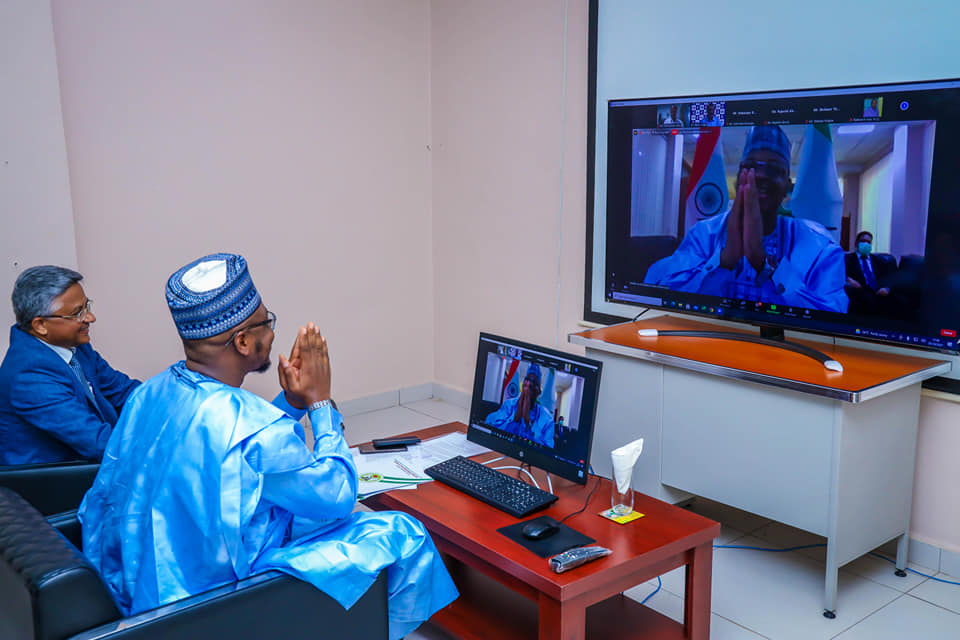
The Minister of Communications and Digital Economy, Isa Ali Ibrahim Pantami (Prof of Cybersecurity) today participated virtually in the India StartUp Week organized by the Indian Chamber of Commerce.

The Minister, Prof Pantami participated from the India High Commission in Nigeria.
In his remarks, Minister Pantami informed the gathering about the promising talents that are readily available in Nigeria with a youthful population that are Digital Natives and so much inclined to digital technology.

The Minister called for enhanced collaboration between India and Nigeria with a view of having a win-win relationship between both countries.


The Executive Vice Chairman (EVC) of the Nigerian Communications Commission (NCC), Prof. Umar Garba Danbatta, has highlighted the various regulatory measures of the Commission toward deepening the adoption of e-Government and other Internet-driven services in the country.

The EVC listed the measures in a presentation delivered during the Nigeria e-Government Summit 2021 recently held in Lagos titled, “e-Government: Opportunities and Challenges”, in which he focused on how government agencies and parastatals can take advantage of advances in Information and Communication Technologies (ICT) to improve service delivery to Nigerians.

Represented by the Commission’s Executive Commissioner, Stakeholder Management, Adeleke Adewolu, Danbatta stated that the NCC has been working assiduously with all stakeholders to deepen penetration of broadband infrastructure and services which support the growth of e-Governance and other critical digital economy objectives throughout Nigeria.

The EVC of NCC said the Commission recently unveiled its second Strategic Vision Plan (SVP)- 2021-2025, which enables it to effectively align with efforts of the National Digital Economy Policy and Strategy (NDEPS) 2020-2030; the Nigerian National Broadband Plan 2020-2025, and other digital economy polices and global best practices.

“Leveraging on the successes we achieved under our previous SVP, we are repositioning both the Commission and the entire industry to facilitate the availability of solid infrastructure and to proliferate digital platforms that effectively and efficiently enable digital inclusion throughout Nigeria,” he said.

Highlighting some of the activities of the Commission geared towards ensuring accessibility to efficient and affordable network infrastructure to power e-Government and other digital economy initiatives in the country, Danbatta, pointed out that, following the presidential approval of the Fifth Generation (5G) Policy, the NCC has developed a 5G Deployment Plan for Nigeria’s digital economy.

Danbatta said the Commission has set up a committee to auction the 3.5 gigahertz (GHz) band for 5G deployment in Nigeria, and the details will be announced in due course. Prof. Danbatta also disclosed that the regulator is currently updating the National Frequency Allocation Table (NFAT) to achieve more efficient spectrum allocation and usage to reflect World radio communications Conference (WRC)-19 recommendations. He declared that the update of the spectrum allocation table is among several other initiatives being implemented by NCC to ensure efficient use of spectrum resource in the country.

Meanwhile, the EVC has said the task of attracting investments into the broadband infrastructure space is a collective responsibility. Thus, he called for increased collaboration of all stakeholders in other to remove barriers to investment which include multiple taxation and regulation, arbitrary pricing of bottleneck resources such as Right-of-Way (RoW), time-consuming and unfriendly approval processes.

“These factors discourage investments in digital infrastructure and reduce the speed at which we provide our people with access to seamless digital service infrastructure for e-Governance and other services,” Danbatta emphasised.

The summit was organised by DigiServe Network Services Limited, in partnership with NCC, the Federal Inland Revenue Service (FIRS), the Association of Telecommunications Companies of Nigeria (ATCON) and the Association of Licensed Telecommunications Operators of Nigeria (ALTON).

Earlier, Executive Chairman, DigiServe Network Services, Lanre Ajayi, in his opening address, said with the advent of democracy, expectations of citizens from governments are higher because citizens rate their governments largely on how efficient and effective government services are delivered to them.

“Hence, e-Government, which is essentially about the deployment of technologies in government processes and service delivery to citizens, provides immense opportunities for governments to deliver services to citizens most effectively and efficiently,” he said.