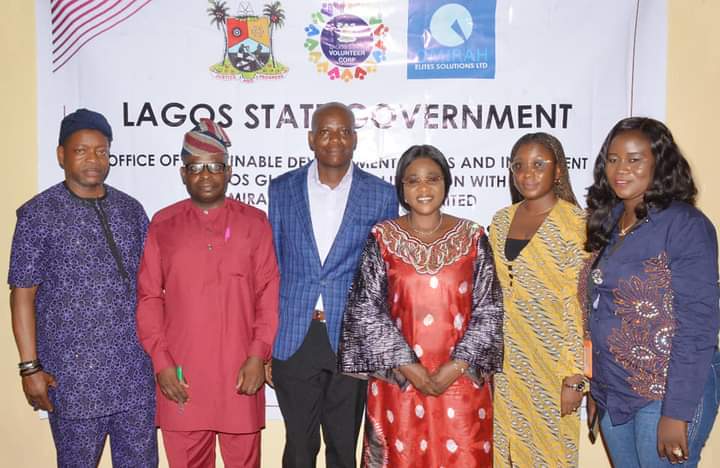
In furtherance of the commitment to strengthen people’s ownership of the development agenda, through enhanced civic engagement and enabling environment for citizens’ action, the Office of Sustainable Development Goals and Investment has concluded the training of 4,500 members of the Lagos State Volunteer Corps (LSVC) on effective execution and delivery of sustainable projects.

Addressing the media at a training session held in Adeyemi-Bero Auditorium, Alausa, Ikeja, the Special Adviser to the Governor on Sustainable Development Goals and Investment, Mrs. Solape Hammond, explained that the training was initiated to scale-up interventions by identifying the gaps in structure and capacity of volunteers towards harnessing the inherent value and contributions they make to social-economic and environmental development of the State.

The Special Adviser said: “Having a structure that assembles individuals, who are passionate about SDGs’ cause and have the requisite skills necessary to carry out the tasks, has inspired the government to further strengthen their capacity and motivate them towards making a meaningful impact in the society”.

Hammond, who was represented at the event by the Permanent Secretary, Office of SDGs and Investment, Mrs. Abosede George, noted that the training programme would go a long way towards deepening the engagement with volunteers, helping them to understand their impact and empowering them to contribute to the attainment of sustainable development goals.

“Given the complexity of volunteerism as a social practice that cuts across different structures, sites, intensities, aspirations and categories, this training offers a critical opportunity to share this administration’s philosophy in providing access to regular support mechanisms”, she enthused.

She explained that volunteerism is a powerful way of encouraging more people to engage in civic and development activities at a local level for planning and action, stressing that the Governor Babajide Sanwo-Olu led administration has strengthened civic engagement, safeguards social inclusion, deepens solidarity and solidifies ownership of development results.

Her words: “The rapid and widespread changes in the social, political, economic and technological landscapes across the globe have heightened citizens’ expectations of the government in creating a broader space for citizen engagement. It is, therefore, critical that you help your volunteers feel ready to jump into their roles”.

Applauding the commitment of the volunteer corps, the Special Adviser stated that volunteerism, as one of the most selfless acts in our life, is indispensable to achieving the goals of the SDGs and it is essential to improve their confidence and knowledge.

She pointed out that while volunteering creates a ripple effect that inspires others, and advances the transformation that is required for the SDGs to take root in communities, it also enhances people’s capacity, builds community participation and social cohesion.

In his remarks, the MD/CEO of OMIRAH Elites Solutions Limited, Mr. Opeyemi Oluleye, who was the lead consultant, enjoined the Volunteers to look beyond immediate benefits while admonishing them to give their best towards making the State the most desirable place to live on the planet.

“While you are giving your time and effort to help others and making a difference in their lives, you are also experiencing many positive effects on your own life. The benefits of voluntary work are extensive through new connections, work experience and skills. It broadens your horizons by increasing empathy, emotional intelligence and enhances your feeling of belonging”, he submitted.

The Volunteers, who were drawn from all the 20 LGAs and 37 LCDAs were trained in batches, with the last batch of 500 Corps participants completing their training on Friday. The training, which was part of the programme to engage the volunteer corps as major stakeholders in the SDGs ecosystem, was designed to add value and advance the scope of the volunteerism structure in the State.

The programme is also part of the yearly activities of the Office of Sustainable Development Goals and Investment aimed at improving the capacity of the State’s Volunteers Corps for seamless project execution and delivery.
LASG

ForAGreaterLagos

…Sets conditions for prospective bidders

The Nigerian Communications Commission (NCC) has officially declared that the auction of the 3.5 Gigahertz (3.5 GHz) spectrum for the deployment of Fifth Generation (5G) technology in Nigeria, will take place on December 13, 2021.

According to the Information Memorandum (IM) presented by the Commission at a stakeholder engagement forum organised on 5G spectrum in Lagos recently, NCC is adopting Ascending Clock Auction format, which is software-based while a mock auction has been slated for December 10, 2021, as a precursor to the actual auction on December 13, 2021.

The IM provides information, conditions, obligations, financial implication, timelines and other necessary details on the planned 3.5Ghz spectrum auction.

The IM also explains the rollout obligations of the would-be eventual winners of the spectrum licence auction, whose reserved price has been pegged at $197.4 million (N75 billion).

The IM also states that only licensees, who make down payment of 10 per cent of the reserved bid price and with 100 per cent regulatory compliance would be allowed to participate in the auction while licensees with outstanding debts that have secured NCC’s approval for a payment plan will be allowed to participate in the auction.

According to the IM, the auction comes with a 10-year spectrum licence and a minimum requirement of an operational Universal Access Service Licence (UASL). However, new entrants or licensees without a UASL will be required to obtain a UASL operational license to be qualified for the 5G licence.

The eventual licensees will have a rollout obligation plan spanning a period of 10 years, beginning from the date of award of the licence. Between the first and second year of the licence, the operators are expected to rollout service in, at least, one state in each geo-political zone.

From the third to fifth year, they are obligated to cover all the zones. Between six to 10 years, they should cover all the states in the country, according to guidelines set out in the IM.

Speaking at the forum, Minister of Communications and Digital Economy, Prof. Isa Ali Ibrahim Pantami, said the Ministry has been working closely with the Commission to ensure that necessary spectrum resources needed for the deployment of 5G network in Nigeria to accelerate the nation’s digital economy space is made available.

Represented by a Director in the Ministry, who is concurrently the Secretary, National Frequency Management Council (NFMC), Abubakar Ladan, the Minister said the 3.5GHz is the most popular spectrum band used globally by regulators and operators for the deployment of 5G technology, and it seems the only band available in Nigeria for immediate use by operators.

In his address, the Executive Vice Chairman of NCC, Prof. Umar Garba Danbatta, listed the various steps diligently taken by the Commission that culminated in present status of the 5G deployment plan. He also reeled out data to justify how profitable investment in 5G deployment will be for potential operators and investors in the country.

According to him, “Nigeria has an estimated population of 214 million, with an average growth rate of 2.6% annually. Approximately 76.46 per cent of the population is under the age of 35. In line with these demographic changes, internet penetration grew from 3 per cent in 2004 to 73.82 per cent as at September, 2021, and broadband penetration increased from less than 10 per cent in 2015 to 40.01 per cent in September, 2021.”

He said while the global impact of Fourth Generation (4G) technology brought about increase in mobile usage and network performance, 5G technology will leverage on this momentum, bringing substantial network improvements, including higher connection speed

, mobility and capacity, as well as low-latency capabilities.

The Forum was well attended by industry stakeholders, including operators, industry associations and groups, advocacy bodies, and the media.

The Association of Licensed Telecoms Operators of Nigeria (ALTON), among others, called on the government to continue to make the operating environment more conducive for the existing and prospective licensees in the telecom ecosystem, in order to enable Nigeria to fully harness and harvest the derivable benefits of mobile technology in the country.

The stakeholder engagement forum was organized in keeping with the provisions of the Nigerian Communications Act (NCA) 2003 and NCC’s tradition of consultative regulatory practice.

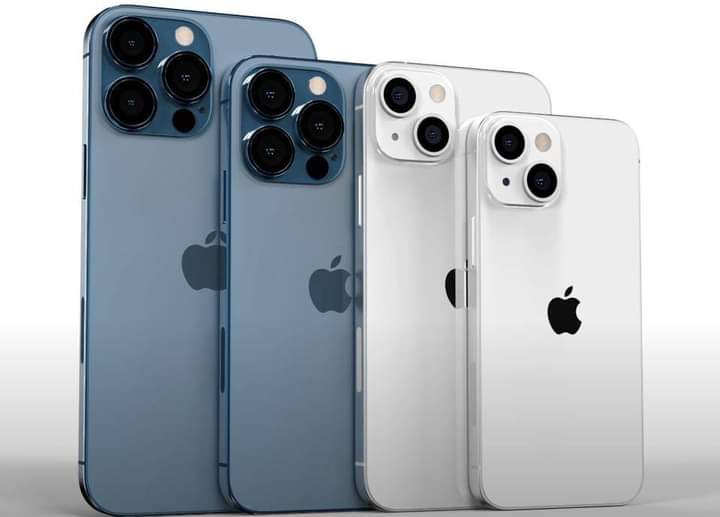
The New York Times shared a perspective that many ‘phonemaniacs’ may be uncomfortable with because it questioned the core of what truly drives their enthusiasm in upgrading their phones even when the one they have can do virtually everything the new phone boasts of offering.

According to the newspaper, buying a $1,000 iPhone can be equivalent to giving up $17,000 in retirement savings or 2,500 cups of coffee. It is the 2500 cups of coffee that got my attention though.

Quoting financial advisers, the NYT says that “by some estimates, an investment of $1,000 in a retirement account today would balloon to about $17,000 in 30 years”.

“In other words, $700 to $1,000 — the price range of modern smartphones — is a big purchase. Fewer than half of American adults have enough savings set aside to cover three months of emergency expenses, according to the Pew Research Center. Yet one in five people surveyed by the financial website WalletHub thought a new phone was worth going into debt for”.

Tech companies, the analysts say, fairly argue that our smartphones are our most powerful tools for work and play and thus worth every penny. But they also play numbers games to downplay the costs of a new phone.

Samsung, for example, has said the price of its new Galaxy phone is $200 — but that’s only if you trade in a year-old phone for credit toward the new one. The true price is $800.

The unsolicited advisers at New York Times admonished that it is worth looking at phone upgrades in a different light to weigh their financial impact. That, they said, can help us make well-considered decisions so that the move isn’t automatic.

Users in five European countries tracked by Kantar Worldpanel — France, Germany, Great Britain, Italy and Spain — are keeping their phones for even longer. From 2016 to 2018, the life cycle of a smartphone was extended by nearly three months, from 23.4 to 26.2. Users in Great Britain logged the longest average of 27.7 months in 2018.

The life cycle of a smartphone in China was relatively shorter at 20.2 months in 2016 and 21 months for both 2017 and 2018.

According to Dominic Sunnebo, global director for Kantar, “The age of poor smartphones is over (in Europe). Most consumers rate their smartphones very highly, so there is less push to change,” he said.

European consumers also believe that the newer devices will be similar in terms of “features and experience,” he added..

Flagship phones from the world’s top three smartphone companies — Apple, Samsung and Huawei — saw an average price increase of 52% in three years. That’s made people less eager to buy new devices.

For me, I think I need a new phone. I have used this ‘akpuruka’ phone for three good years though manufacturers want consumers to change phones every 18 months.

In appreciation of their continuous patronage and support for its brand, the management of Nigeria’s leading road transport company, Peace Mass Transit Limited, recently appreciated some of its customers across the nation.

The gesture was part of their activities to mark this year’s Customer Service Week.

Customer Service Week is an international event devoted to recognizing the importance of customer service and honour the people who serve and support customers with the highest degree of care and professionalism.

The theme for this year’s CSW is “The Power of Service”. The Chairman/CEO of the most sought after transport company, Chief Samuel Maduka Onyishi, thanked teeming customers of Peace Mass Transit for their continuous patronage.

“Safety of our passengers is at the core of our business” the Chairman emphasized.

“The company will continue to provide an affordable and reliable transport system for the people and will use all available resources to become the largest and most efficient road transport corporation in Sub-Saharan Africa” he added while calling for the continuous patronage of their customers.

Chief Maduka assured that PMT will continue to set the pace and break new grounds as the leading transport company in the country.

Celestine( not his real name) started a fintech business with his friends that he met while he was schooling abroad.

The Fintech business model is to make it easy for young Africans to buy cryptocurrency before CBN banned banks from facilitating crypto trading, also the Fintech business model includes a payment wallet where you can pay your bills and they also provide a remittance solution that made it convenient for Nigerians in the diaspora to receive and send money to their dependents in Nigeria.

The business was booming, cash flow was regular and life was fine until EFCC struck.

Apparently, the operatives of EFCC flagged Celestine Fintech’s bank accounts because of the volume of transactions it records daily and those EFCC operatives still living in the analogue age thought they were into Yahoo business or money laundering because they did not understand the model of the business and how it generates billions of naira as monthly revenue.

And so EFCC struck.

On a fine Monday morning like that, EFCC raided Celestine’s office at Ikoyi, Celestine was picked up with his CTO and they were taken to the commission’s office at Ikoyi to explain the source of the funds that move through their account.

Celestine and his CTO called their lawyers to join them at the EFCC office and after interrogation by the operatives of the anti-corruption body, the operatives were not convinced that the Fintech Celestine was running was a legit business.

“Just like that, you people are making billions of naira monthly”?

“Is it how easy it is to make money? EFCC officials queried Celestine and his lawyers.

After 3 days of intensive interrogation by EFCC operatives with documents tendered, the EFFC guys were finally convinced that Celestine Fintech business was legit until they asked one important question- who is on your board?

Celestine and his CTO froze.

They had no one, which was another problem. It took the intervention of Celestine’s dad who is a big man and an elite within the Lagos circle to get his son and the CTO off the EFCC hook.

I learnt a valuable business lesson I had taken for granted before that day-Nigeria is a hostile place to do business but a business with a board of directors made up of reputable individuals is a signal to the system that you are not running a Yahoo yahoo/money laundering business.

Most importantly, you are not running a business that is a criminal threat to the society.

Your startup needs a board of directors to derisk the risk of doing business in Nigeria.

If Celestine had a board with a well-connected individual as the chairman of the board, he would not have spent 3 days with EFCC. It is not possible

What would have happened is that the board of directors would have gotten involved to explain to EFCC what the business does, how they generate their cash flow and most importantly, the chairman of the board would just make a call and Celestine would be freed from the EFCC gulag.

That Obi Cubana is spending his second night at EFCC cell, contrary to the report that went out yesterday that he has been released is because of the absence of a structured board of directors for his Cubana business.

If Cubana group were to have a Nigerian big man /big woman with influence and clout for instance as the chairman of the business, I doubt that EFCC would have arrested him, they would have thought it twice before coming for him knowing that he has a well-structured board of directors that back him up.

Allen Onyema of Air Peace paid dearly for not having a structured board of directors for Air peace airline when he was indicted for money laundering by the American Department of Justice.

If Air Peace has had a board of directors with proper corporate sound practice and structure, Allen would not have made the schoolboy mistake that he did, moving money around for the purpose not intended for it because the board will never allow nor authorize him to engage in such unethical practice but the good thing is that he learned from that experience by constituting board of directors for his Airline business after the indictment.

Air Peace Airline today has a proper board of directors made up of 7 board members, board members who are seasoned men and women and they are expected to bring to bear their experience to the growth of Nigeria’s biggest airline.

According to Iyinoluwa Aboyeji, the only Nigerian tech entrepreneur who founded two unicorn companies (Flutterwave and Andela), Here are five tips for picking the right board members for your Nigerian startup.

1.) Stay away from partisan politicians even if they are in power today. Power comes and goes. If they leave power you will become a casualty of their politics. Instead, focus on those who are apolitical and have served across administrations. Their networks are more widespread.

  1. Try to find someone who sees being on your board as a social mission or with whom you have a personal relationship, not just a business opportunity. This way you don’t have to worry about take over attempts.
  2. Reference board members before you bring them on board. Some board members are trouble. Some have corporate misconduct or political exposure past you don’t want to be affiliated with. Use Kroll or a good background check company.

4 Find someone who is willing to learn from you too. Many board members just want to dispense wisdom independent of context or information about what has changed and what remains important.

  1. Be loyal and build trust with your board members by always keeping them informed. Don’t treat them like rubber stamps. Don’t make major decisions without consulting them. Never bad-mouth them and even when you disagree use emotional intelligence.

There is so much wisdom and power in intergenerational solidarity. I have been very lucky with my older friends. Many older people want to deeply invest in young people. Make it worth their time Iyin concluded.

Another thing to note is that it is not important nor mandatory for these board members to invest in your business, you can invite them to join the board of your business for their clout, experience and contact because When you have EFCC case, Police trouble or regulator Wahala for instance, just one phone call and you are a free man/woman.

Because of Celestine’s experience, the next business I’m about to start with my friends next year will have a solid board of directors with a big man/woman that has clout and contact as the chairman of the startup.

This is very important.

So dear young millennial entrepreneur, your business will not be a small business forever.

One day, it will scale the way Cubana’s scaled so for you to do business in a hostile place like Nigeria where many people are praying for your downfall, a country with so much hatred and vileness, you need to have in place, a proper board of directors for your business with a solid chairman that has clout and contacts of who is who in Nigeria to head the board of the startup.

I’m sure you will not like to sleep over at the EFCC office because the illiterate EFCC operatives do not understand how your business makes money.

A stitch in time they say saves nine

Chukwudi Iwuchukwu

The Institute of Software Practitioners of Nigeria ISPON announces the 2021 edition of the Simeon Agu Prize for the Best Software Entrepreneur of the Year. Established in 2012 in collaboration with the family of Late Engr. Simeon Agu to keep alive his excellent contributions to the software profession and industry, the award is presented annually at the National Information Technology Merit Awards NITMA of the Nigeria Computer Society.

The award is targeted at software startups to recognize their entrepreneurship as they build a fledgling software business.

This year’s award seeks to reward startups for work done from September 2020 – September 2021.

Consideration of the award would be made based on the following criteria:

1.       Idea: what is the general idea behind the startup, how good is it and how does it make the startup rank better than other existing solutions

2.       Innovation: how innovative is the idea, how much of a disruption has it caused and what new trend has it led to

3.       Impact: how much impact does it have on the users, businesses and the industry (where applicable)

4.       Business model: how good is the business model, how scalable is it

5.       Funding: how has the company thrived financially, how much has the company been able to raise and what was the financial turnover. Do note that for consideration, all investor funding must be local.

Per selection of the winner of the award this year, there will be an open process where you can nominate a startup you feel deserves the award and has fulfilled the set criteria.

The panel of judges would shortlist 3 finalists who would be voted for by the general public.

A combination of the number of votes garnered as well as points scored from the technical review of the startup by the judges would determine the winner.

For more information on the process and to make your nomination, do visit https://thesimeonaguprize.ispon.tech

Engr. Simeon Agu, who the prize is instituted in honour of, was the founding President of ISPON. He started his career in information technology at Shell Petroleum Development Company in 1971.

He later moved to the National Electric Power Authority in 1977 as Manager, Systems Development and eventually rose to the position of Director, Computer Services.

He was founder and Chairman of Computer Systems Associates (Nigeria) Limited which metamorphosed into Neptune Software Limited, a foremost international software outfit, growing  it from 3 to over 100 staff with the headquarters in Great Britain and offices in Nigeria, India, Kenya, Uganda, Zimbabwe and South Africa.

Simeon Agu was a distinguished IT practitioner, software industry pioneer, founding President of ISPON, Fellow of Nigeria Computer Society NCS and a member of the Computer Professionals Registration Council of Nigeria CPN. 

As NCC, Danbatta, others receive awards 

As stakeholders in Nigeria commemorate 20 years of telecoms revolution in Nigeria, the Nigerian Communications Commission (NCC) has clearly identified key initiatives being implemented to consolidate the growth and gains of the telecom sector. 

Executive Vice Chairman of the Commission, Prof. Umar Garba Danbatta, listed the digital frontiers while delivering a paper titled: ‘Telecommunications in Nigeria: The Next Frontier’ at the 20th anniversary of the telecommunications revolution in Nigeria organised recently by Compact Communications Limited, at the Muson Centre, Lagos. 

At the event, the Commission received a recognition award “in appreciation of its institutional support to the growth and development of telecoms in Nigeria”. The EVC of NCC also received a separate award “in appreciation of his immense contribution to the growth and sustenance of telecoms development in Nigeria.” 

Represented at the forum by NCC’s Director, Public Affairs, Dr. Ikechukwu Adinde, Danbatta said in the last 20 years, the sector has witnessed significant growth in subscribers, internet usage, investment, innovation, contribution to Gross Domestic Product (GDP) and multiplier effects of the growth in other sectors of the economy. 

Danbatta stated that in collaboration with relevant stakeholders, NCC is driving new frontiers aimed at ensuring consistent growth of the nation’s digital economy sphere.  

According to him, as a foremost telecommunications regulatory agency and consistent with NCC mandate as stipulated in the Nigerian Communications Act (NCA) 2003, and other guiding legislations, the NCC has been at the forefront of leveraging latest technologies and accelerating broadband infrastructure deployment to put Nigeria on the global map of the digital economy experience.  

In this regard, he said NCC was working to ensure increased broadband penetration in line with Federal Government’s targets as contained in the Nigerian National Broadband Pan (NNBP), 2020-2025. The NNBP was launched by President Muhammadu Buhari in March 2020.  

Danbatta explained that the NNBP has a target to achieve 70 per cent broadband penetration among 90 per cent of the country’s population. The Plan also seeks to achieve broadband speeds of 15Mbp and 25Mbps in rural and urban areas respectively over the next five years. 

“The Commission is also driving various initiatives aimed at facilitating the deployment of Fifth Generation (5G) Mobile Technology in Nigeria. 

Prof. Danbatta emphasized that a robust broadband infrastructure will play a key role in fast-tracking the effective deployment of 5G technology and facilitate availability of services associated with 5G technology.  

“Already, the Commission is set to auction some spectrum slots in 3.5GHz band and we have confirmed 97 per cent readiness for 5G deployment in this regard. This is in line with the marching order given to us by Honourable Minister of Communications and Digital Economy, Prof. Isa Ali Ibrahim (Pantami), following approval by the Federal Executive Council to proceed on our 5G Deployment Plan. The Information Memorandum (IM) for the auction had earlier been shared with stakeholders and we are set to auction the 5G spectrum before the end of the year,” he said. 

The NCC Chief Executive also said one of the initiatives being emplaced by the Commission to enhance the attainment of the next frontier for telecom development in Nigeria and the nation’s economic growth, is the ongoing review of licensing structure in the sector. This is to align telecoms licensing process with the wide range of technological advances, convergence of technologies and services shaping global telecoms space. 

Danbatta said the Commission has also finalized review of its Spectrum Trading Guidelines (STG). The STG, according to the EVC, allows spectrum resource in-country to be traded on the Secondary Market through Transfer, Sharing or Leasing (TSL) once the stipulated regulatory conditions have been complied with.  

Danbatta declared that NNBP 2020-2025 requires that these Guidelines be reviewed to ensure that un-utilised spectrum is fairly traded to facilitate rollout by other operators among others. The Guidelines will, therefore, facilitate the country’s yearning for ubiquitous broadband access in line with the economic agenda of the Federal Government. 

As vehicles for implementation of the NNBP, the National Digital Economy Policy and Strategy (2020-2030) and other similar digital economy policies, Danbatta said the NCC has unveiled its Strategic Management Plan (SMP) 2020-2024 and the Strategic Vision Plan (SVP), 2021-2025, which will ultimately drive the next frontier of growth in the telecoms sector. He said the two strategic plans embody critical areas on which the Commission intend to focus toward driving the implementation of the digital economy agenda of the government. 

He stated that the two regulatory documents (the SMP and SVP) encapsulate the totality of regulatory and policy initiatives, designed to re-invent and transform the telecom ecosystem, within the context of regulation, to a greater height. He added that this, to the Commission, is the next frontier for the sector. “While emerging technologies are disruptive by nature, Nigeria cannot afford to lag behind digitally and this explains Commission’s engagement with developmental regulations for the industry and we are irrevocably committed to this,” he said. 

Other individuals bestowed with recognition awards at the event include Former President Olusegun Obasanjo; and the former EVC/CEO of NCC, Dr. Ernest Ndukwe, both for pioneering the Global System for Mobile Communications (GSM) revolution of 2001. The Zenith Bank also received an award for being at the forefront of leveraging technology for powering financial services delivery. Among the journalists who received awards is a veteran ICT journalist/Publisher, E-World News, Aaron Ukodie. 

26-year-old Onyinye trapped under collapsed Ikoyi high-rise building— one week after joining Fourscore Homes

On Monday morning, Onyinye Enekwe, a graduate of the Nnamdi Azikwe University, left for Ikoyi where she worked as second personal assistant to Femi Osibona, owner of Fourscore Homes.

Chinedu Enekwe, her cousin, said she joined Fourscore Homes the week before.

Around 2pm on Monday, the building collapsed, with Onyinye and several others still trapped in the rubble as of Wednesday afternoon.

According to Chinedu, the family has heard nothing from Onyinye since the building collapsed.

“She left her elder sister’s house around 6am for work on that day,” he told TheCable.

Chinedu added that Onyinye had taken a picture of her at the site, which she sent to her older sister just as she arrived at work on Monday morning.

He said the family has received “no information” from the Lagos State Emergency Management Agency (LASEMA) and National Emergency Management Agency (NEMA) or other rescue workers concerning her whereabouts.

Chinedu, however, said the family members are praying for her safe return.

“We’re hopeful. We believe she will be found. We are in prayers for her to be found,” he told TheCable.

There is no official figure of the number of persons who were in the building before the incident happened, but over 50 people are said to have been trapped.

TheCable had reported that Osibona is also believed to be trapped in the rubble as he hasn’t been seen since the day of the incident.

As of Wednesday, the death toll had risen to 22, while nine persons have been rescued.

Credit: The Cable

Rainoil Limited, a leading player in the downstream oil and gas industry, has completed the acquisition of majority shares in Eterna Plc, a publicly listed oil and gas company.

This was achieved following the successful purchase of majority shares of Eterna Plc, through its investment arm – Preline Limited.

On the 21st of December 2020, Eterna Plc issued a public statement notifying Shareholders, The Nigerian Exchange Limited and the general public of negotiations by substantial shareholders to sell equity holdings in the Company. On the 25th of August 2021, Eterna Plc announced the execution of a Sale and Purchase Agreement (SPA) enabling Preline Limited acquire 794,969,774 shares.

Commenting on the transaction, the Group Managing Director, Dr. Gabriel Ogbechie said: “The acquisition is in alignment with our targeted expansion strategy across the oil and gas value chain, and will position the Company for sustainable growth and superior value creation for all our stakeholders. It also underlines our commitment to Nigeria at this critical evolution point of the Energy Sector. We also expect that this will reinvigorate the fortunes of Eterna Plc and optimize the Company for improved performance.”

Over the past 24 years, Rainoil Limited has increased its asset base to include:

Three ultra-modern petroleum product storage depots in Delta, Cross River and Lagos States
An 8,000 metric tonne LPG storage facility in Lagos State

Over 100 retail outlets spread across the country
A fleet of over 140 petroleum product tank trucks for delivery of products to its network of stations and customers across the country

Chukwudi Iwuchukwu

Chukwudi! Welcome to my house, how are you today?

I’m very fine sir, I replied to a man who is a successful billionaire businessman (name withheld) and whose humility for all his wealth is very infectious.

Did I tell you that I bought a new car to celebrate my Mircalious recovery from Covid 19? my guest asked me after we are done with pleasantries.

No sir, I did not hear. Was it the 2021 Landcruiser that you bought some time this year.

No, that one is now an old car. it now has an elder brother. It was on the internet he continued, I drove it out not quite long for an event, your people(bloggers) decided to take a picture of it and upload it on the Internet.

It went viral! I’m surprised that you did not hear, you that is the minister of information and very current.

Viral? which car is that? I asked

It is Toyota Landcruiser 2022, I made the order sometime this year straight from Japan and I think I’m the first human being driving the model of the car in the whole of Nigeria. He said, with this air of accomplishment written all over his face and he has every reason to be proud of himself.

Come, let me show you.

As we walked to his garage, I remember the Viral 2022 Toyota Landcruiser seen on Lagos road that went viral a few days ago and was on so many auto blogs that include Autojosh and Supercars. I did not imagine that the car belonged to my senior friend and chief.

As he was showing me the interior of the new Whip that he bought, I saw a man proud of himself, of his journey and how far he has come.

My senior friend arrived in Lagos in the ’90s as Nwa Boy(apprentice) from his community in Anambra state to serve his master, penniless, broke but he had huge dreams.

Dreams to change his life, dreams to start and run a successful business and then live a baby boys life on his terms and conditions.

He did not seek anybody’s permission to be successful. He believed in the power of his dreams and took the steps to make them happen.

As we were going back to his magnificent mansion after he has shown me the car, I was way more than proud of Igbo traders which my friend is the poster boy for me at that moment, successful Igbo traders who are living the Nigerian dream, building flourishing businesses despite Nigeria and not because of it.

Igbo people have a reputation in Nigeria and probably throughout Africa, as resilient, dogged traders who build viable small-to-medium size enterprises which are completely independent of government.

As we were gisting, now seated inside his expansive sitting room, my friend shared with him his close shave with death and how he survived Covid 19.

I went to the land of death and came back. That experience changed me forever, that is why I want to be intentional in the way I live my life going forward, I want to enjoy my life and just live without anybody’s permission.

COVID 19 is real and it is deadly, he said as he waved me off.

On my way home, these thoughts have been playing on my head:

The typical Igbo trader is has been caricatured for decades in Nigeria, but there are many things that we can all learn from him. More than anything the Igbo trader is a symbol of aspiration of that Nigerian dream that anything is possible, you can change your life on your own terms living in Nigeria and I feel this quote exemplifies him in many ways.

“Nothing in this world can take the place of persistence. Talent will not: nothing is more common than unsuccessful men with talent. Genius will not; unrewarded genius is almost a proverb. Education will not: the world is full of educated derelicts. Persistence and determination alone are omnipotent”

-Calvin Coolidge