First Lady of Nigeria, Dr. Aisha Muhammadu Buhari has commended United Nations Fund for Population Activities (UNFPA) over its commitment to RMNCAH+N. She expressed happiness that the agency has lived up to its billing concerning the health of women and children across the world. She was speaking during a courtesy call by officials of UNFPA led by Assistant Secretary-General of the United Nations and Executive Director UNFPA, Dr. Natalia Kanem, on Thursday 25th November 2021, at the State House, Abuja.

Mrs. Buhari addressed UNFPA as worthy partners for sharing in the strategic vision of Future Assured in advancing the agenda of Reproductive, Maternal, Neonatal, Child, Adolescent Health and Nutrition (RMNCAH+N).

“With this support”, she said, “we have in the past 6 years achieved numerous successes, especially in bridging some of the gaps limiting the delivery of comprehensive and quality RMNCAH+N services.”

She made reference to the recent celebration of the 6th anniversary of Future Assured where successes, challenges, and lessons learnt were enumerated as part of an accountability obligation. Although much has been achieved, she said, more needs to be done.

Mrs. Buhari also informed the United Nations delegation of her recent election as President of African First Ladies Peace Mission (AFLPM) which, she said, comes with the greater responsibility of leading African First Ladies to contribute to peace and development in the continent. She called for the support of the international community in this regard.

Earlier, the Executive Director, Dr. Natalia Kanem said she was in Nigeria as part of the celebration of the annual 16 days of activism against gender-based violence, saying the figures indicate we are not out of the woods yet, but it is encouraging to see that the death rates are reduced and moving downwards. She commended the First Lady for cascading her programmes through the states’ First Ladies to reach the grassroots.

The Executive Director was accompanied by the Regional Director of UNFPA, Dr. Argentina Matavel, and Nigeria Country Representative, Dr. Ulla Mueller. The Meeting was also attended by the Hon. Minister of Women Affairs, Dame Pauline Tallen.

Aliyu Abdullahi

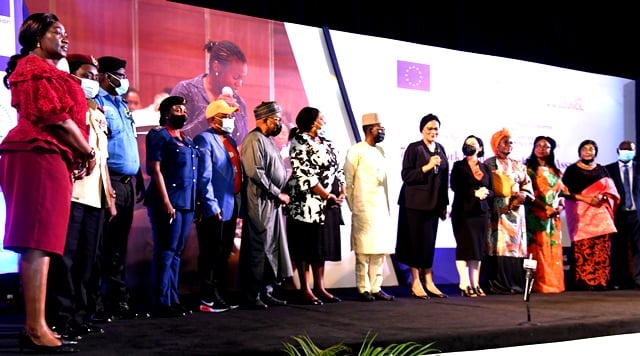
The Honourable Attorney General of the Federation and Minister of Justice, Abubakar Malami SAN, represented by Ag. Director, Planning, Research and Statistics Barr. (Mrs) Victoria Fila Ojogbane, has categorically affirmed the support of the Ministry toward the establishment of special courts to prosecute Sexual and Gender Based Violence (SGBV) cases in the country.

The HAGF made this affirmation during the 7th Network Conference on Sexual Assault Referral Centres (SARCs) jointly organized by Federal Ministry of Justice, FCT High Court, National Agency for the Prohibition of Trafficking in persons (NAPTIP) and the Rule of Law and Anti-Corruption (ROLAC) Programme. The theme for 2021 is the Imperative for Special Sexual and Gender Based Violence (SGBV) Courts as part of events lined up for the sixteen (16) days of activism against gender based violence in commemoration of International Day for the Elimination of Violence against Women.

‘It is my firm believe that the creation of Special courts to handle cases of sexual and gender based violence will improve the effectiveness of courts services, ensure support for the victims, improve victim participation in the prosecution of their cases and promote efficiency and better information sharing’. The HAGF stated.

‘In the pursuit of this essential need, I approve the constitution of a Federal Special Prosecution Team comprising of investigators and prosecutors from the Ministry, NAPTIP, Nigerian Police Force and other Agencies for training and other incidentals tailored towards achieving the ultimate goal of improving access to justice by survivors of SGBV’. The HAGF further stated.

The HAGF used the opportunity to appreciate and thank development partners particularly the European Union, United Nations Agencies, ROLAC, UNICEF, UNODC as well as Ministry of Women Affairs, Ministry of Humanitarian Affairs, Disaster Management and Social Development among others especially in relation to building capacity of critical justice actors and in supporting the Ministry’s efforts at galvanizing synergy among justice and law enforcement actors.

In her opening remarks, the Honourable Minister of Women Affairs, Dame Pauline Tallen OFR lamented the huge number of pending sexual related cases in courts. She assured that her office was taking all necessary steps in collaboration with the Federal Ministry of Justice, Office of Chief Justice of Nigeria, National Assembly and development partners to expedite action on the pending cases and get justice for the victims.

‘Women and children that are being violated are too huge. The number is too huge to be ignored and these are future mothers. And it is not only the girl-child, even the boys. The number of boys that are violated and being abused is also huge. We can’t sit and do nothing. They are our future mothers and future leaders’. She declared.
While delivering his keynote address, the Chief Justice of Nigeria, Hon. Justice Ibrahim Tanko Muhammad, represented by a Justice of the Supreme Court, Justice Amina Augie, advocated for synergy between security agents, the public and the media in tackling the prevalent problem of gender based violence.

‘Courts do not go looking for cases but courts entertain cases brought to it by the public’. The CJN stated.

He therefore urged the Media to step up reportage on violence against women and girl child adding that cases of violence against women were being under reported.


The CJN further pledged the commitment of the courts to working with the Federal Ministry of Justice and the Ministry of Women Affairs in speedy prosecution of the offenders.

Aderemi Adelabu

As the pandemic dispersed the workforce, necessitating more sophisticated means to connect, collaborate and communicate, digital transformation became a business imperative. Fikile Sibiya, CIO at fintech specialist e4, explains why a roadmap for the future is essential in this transformation, and elaborates on what it should entail.

Organisations in diverse industries are transforming their business models by embracing modern technologies to enhance their product offerings, client experiences and ways of doing business. Though this shift was already happening pre-pandemic, it has sped up considerably since 2019.

As all this analogue-to-digital transformation is occurring, and occurring at a fast pace, the existing workforce often does not have the requisite skills to keep up with the evolution. Bringing the workforce along on the organisation’s digital transformation agenda involves re-skilling and upskilling the workforce, at all levels, to understand and effectively work with and apply digital technologies.

Why a roadmap is important

When approached correctly, an organisation’s investment in technologies that empower their workforce see a major improvement in employee engagement and business performance. But with no roadmap, an investment that seems ground-breaking on paper never fully translates to the real world.

Technology is the foundation of digital transformation, but the workforce is the driving force. A roadmap gives clarity on the organisation’s transformation vision and helps the workforce create a link between their work and the organisation’s strategic objectives. It also empowers the workforce to make informed decisions that support the strategic imperatives of the organisation. Moreover, it provides a clear guide on skills and knowledge gaps and how to address these.

With a clear roadmap and proper implementation, digital transformation can empower the workforce of today with self-service capabilities, more robust data driven decision-making to deliver superior customer experience, automation of key processes which leads to efficiencies and enhanced productivity, and enhanced mobility and flexibility. 

What a roadmap should entail

Firstly, organisations need to galvanise the workforce. The vision of digital transformation and what it means for the workforce needs to be palpable and exciting. It is about establishing a culture of innovation and digital curiosity. Organisations, therefore, need to clearly define and articulate the vision and the goals for the transformation and draw the link between the overarching strategy to the day-to-day activities of employees. Organisational leaders must also design a compelling experience for employees. This can be achieved by organisations implementing digital tools to make information readily accessible.

Secondly, it is crucial to not only invest in technologies, but also in people. Organisations need to upskill people strategically, often starting with high-impact roles. Invest in change management initiatives and efforts that are a catalyst to behavioural change. Empower the workforce with access to relevant and timeous information.

Furthermore, using a blend of technologies is important. These technologies, when used efficiently, assist in employee productivity, engagement and efficiencies. But, while building a culture of digital curiosity, cybersecurity needs to be built into solutions as data breaches have recently become a big concern for almost all organisations. Examples of these technologies and solutions are:

  • Communication and collaboration tools
  • Work/task management systems
  • Document management platforms
  • Virtual assistants (VAs)
  • Data analytics
  • Cyber security
  • Technology-integrated workflows

The transformation journey should also be collaborative, and the workforce needs to be active participants. Employees have the best understanding of the on-the-ground customer experience, they know the flaws or weaknesses in business processes. It is important for organisations to encourage employees to be invested in the transformation by leading the innovations. Unlock potential by giving employees a level of autonomy to determine how, where and when to digitally transform their operations.

In the end, the human aspect should be at the heart of any transformative journey – not only with regards to re-skilling and upskilling people to effectively use modern technology solutions, but also managing attitudes towards these solutions. It is about going beyond understanding the need to change and adapt, to creating a culture where the workforce defends and promotes the use of technology. A culture where tomorrow is created today.

The IDC forecasts that South Africa’s IT spend will be $12.78 billion (R197 billion) in 2021, an increase of 5.2% over the previous year. One of the biggest contributors to this figure is software and cloud spend, which has grown exponentially since the start of the pandemic.

As organisations rushed to enable remote working, many companies hastily procured software without being fully informed of their longer-term needs. This has potentially resulted in rigid multi-year contracts, overspend on licensing, limited processes in place to manage and control usage and therefore spend, leading to severe implications for future budgets.

As the local business world settles into a hybrid of remote and office-based employees, software requirements will change again. Staff numbers may have changed, requiring a greater or reduced number of software licenses. Some on-premises applications that are licensed by location will be back in use and may need additional licenses. In addition, to ensure remote workers are kept safe, different license SKUs – like E5 Microsoft 365 with added security features – will be required. But not all employees will require that level of security, and an E1 or E3 license may be a more cost-effective fit for them. 

Now is the time to rethink software spend to ensure your tech budget is optimised, while avoiding sizeable non-compliance fines, and guaranteeing new ways of working are adequately supported.

Overspending culprits

International research firm Gartner estimated in 2020 that unused software may represent more than 20% of software expenditure in the average company. Wastage is often attributed to specialist programmes such as design software being deployed across the company, though only a few employees have the knowledge to use them to their full advantage.

Equally, this can leave a business at the mercy of the vendor if non-compliance is claimed following an audit. One in three pieces of software in South Africa is unlicensed, according to the BSA. This could open the company up to thousands, if not millions, in non-compliance bills. Having visibility into suspected non-compliance, applying the fixes needed, and, importantly, having a trusted partner to negotiate with the software vendor, can make all the difference.

On the other hand, organisations can cut software costs by 30 percent by implementing IT asset management. This helps to reduce the risk of non-compliance and its associated costs, as well as find areas to improve ROI on tech spend.

Software audit

To fully understand your software position, an internal audit is crucial. This shouldn’t be a once-off event but should be revisited annually as needs change over time – especially during and after the pandemic.

Such an audit should include an initial inventory of software assets, both on-premises and in the cloud, and the number and type of licenses (entitlement) that you have purchased. This data will allow you to assess any new, or old, software / applications that have been deployed and validate your compliance against the vendor contract.

With a clear picture of the company’s software estate, start looking at ways to reduce cost, such as removing unused software or moving to consumption-based contracts. By making sure you understand your unique business requirements and software estate year-round, you can revisit renewal negotiations annually, and consider renewing earlier in the quarter to take advantage of better pricing and discounts.

Internal audits and software tracking can be difficult to manage in-house. Interpreting complex software contract terms & conditions, reviewing purchase records and license entitlements, and taking effective remedial action where needed, often requires specialist knowledge. Consider investing in an external partner to help you navigate this process and who can continue to monitor your software situation on an ongoing basis.  SoftwareONE’s professional services have provided invaluable insights and savings to our customers.  Since the start of Covid-19 lockdown, we have on average seen a 97-1 return on investment, which means that for every rand spent, ninety seven is saved from either an audit, an agreement renewal, an optimisation of on-going cloud spend, or a proactive reduction of identified risk and non-compliance.

As digital transformation accelerates, it will become even more important to make the most of your IT investment. Making smart software decisions isn’t simply about getting the best price but ensuring you’re getting the best solution for your unique business.

By: Marilyn Moodley- Country Leader for South Africa and WECA (West, East, Central Africa) at SoftwareONE


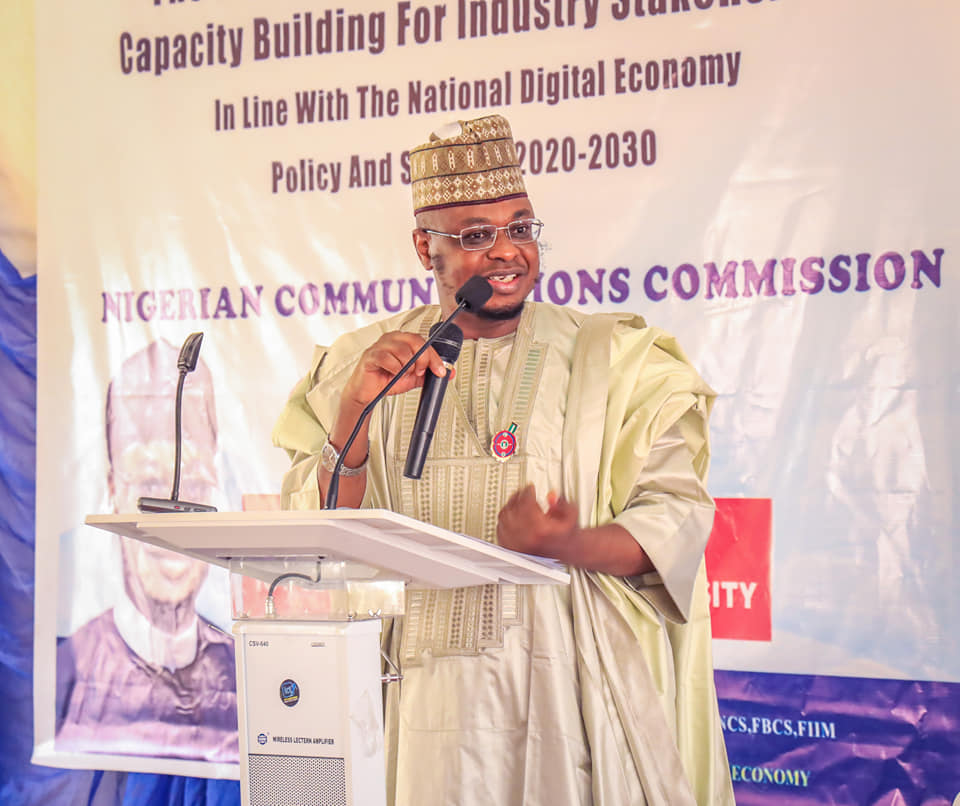
The Minister of Communications and Digital Economy, Prof. Isa Ali Ibrahim (Pantami) today flagged off FG’s Digital Entrepreneurship Programme for Industry Stakeholders taking place in Gombe State University (GSU), Gombe, Gombe State.
The capacity building programme is aimed at enhancing Digital Literacy and Skills, in line with the implementation of the National Digital Economy Policy and Strategy for a Digital Nigeria.

Prof. Pantami while making his remarks urged the participants to embrace the spirit of Digital Innovation and Entrepreneurship, stressing that, they are the two prerequisites for a Digital Economy.

The Minister cited an example with MIT which is one of the most successful institutions globally because it adopted a Regional Entrepreneurship Acceleration Program (REAP) which helps accelerate economic growth and promote social progress through innovation-driven entrepreneurship (IDE).

Minister Pantami informed the gathering that the focus today across the globe has shifted from paper qualification to skills.

“Tech Companies like Amazon, Uber, Google are successful because they were able to identify a problem in the society and proffer a solution”. The Minister said.


Pantami urged the participants to strive to possess soft skills such as Critical thinking, analytical thinking, collaborative thinking, creativity, and problem solving.

The Nigerian Communications Commission has again given  expression to its commitment to reach all categories of telecom consumers, with the launch yesterday in Benin, of a consumer-centric outreach programme tagged, “Shine your eyes, no fall mugu”, which literally translates to, “Be alert, Don’t be a victim of fraudsters”.

An initiative of the Commission’s Consumer Affairs Bureau (CAB), the programme is specially conceived and implemented using Nigerian pidgin. It’s intended for a segment of telecom consumer population who are more comfortable with localised communication that resonates with their reality.

The two-day programme, implemented in three phases, started with a road show yesterday. The Show featured local artistes and comedians who displayed musical and other performances to amuse and entertain people to create awareness and sensitise telecom consumers about how cybercriminals may use telecom platforms to defraud unsuspecting members of the public.

Today, the last day of the two-day event, will feature a 20-minute radio talk in Nigerian pidgin, to further create awareness and like the roadshow, to invite telecom consumers to an enlightenment forum where presentations will be made about tricks deployed by cybercriminals to defraud people online. The presentations will also capture measures to be taken by consumers and members of the public in order not to fall victim of fraudsters who may use telecom platforms to perpetrate fraudulent acts.

Additionally, at today’s enlightenment forum, drama, audio narratives and other attractions thematised on the centrality of vigilance, alertness and caution in the cyberspace by all users, will be featured.

The programme is facilitated by a local partner who supports NCC, by mobilising critical segments of the public through opinion leaders and social groups to participate in the events, in order for them to be armed with the right information they may require to explore the Internet safely. These leaders and members of the public attending the forum, are expected to re-diffuse the messages to other members of the public and others in their socio-cultural groups.

This programme, coming on the heels of NCC’s National Cybersecurity Awareness Month (which occurred in October), and the annual National Cybersecurity Conference, which took place on 3rd November, 2021, is meant to reinforce the messages of cyber awareness, cyber vigilance, and cyber smartness to telecom consumers whenever they are online.

The roadshow yesterday commenced at Ekehuan Road, and the procession drove through Airport Road, to State Secretariat, Sapele Road and through round about to Ring Road, to Akpakpava, Dawson Road and back to Ugbowo and Uselu Market. The motorcade, the music, the displays by artistes and the underlying narration of the message of the outreach in Nigerian pidgin caught the attention of residents and passers-by who patiently listened to the messages. Information, Communication and Education (IEC) materials were also shared with the public at every neighbourhood the procession stopped to display and educate the public.

More mobilisation campaigns and awareness creation will be made during the radio component of the sensitization today, happening at Vibes Radio, 97.3 FM at 8.45 a.m. Thereafter, the Enlightenment Forum will take place at Obey God Events Centre at Nova Road, opposite Uwasota Junction, Benin.

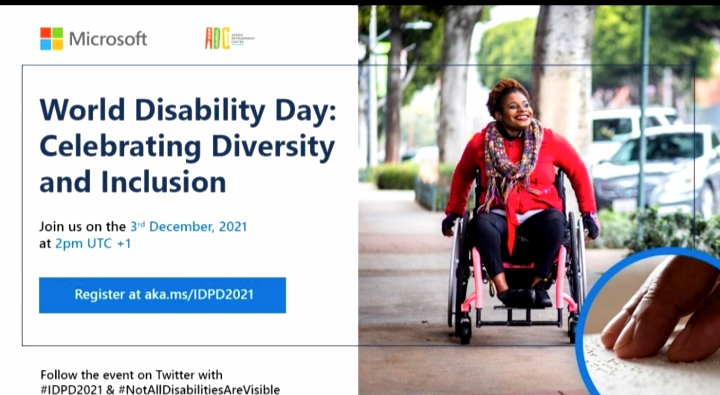
…Microsoft ADC Disability Inclusion event is aimed at identifying the stereotypical perspectives affecting the employment of talent living with disabilities.

Microsoft Africa Development Center (Microsoft ADC), the engineering center for Microsoft is set to host a Disability Inclusion event across Africa focused on engineering and non-engineering talents living with disabilities on the 3rd of December, 2021. The event is diversity-centered and will encourage the inclusiveness of people living with disabilities in key career paths, while also raising awareness about the potential of talents living with disabilities. The event will showcase appropriate facilities, programs, and tools well suited for people with disabilities to achieve functional change.

The event will cover the Microsoft Accessibility- an essential tool used in delivering on Microsoft’s mission which is to empower every person and every organization on the planet to achieve more, and also unveil the next phase of the accessibility journey, our companywide commitment to creating and opening doors to bigger opportunities for people with disabilities and bring together every corner of Microsoft’s business while focusing on these three priorities: Spurring the development of more accessible technology across the industry and the economy, using the technology to create opportunities for more people living with disabilities to be included in the workforce; and building a workplace that is more inclusive for people living with disabilities.

Presenting the keynote at the Microsoft Disability Inclusion Event, Jack Ngare, Managing Director, Microsoft ADC- Kenya, noted ‘’More than one billion people around the world live with a disability, and employment rates are relatively lower and poverty rates are higher for people with disabilities than for those without disabilities. From our 25 years of work on accessibility at Microsoft, we at ADC have learned that people with disabilities represent one of the world’s largest untapped talent pools, and that inclusion of disabled talent is crucial to achieving our mission. Our employees with disabilities continue to be the catalysts of our innovations such as Learning Tools, live captioning in Teams, , Seeing AI and many more. We continue to actively work to hire and nurture people with disabilities to bring their expertise into our processes, products, and culture at every level.”

Speaking further about the importance of the Microsoft ADC Event, Sophie Okonkwo, Engineering Talent Sourcing Specialist, Microsoft ADC, added “Diversity in the workplace is an essential component of any highly inclusive organization like Microsoft. Organizing this event to engage people with disabilities and allies in the Africa tech ecosystem is imperative, as the awareness of disability and inclusion needs to be widespread. The Microsoft Africa Development Centre Disability Event aims to celebrate the ability in disability and bring to the fore, the limitless possibilities that people with disabilities can achieve in an inclusive world”.

The Microsoft ADC Disability Inclusion event is an open to all virtual event to commemorate the International day of persons with disabilities in Africa as well as reveal the ecosystem of Microsoft’s commitment to creating a diverse and inclusive workforce and work culture. The event’s activities are backed up by organizations affiliated with Microsoft Africa Development Centre, and participants would have access to a wide range of mentors and speakers.

About Microsoft ADC
Microsoft Africa Development Center (ADC)represents Microsoft’s first-ever engineering offices in Africa, with locations in Nairobi, Kenya and Lagos, Nigeria. These centers were created by Microsoft to serve as a base for African industry leaders to create local solutions with global scalability as well as provide employment opportunities and further enhance technological innovations in the continent of Africa.

About Microsoft


Microsoft (Nasdaq “MSFT” @microsoft) enables digital transformation for the era of an intelligent cloud and an intelligent edge. Its mission is to empower every person and every organization on the planet to achieve more. For more information, news and insights from Microsoft, please visit Microsoft’s news center at http://news.microsoft.com and or Middle East & Africa News Center (microsoft.com)


Lately, the Christendom especially in Nigeria has been under scrutiny. Many true men of God have risen up to speak against the monetization and commercialization of the gospel of Our Lord Jesus Christ. A lot of “pastors” have used the name of Christ and Christianity to fleece people their hard-earned money under different mode such as seed, offerings etc. having seen this, a true man of God, Ephriam Ononye, the General Overseer of Ephraim Ononye Ministry Worldwide has risen up and condemn these obnoxious acts many of these false prophets do. And they have come out to fight him from spiritual warfare to the physical warfare, this is to show how desperate these some of these called men of God can be.
Speaking to the media, Pastor Ephraim said” all these things are all happening because they want to get me down. They have done everything to ensure that I am down but God being with me has been vindicating me”


“I am a preacher and I have been in the ministry for twenty-four years; I have seen God do wonders and I must say, prophecy is real and miracle are real. But I find it hard why people are trying to blackmail me for exposing their tricks. They are bringing bad name to the Christian faith. How can you extort people in the name of prophecy and miracle and this ha made people weak to go to church and this is because they have been extorted, duped and distorted? “


He added “Because of their experience, people do not go to church these days. God mandated me to expose their tricks and this is what I have been doing in media for years. They have ganged up to silence me using blackmail and whatever. Their plans are to bring up cases that will make people see me as a devil and people would no longer listen to me. Their tools are rape case, murder case etc. they planted a young lady and made her confess that I raped her and the police invited me and found me innocent.”


He also opined that “They insisted that I should be charged to court and they are ganging up seriously and though, in their midst they have the Judas and this their Judas is the one giving me this information. They want to soil my name and they know that I do not have case but that is not their concern but that of media circulation. This is their concern. This is to show how desperate people are. I am using this medium to let the world know their plan.”


“I call on the general public to take over this investigation because I will always be available to assist the investigation. God gave us the grace to serve him and He never demanded money from any of us. I wonder why these people or pastors are asking money and deceiving people with fake and stage-managed miracles and prophesies and my work is to keep letting the world to know the truth. That is my mandate”, Pastor Ephraim concluded.

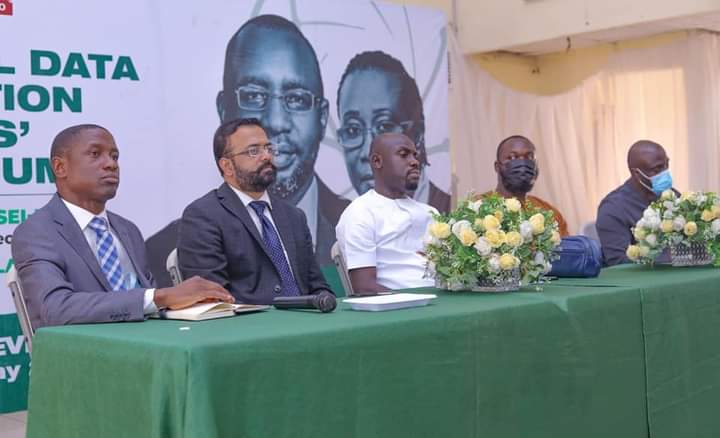
In its commitment to upscale Data Protection in Nigeria, the National Information Technology Development Agency (NITDA) has begun the process of licensing and partnering with a qualified institution to set standards, prepare exams and issue certifications on data protection skill in the country. These processes are part of the implementation of the Nigeria Data Protection Regulation (NDPR), a subsidiary of data legislation in the country.

The Director General of NITDA, Mallam Kashifu Inuwa, CCIE, strongly advised on the need for Data Protection Officers (DPOs), during a hybrid Symposium organized for Lagos State DPOs, saying; “data protection officers should constantly keep themselves abreast of trending innovations in keeping their data credible”.

Inuwa, while admonishing DPOs to improve their capacities by adopting best practices for Data Privacy, stated that Artificial Intelligence and Cloud Services are essential elements in safeguarding data from breach thereby enhancing the integrity of data.

He argued that it was pertinent to incorporate artificial intelligence into data protection to enhance its accuracy and consistency. He further disclosed that there is need to sieve and categorize data elements which will determine the cloud adoption strategy to be used.

The DG also added that there is need to create professionals in the data protection ecosystem to meet global standards. “One of the ideas we are mulling is to have an industry association for DPOs and the proposed DPO Forum that would be a peer review mechanism and a point of contact with regulators to shape policies and propose standards for the industry”, he said.

According to Inuwa, since the issuance of the NDPR in 2019, NITDA has empowered DPOs by drafting, engaging the public, and publishing the NDPR Implementation Framework to shed light on the provisions of the NDPR for easy interpretation and application.

He further noted that the Agency’s partnership with the DPOs has created over 7,600 new job roles in the Data Protection sector. “We envisage that Nigeria would lead Africa by certifying 350,000 persons with local and global competence in data protection by 2024”, Inuwa averred.

The Executive Commissioner of Ghana’s Data Protection Commission GDPC, Her Excellency Ms. Patricia Adusie-Poku, in her remarks applauded NITDA for the laudable initiative in organizing the symposium to add knowledge value to DPOs.

She stated that DPOs are like risk managers in their organizations and it is their responsibility to ensure that all requirements are put in place to checkmate data breach and promote Data Protection.

The symposium had in attendance, Mr Ridwan Oloyede from TechHive Advisory, Mr Yaya Itai from First Bank Plc, Mrs Moyosore Jide-Taiwo from Airtel Nigeria, Dr. Alexander Anago, Mr Bharat Soni from GTCO and a host of other data protection officers from various organizations.