


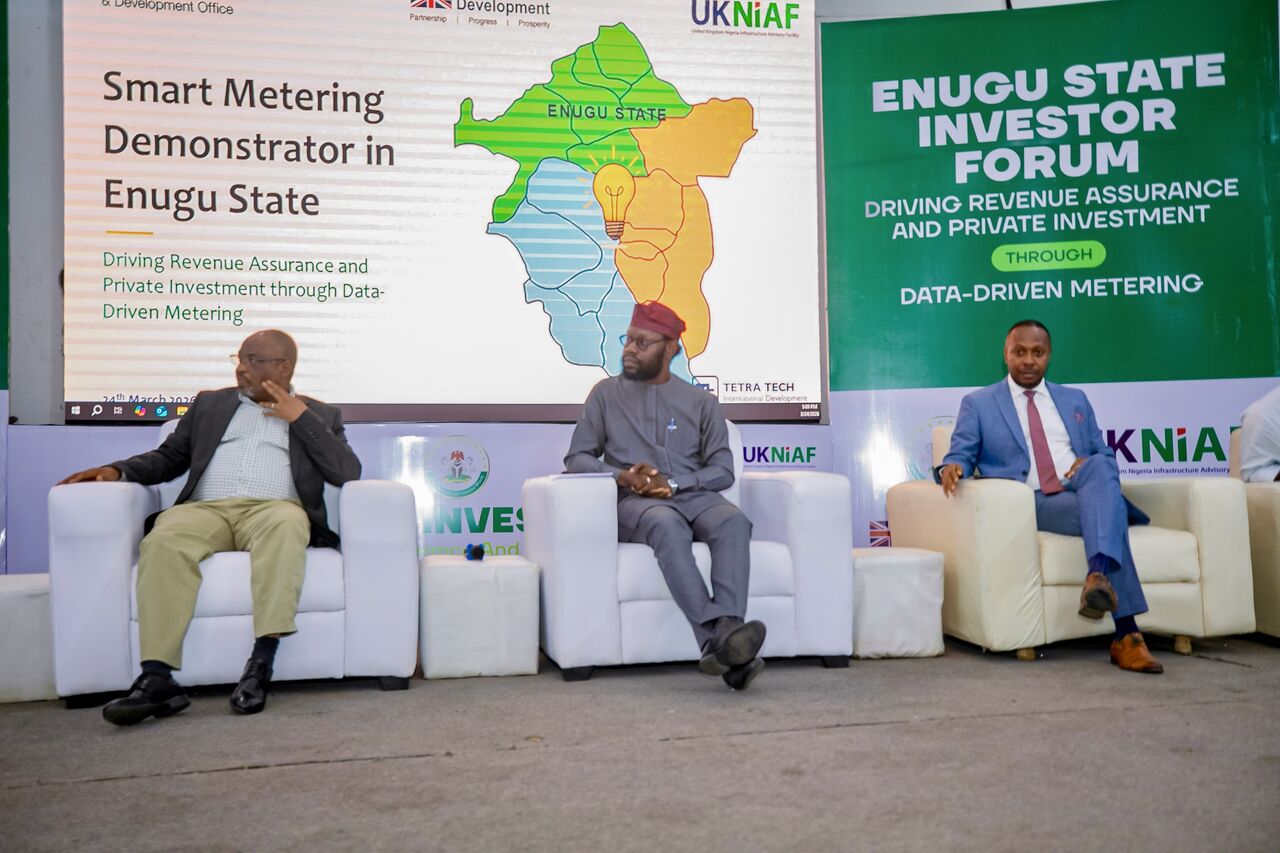






Discussions at the Enugu State Investor Forum have underscored revenue certainty, rather than technology alone, as the primary factor in attracting private investment into Nigeria’s power sector.
Speaking at the forum, Vice President for Project Finance and Advisory, Damian Attah, who served as a panelist at the event themed around driving revenue assurance and private investment through data-driven metering, said that smart metering systems only become attractive to investors when they improve the predictability and reliability of cash flows.
According to Attah, the core challenge facing the sector is not the availability of technology, but the ability to ensure consistent revenue collection.
“Investibility is driven by revenue certainty, not technology,” he said, adding that smart metering becomes viable when it transforms unpredictable cash flows into contractually secure and defensible revenue streams.
He noted that while advanced metering infrastructure, including artificial intelligence-enabled systems, can help detect tampering, predict default patterns, and provide real-time loss analytics, their true value lies in strengthening revenue assurance mechanisms.
Participants at the forum emphasized that predictable revenue flows are critical to making power projects bankable and attractive to private investors. Attah explained that when reliable collections are supported by structured mechanisms such as output-based contracts, escrow arrangements, and collection guarantees, projects can transition from being grant-dependent to commercially sustainable.
He also highlighted the importance of an enabling environment for private sector participation, pointing to the need for credible regulation, enforceable contracts, and government-backed revenue commitments to build investor confidence.
Smart metering, he added, can improve the creditworthiness of electricity distribution companies, particularly when combined with prepaid systems and mobile payment platforms that help reduce losses at the final point of consumption.
Blended finance structures were also identified as a key enabler, with government-backed first-loss guarantees helping to de-risk investments while private capital funds large-scale metering infrastructure deployment.
Attah further noted that the role of smart meters extends beyond basic consumption tracking, describing them as part of a broader data and intelligence ecosystem. This includes capabilities such as demand forecasting, dynamic tariff management, fault detection, and overall system optimization.
The forum brought together stakeholders from government, regulatory bodies, development finance institutions, and the private sector, all focused on improving revenue assurance and expanding investment into Nigeria’s power infrastructure through data-driven solutions.