


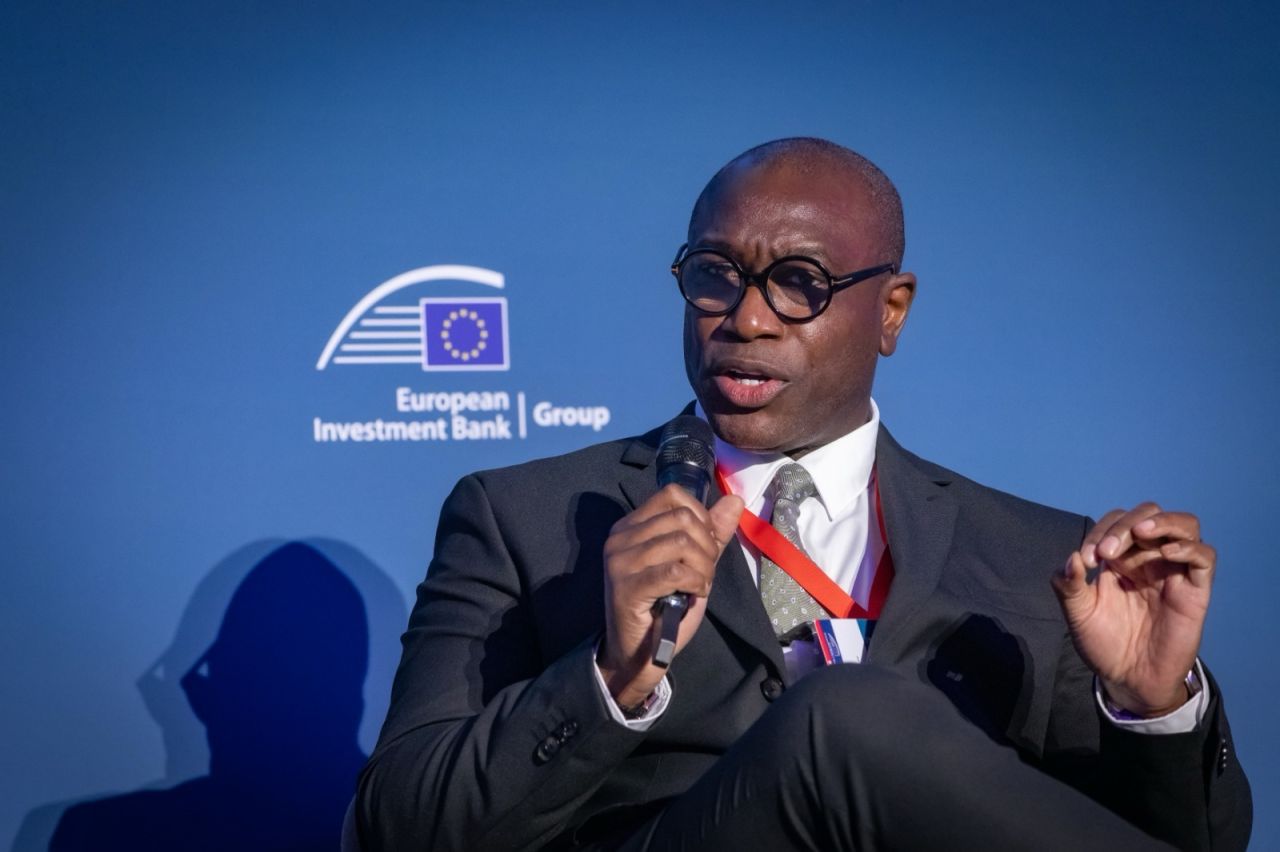






At the recent European Investment Bank (EIB) Global Forum, Dr. Hubert Danso, CEO and Chairman of Africa Investor (Ai) Group, highlighted a critical challenge facing Africa’s industrial development: the continent suffers not from a lack of capital, but from a shortage of investable development projects. Speaking at the €300 billion Global Gateway discussion, Dr. Danso emphasized that while global institutional investors manage more than $300 trillion, Africa’s development finance system mobilizes only $0.20 to $0.38 of private capital for every development dollar invested—far below the long-stated ambition of $10.
“Capital does not move because development is persuasive,” Dr. Danso told the Forum. “It moves when development becomes investable.” He contrasted Africa’s current gap with European instruments, which, as noted by Council of the European Union President António Costa, have demonstrated the potential to mobilize up to €15 for every €1 of public capital invested. This stark disparity, Dr. Danso argued, is not a capital problem but an investability problem.
Dr. Danso explained that institutional investors are not merely providers of capital—they are architects of asset classes. Historical examples include venture capital ecosystems pioneered by the Yale University Endowment, global infrastructure allocations by Canadian pension funds like CPP Investments, and responsible investment leadership by sovereign wealth funds such as Norway’s Government Pension Fund Global. These examples show that large-scale capital flows when structured, bankable investment frameworks exist.
To close Africa’s investability gap, Dr. Danso outlined two key priorities. First, democratizing investor access to Global Emerging Markets (GEMs) risk data would allow institutional investors to analyze opportunities with the transparency standards required by large portfolios. Second, deepening partnerships between Global Gateway, the European Investment Bank, the European Commission, the EBRD, and institutional investors can create scalable, investable asset classes for development. Platforms such as Institutional Investor–Public Partnerships (IIPPs) could align public institutions with institutional investors to design infrastructure systems capable of absorbing capital at scale.
Dr. Danso’s remarks underscore a growing consensus among global development leaders: unlocking Africa’s industrial and infrastructure potential depends not on attracting more capital, but on transforming development projects into assets that are both bankable and capable of generating institutional-scale returns.
“Once development becomes investable,” Dr. Danso concluded, “capital reallocates—by mandate, at scale.”