


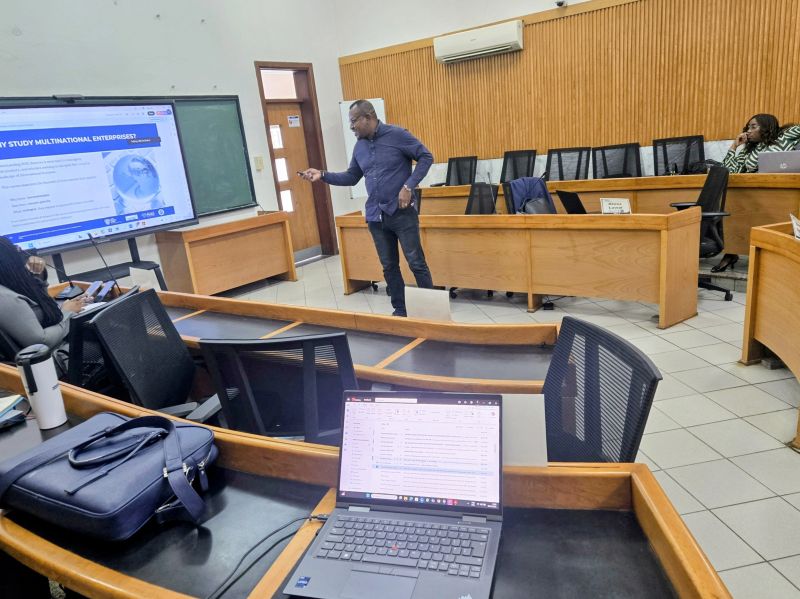
Nigerian businesses no longer have to follow the traditional slow-growth path to international expansion, according to Dr. Jekwu Ozoemene, seasoned CEO and adjunct faculty at Lagos Business School (LBS). Speaking to his DBA 4 students during two intensive sessions, Dr. Ozoemene explained how modern companies are rewriting the rules of global growth.
Reflecting on decades of business practice, Dr. Ozoemene contrasted the old expansion model—where firms grew locally first, slowly scaling operations like a neighborhood trader—with the contemporary rise of “Born Globals.” These are companies that launch with a global mindset from day one, bypassing incremental domestic dominance to integrate immediately into international networks. Nigerian fintech innovators such as Paystack and Flutterwave exemplify this approach, expanding across Africa and the globe without waiting to saturate the local market.
“This shift is massive for Nigeria and the global economy,” Dr. Ozoemene said. “Technology moves at lightning speed, yet protectionism and trade wars are rising. The old challenge of the ‘Liability of Foreignness’—not knowing local markets—is now surpassed by the ‘Liability of Outsidership.’ If Nigerian firms aren’t connected to the networks where innovation happens, they risk being left behind.”
Dr. Ozoemene emphasized the potential for Nigerian businesses to leverage their youth-driven, digitally-savvy population. By employing a Linkage-Leverage-Learning model, companies can partner with global players, adopt their technologies, and internalize skills to become globally competitive. “It’s like Wasiu the mechanic in Mushin partnering with a foreign auto brand, learning advanced diagnostics, and eventually running a world-class workshop in Victoria Island,” he explained.
He also stressed the importance of agility, sustainability, and governance. In today’s volatile global market, companies must sense shifts, seize opportunities, and adapt quickly. Environmental, social, and governance (ESG) practices are no longer optional—they build credibility and trust with international partners.
Dr. Ozoemene concluded with a key takeaway: “Expanding globally is no longer a luxury reserved for big firms; it is a survival strategy. Strong relationships, adaptability, and integration into global networks are the new currency for success.”
With Nigeria’s vibrant digital ecosystem and entrepreneurial talent, experts say this shift could position the country as a hub for globally competitive startups, driving economic growth, job creation, and technological innovation across Africa.