

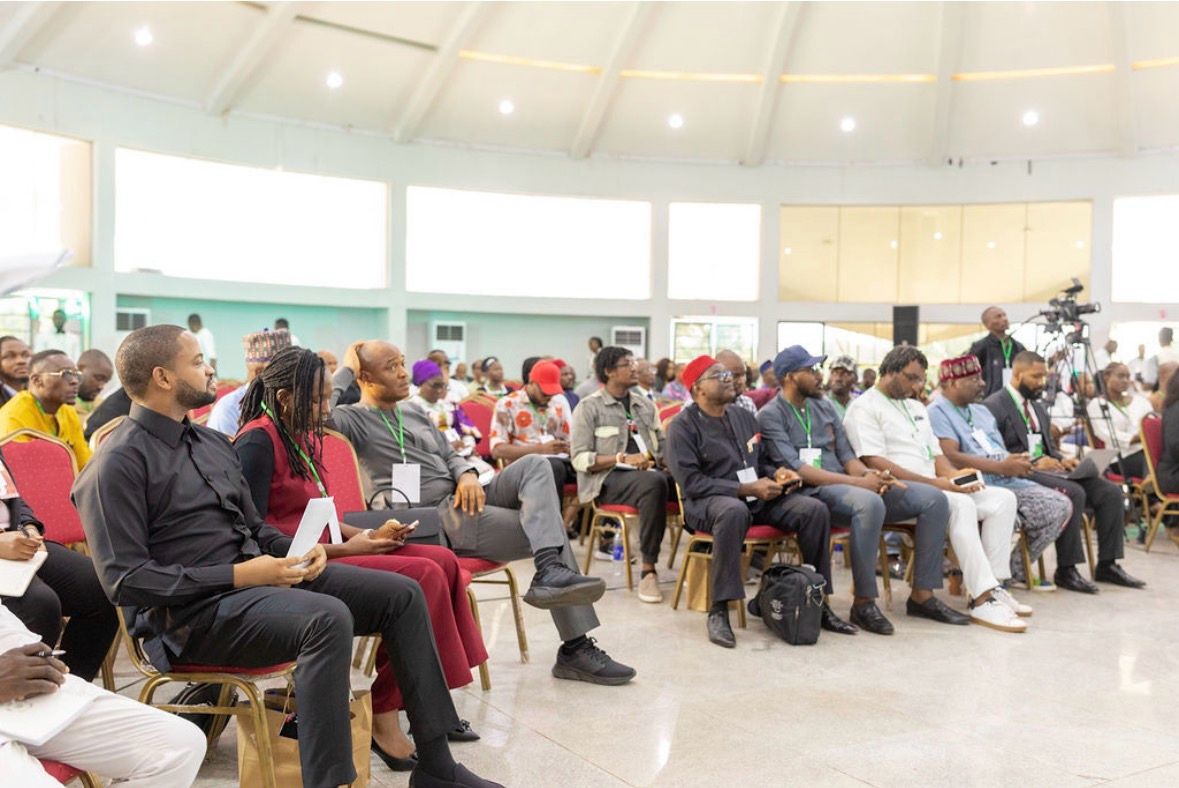
On 3 February in Enugu, the South-East of Nigeria experienced what many participants described as a rare moment of alignment—one where political authority, private capital, and long-term economic thinking converged with unusual clarity.
The South-East Vision 2050 Stakeholder Forum, convened by the South East Development Commission (SEDC), brought together the Kashim Shettima, four South-East governors, senior policymakers, and private-sector leaders. Beyond the symbolism of high-level attendance, the forum stood out for its focus on execution—how the region can deliberately design its future rather than wait for it to arrive.
Among the most substantive contributions was that of Innocent Isichei, founder and senior advisor on African tech policy, whose presentation reframed the South-East’s development challenge in pragmatic terms.
Rather than positioning the region as lacking entrepreneurship or ambition, Isichei argued that the South-East’s core problem is not absence of activity, but absence of structure, coordination, and scale.
For decades, the region has been one of Nigeria’s most entrepreneurial zones—rich in commerce, manufacturing, trade, and informal industrial clusters. What has been missing, he noted, is the systematic integration of digital tools, modern infrastructure, and institutional capital that can transform fragmented success into durable economic power.
His thesis was straightforward but consequential: the South-East does not need reinvention; it needs modernisation.
Isichei proposed a functional, city-specific economic architecture, built around the region’s existing strengths rather than abstract aspirations.
Aba, long recognised for its manufacturing clusters and artisan economy, can evolve into a digitally enabled production and e-commerce hub. By embedding technology into design, inventory management, payments, and logistics, Aba’s manufacturers can move from local markets to continental and global supply chains.
Onitsha, historically one of West Africa’s busiest trading centres, is positioned to become a logistics and digital-trade backbone. With the right investment in platforms, warehousing, and cross-border trade systems, Onitsha can formalise and scale commerce across Nigeria and the wider sub-region.
Nnewi, often described as the industrial heart of the South-East, has the potential to climb further up the value chain through automation, advanced manufacturing, and supply-chain technologies. Doing so would not only increase productivity, but anchor higher-value industrial jobs within the region.
Enugu, Isichei argued, should function as the coordination and innovation nerve centre. With more than seven universities located within a six-mile radius, Enugu has a rare concentration of talent, research capacity, and institutional density. When universities, innovation hubs, investors, industry leaders, and government collaborate deliberately, ideas can move efficiently from research to prototype, and from prototype to scalable enterprise.
This form of intentional coordination, he stressed, is what differentiates cities that host ideas from cities that commercialise them.
Central to this vision is capital—specifically, patient and regionally anchored capital. Isichei highlighted the strategic importance of the South-East Venture Capital Fund, alongside seed funding initiatives led by SEDC. With the right governance framework and genuine financial commitment, such a fund can act as a signalling mechanism—crowding in domestic and international venture capital, development finance institutions, and strategic partners.
Importantly, the fund’s value lies not only in money, but in confidence. It sends a message that the region is prepared to take equity risk in its own future, rather than waiting to be discovered from outside.
Perhaps the most encouraging signal from the forum, Isichei noted, was a shift in regional mindset.
For years, conversations about the South-East have often been framed around marginalisation—why infrastructure lagged, why federal investment was limited, why opportunities bypassed the region. At the Vision 2050 Forum, that narrative appeared to be giving way to a more constructive question: What exactly do we need to build, and how do we sustain it over time?
That reframing matters. Regions that develop successfully do so not by copying existing ecosystems wholesale, but by learning selectively—adapting proven models to local realities, institutional strengths, and cultural dynamics.
The ambition for the South-East, Isichei concluded, should not be imitation but intentional design: building institutions that fit the region’s industries and people, aligning policy with capital, and maintaining consistency long enough for compounding effects to take hold.
If sustained, the Vision 2050 Forum may be remembered not simply as another regional convening, but as the moment the South-East began the difficult but necessary transition from aspiration to execution—from inherited entrepreneurship to engineered prosperity.