


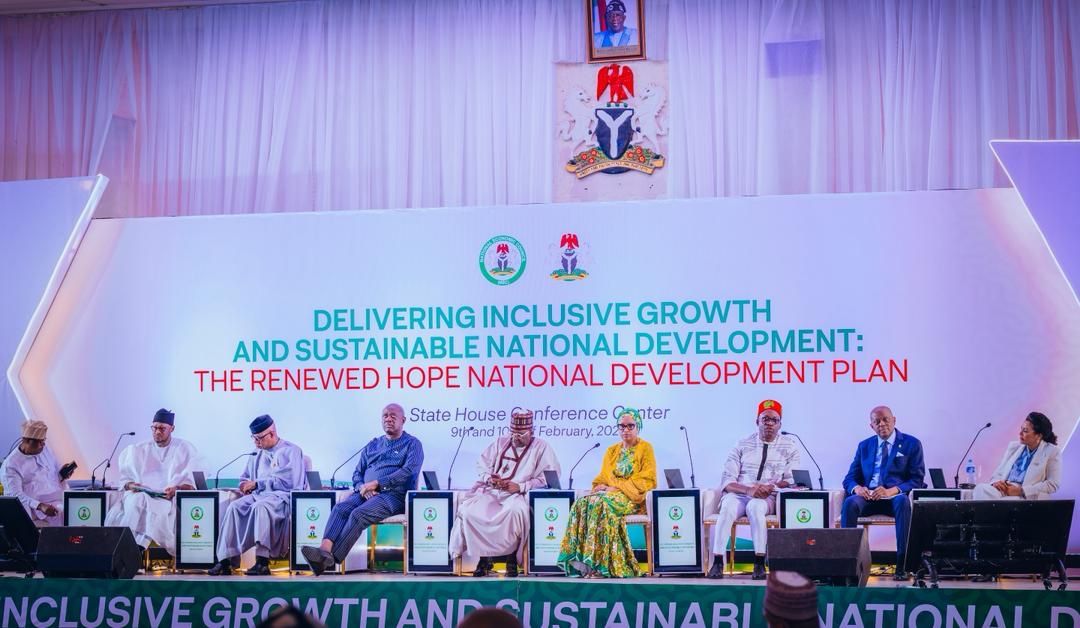



The Honourable Minister of State for Finance, Dr. Doris Uzoka-Anite, on Tuesday presented Nigeria’s Fiscal and Monetary Outlook for 2026–2030 at the National Economic Council (NEC) Conference, outlining the Federal Government’s strategy for transitioning from economic stabilisation to inclusive, investment-driven growth.
The presentation was delivered in alignment with the Renewed Hope National Development Plan and focused on consolidating recent reforms while accelerating broad-based economic expansion across the federation.
Uzoka-Anite noted that the past two years have been foundational for Nigeria’s economic reset, citing major policy actions such as the removal of fuel subsidies, liberalisation of the foreign exchange market, and fiscal consolidation measures. According to her, these reforms were critical in restoring macroeconomic stability and rebuilding investor confidence.
“Stability is only the starting point,” she stated, adding that the next phase of Nigeria’s economic agenda must prioritise inclusive growth that creates jobs, strengthens productive sectors, and improves living standards nationwide.
The Minister outlined a forward-looking framework designed to drive sustainable expansion between 2026 and 2030. Central to the strategy is the Domestic Growth Acceleration Strategy (DGAS), a coordination mechanism aimed at aligning capital mobilisation with sector priorities while strengthening collaboration between federal and state governments to ensure effective implementation.
She also highlighted a renewed focus on investment budgeting, explaining that public resources would be directed toward projects capable of de-risking private sector participation, generating long-term economic returns, and maximising the multiplier effect of government spending.
In addition, Uzoka-Anite emphasised the importance of strengthened fiscal and monetary policy coordination, noting that predictable revenue generation, sustainable debt management, and macroeconomic stability remain essential pillars for attracting investment and supporting growth acceleration.
According to her, maintaining reform momentum and ensuring disciplined execution will be critical to translating economic stabilisation into tangible socio-economic gains.
“If we remain focused on implementation, Nigeria can convert stabilisation into sustained growth, and growth into measurable improvements in the quality of life for our citizens,” she said.
The NEC Conference brought together key stakeholders to deliberate on strategies for deepening economic resilience and fostering long-term development under the Renewed Hope agenda.