



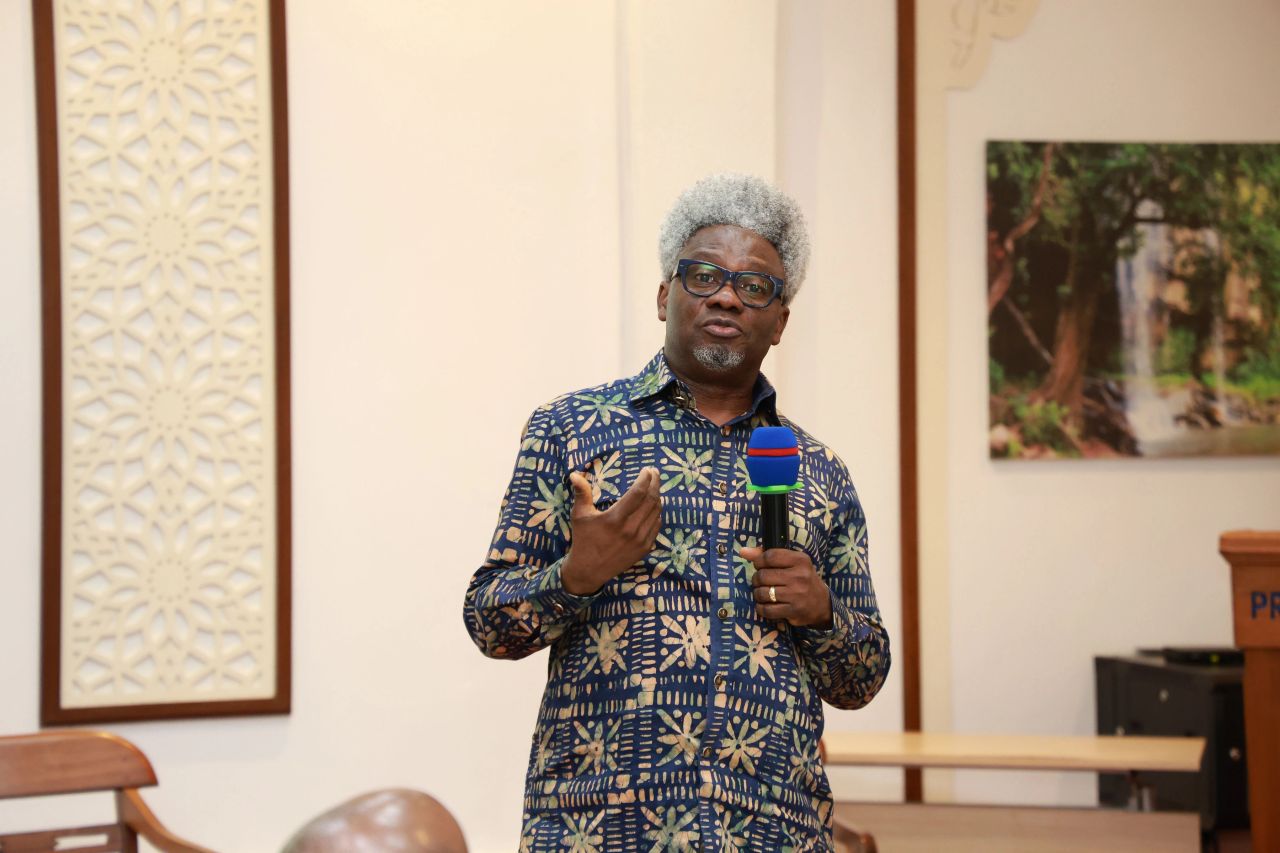
A media scholar and communication expert, Dr. Omoniyi Ibietan, has warned that the rapid adoption of Artificial Intelligence (AI) in media production must not erode the professional and ethical foundations of journalism, stressing that “not all media is journalism.”
Ibietan made this assertion while delivering the keynote address at the 2025 Annual Retreat of Daily Post employees, held on December 11, 2025. Daily Post is one of Nigeria’s leading online newspapers, recording an estimated 15 million weekly impressions and playing a significant role in the country’s emerging Fifth Estate.
Speaking on the theme “Not Every Media is Journalism: Professional and Ethical Imperatives of Good Journalism in the AI Era,” Ibietan examined the growing influence of AI on news production, distribution and consumption, while emphasising the continued relevance of journalistic ethics, investigation and interpretation.
He described Artificial Intelligence as computer systems designed to perform tasks traditionally associated with human intelligence, including reasoning, learning and creativity, citing the European Parliament’s definition. While noting that AI was once viewed as science fiction, he said it has become central to social transformation.
Ibietan explained that although AI comes in various forms, generative AI tools—such as ChatGPT—are currently the most influential in communication management and media practice, reshaping newsroom operations and audience engagement.
However, he drew a clear distinction between “media” and “journalism.” Media, he said, encompasses a wide range of content including entertainment, advertising, public relations, music, reality television, social media stunts and other forms of mass communication. Journalism, by contrast, is defined by informed, factual, investigative and interpretive reporting that strengthens democracy, social cooperation and development.
According to him, journalism plays a constitutional and societal role by holding power to account, educating citizens and enabling informed participation in governance. He warned that democracy cannot thrive without credible and ethical journalism.
Ibietan referenced the long tradition of critical journalism in Nigeria, tracing it from early nationalists such as Herbert Macaulay, Ernest Ikoli, Obafemi Awolowo and Anthony Enahoro, through the era of military rule sustained by publications like Newswatch, Tell, The Guardian, Punch, and Vanguard, to contemporary platforms including Premium Times, The Cable, Daily Post and others operating in the digital and AI age.
He also invoked the sacrifices of journalists such as Dele Giwa and Bagauda Kaltho, who paid with their lives in the pursuit of investigative journalism and accountability.
Addressing the ethical demands of journalism in the AI era, Ibietan cautioned against the uncritical reliance on AI-generated content. He said journalists must remain well-educated professionals with grounding in journalistic theory, ethics, law and practice, supported by continuous training and upskilling.
“Journalists are chroniclers of history in a hurry,” he said, adding that the responsibility to inform the public requires accuracy, truthfulness and conscientious reporting. He warned that AI systems are probabilistic and prone to error, making human editorial judgement indispensable.
Ibietan stressed that journalists reporting conflicts and crises must ensure their work does not endanger citizens or security personnel, underscoring the primacy of public interest journalism.
He cited Walter Lippmann’s Public Opinion (1922) to highlight the link between journalism, public education and democracy, arguing that crises in democracy are often rooted in failures of journalism to properly inform and educate the public.
Referencing the Code of Ethics of the Nigeria Union of Journalists (NUJ), Ibietan reminded journalists of their obligations to truth, accuracy, fairness, independence, respect for human rights and national unity.
While acknowledging that AI has accelerated the spread of misinformation, deepfakes and fabricated content, he argued that AI itself is not the core problem. Rather, he said, irresponsible use of the technology poses the greatest risk.
Paradoxically, he noted, AI also offers powerful tools to combat misinformation. He encouraged journalists to adopt AI-powered verification and detection tools, including deepfake detectors and misinformation analysis software, to strengthen newsroom fact-checking and content verification.
Ibietan concluded by urging journalists and communication professionals to deliberately upskill in AI literacy, using the technology responsibly to reinforce ethical journalism rather than replace it.
“AI should serve as an assistant, not a substitute,” he said, adding that credible journalism must leverage innovation to protect truth, democracy and the public good in an increasingly complex media environment.