


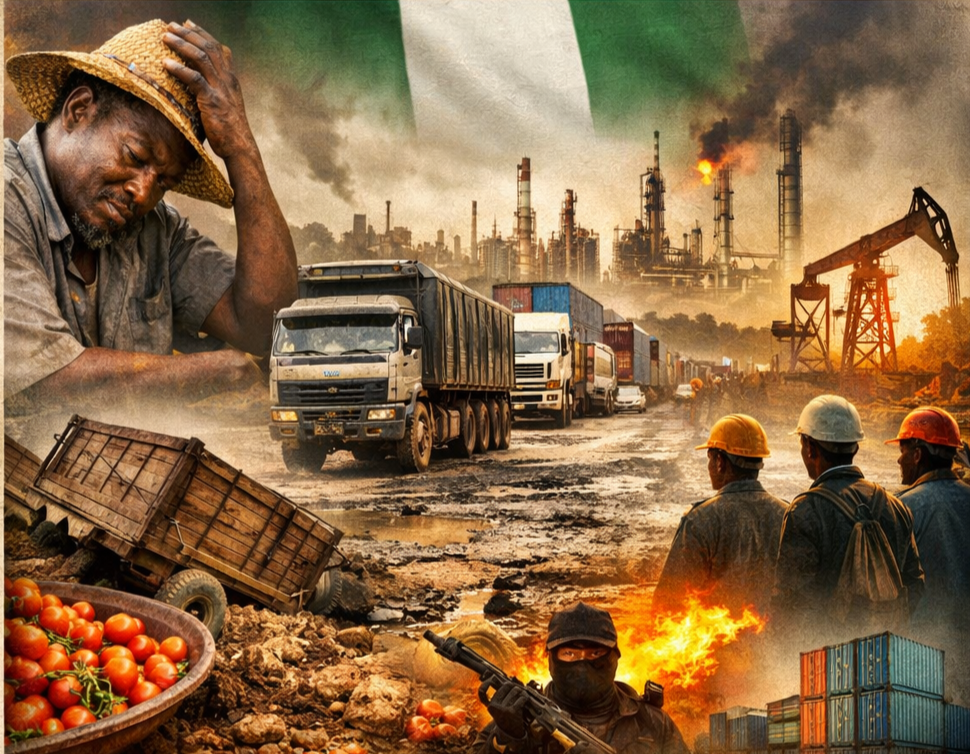






- The Nigerian supply chain has evolved from a primitive colonial-era focus on raw material exports (namely cocoa, palm oil) to a complex modern system dominated by petroleum since the 1970s oil boom, leading to the creation of the Nigerian National Petroleum Corporation (NNPC)
- SCM in Nigeria faces complex and deep-seated challenges primarily rooted in infrastructure deficiencies, inconsistent policies, and significant security risks, which if resolved, could contribute an additional 2% to 3% to Nigeria’s GDP growth annually
- Poor roads (as only a small proportion of the 195,000 km of roads are paved, hike transportation costs by 40%, which is estimated to increase the final price of goods by up to 30%), underdeveloped ports, and unstable power supply lead to wasted time and compromised cold chain logistics with the attendant post-harvest losses of up to 40% and spoilage of perishable agricultural goods
- Security issues, including banditry in the North and vandalism in the Niger Delta, create fractured supply chains
- The COVID-19 pandemic accelerated the shift toward digital SCM tools like e-procurementbut Nigeria faces greater barriers to adopting Artificial Intelligence (AI) in SCM compared to developed economies due to a lack of regulatory clarity, high implementation costs for SMEs, and inadequate digital infrastructure
- The Fuel Subsidy Removal of 2023 has been a significant disruptive force, leading to a direct increase in logistics and transportation costs, straining the supply chains of essential goods, and causing delays and price hikes for consumers
- While the oil and gas sector accounts for 90% of Nigeria’s foreign revenue, its supply chains are highly vulnerable to theft and vandalism; upstream operations frequently delayed by customs, which can raise operational costs by 20% to 30%, while bunkering results in the loss of approximately 200,000 barrels of oil daily
- The African Continental Free Trade Area (AfCFTA) presents a major opportunity as intra-African trade is projected to grow by more than 20% if regional cooperation on logistics and customs interoperability is achieved
- Inefficiencies in SCM have dire human consequences in the health sector as the case in Northern Nigeria where inconsistent supply chain practices lead to frequent stockouts of essential malaria drugs
- Sustainability is becoming a core component of modern SCM in Nigeria tocounter the high greenhouse gas emissions from logistics activities;thus, “city warehousing” and the adoption of electric vehicles to reduce route emissions and lower long-term costs are the future prospects
Rome Business School Nigeria release a report in January 2026. The report establishes Supply Chain Management (SCM) as the fundamental architecture of Nigeria’s contemporary economic framework, facilitating the movement of goods, services, and information across a nation characterized by vast resources but significant developmental hurdles. The author defines SCM as planning, implementing, and controlling processes that enable the efficient flow of goods and services. These are procurement, production, distribution, and logistics, incorporated with the aim of minimising costs and maximising value. Supply chains are the threads that make the Nigerian economy, people, resources and markets work together to sustain everyday lives and national development. It plays a pivotal role in trade, manufacturing, agriculture, oil and gas, FMCG, and healthcare and pharmaceuticals.
This report explores the evolution of Nigerian SCM from its colonial extractive roots to a modern system striving for integration, resilience, and technological maturity. Supply chains in the colonial period were primitive, focusing solely on exporting raw materials such as cocoa, palm oil, and minerals to the European markets without much attention to local processing and integration. Nigeria sells $1.5 billion worth of cocoa and sesame every year. SCM witnessed modernization as the Nigerian economy began to diversify after independence in 1960 following a shift in interest towards petroleum supply chains and the oil boom of the 1970s. SCM has revolutionized Nigeria’s trade landscape in the post-oil boom era. It provides the strategic framework necessary to manage the complex logistics of exporting crude oil while simultaneously opening international pathways for Nigerian farm produce and manufactured exports.
Regarding trade, SCM enables the importation and exportation of commodities, allowing Nigeria to access global markets for oil, farm produce, and manufactured products (pp.4).
The millennium has also been marked by globalization, and Nigeria has been part of the World Trade Organization since 1995, which has forced it to have more advanced SCM practices to compete globally. The 2010s were a turning point for sustainability and resilience due to global disasters such as the 2008 financial meltdown and the 2014 Ebola outbreak, which highlighted the importance of robust supply chains in healthcare and food businesses. In 2020, the COVID-19 pandemic further accelerated the evolution of history, compelling a shift to digital SCM tools, such as e-procurement platforms, in response to the disruptive effects on global trade. COVID-19 exposed vulnerabilities, with border closures preventing fertilizer imports and triggering food price surges that pushed 7 million more Nigerians into poverty.
SCM goes beyond logistics as a concept to cover sustainability, resilience, and technological integration. in the food and fast-moving consumer goods (FMCG) markets. SCM encompasses policy incentives that promote environmentally friendly sourcing and distribution, as well as minimizing wastes and maximizing food security. SCM in Nigeria does not represent only a business activity but also an initiative towards inclusive growth in manufacturing (which contributes 10% to GDP) and agriculture (around 25% to GDP). Agriculture is Nigeria’s economic heartbeat, employing over 35% of the workforce and contributing around 25% to GDP, although its supply networks are plagued by inefficiencies that waste potential and hardship for millions. Smallholder farmers, who grow 80–90% of the food, have trouble getting their commodities to processors because of bad roads and storage. This can lead to up to 40% of crops like tomatoes and maize being lost after harvest. The Special Agro-Industrial Processing Zones (SAPZ) are one example of a government program that tries to fix this by building centers with better infrastructure that connect farmers directly to processors and cut travel times from days to hours. This might help rural women, who make up 70% of agro-processors, earn more money, which would give them more power and improve the nutrition of their families. Energy transformation adds layers gas flaring reduction requires new supply channels for LNG exports, predicted to expand 10% in 2025.
The problems faced in Nigeria in the SCM are complex and rooted in infrastructure shortages, inconsistent policies and external shocks, which undermine the efficiency and resilience of the system. Lack of infrastructure, such as poor roads, underdeveloped ports, and inconsistent power supply lead to expensive transportation costs and wasted time. Only a small proportion of the 195,000 km of roads are paved, resulting in an increase in the cost of transportation, which is estimated to increase the final price of the goods by up to 30%. There is also a heavy reliance on paper-based inventory systems leading to slow decision-making, uncoordinated stock replenishment, and higher error rates. Also, outdated customs systems and paper records at major ports add significant dwell time and freight expenses. The 2023 removal of fuel subsidies caused a direct spike in logistics and transportation costs, impacting the prices of essential goods like food and fuel. Double taxation and other fragmented trade rules frequently force SMEs into unauthorized, informal trade channels.
Furthermore, bureaucratic hurdles and varied valuation standards in customs procedures further fracture supply chains. Banditry in the north disrupts traffic and threatens the lives of personnel by attacking transport convoys. Also, theft on highways reduces the integrity of assets and creates significant financial losses for businesses. Technology drives change, Industry 4.0 tools like IoT track inventories, minimize stockouts that affect 60% of enterprises. Green sourcing and garbage recycling, boost performance by 20% for enterprises implementing them. Yet, these digital technologies are very expensive for many SMEs to adopt, e.g. the high cost of implementing advanced technologies like AI, blockchain, and cloud computing. Inconsistent broadband and fiber network access hinders the real-time tracking and data-driven decision-making necessary for agile supply chains. In addition, there is a notable gap in personnel trained to manage modern, data-driven supply chain systems, leading to costly operational blunders. These problems according to the report has led to factory closures and employment losses for 1.5 million workers in the manufacturing sector.
Pharmaceuticals guarantee health security, yet 70% of imports result in shortages, and counterfeit medications kill 100,000 people annually in Africa, many of them in Nigeria. cold storage gaps occur in supply chains; 20% of vaccines are spoiled in transit due to power outages. Approvals are delayed by regulatory obstacles, although local production initiatives like PVAC strive for 60% self-sufficiency. Stakeholders work together: wholesalers, who have over 5,000 licenses, connect manufacturers to pharmacies; nonetheless, waste from inefficiencies costs $1 billion. Consumer spending is driven by FMCG, with retail chains meeting 200 million people’s daily requirements, while affordability is strained by 25% inflation. Supply agreements reduce risks by defining provisions for quality and on-time delivery. Agile chains are essential to the expansion of e-commerce, which is expected to reach $10 billion by 2025 and empower SMEs in distribution. Moreover, the problem is exacerbated by regional differences; the North cannot be linked by railways, Southern ports are crowded without the inland connection, and the rural warehouses are crudely equipped in comparison with the urban one.
The Rome Business School Nigeria report, posits that SCM holds enormous potential for national development. SCM can improve the competitiveness of exports, especially in non-oil industries, reducing Nigeria’s oil dependency and generating employment. Quality of life is directly affected by sufficient SCM that guarantees food security, access to medical care and resilience during disasters. In the healthcare sector, they can guarantee the timely delivery of life-saving commodities. SCM can also be an initiator of environmental stewardship and social equity, in line with international objectives, such as the UN Sustainable Development Goals. Climate change adds pressure as floods block roads, affecting output by 15% in northern states in the year 2024. Agriculture and Agro-processing supply chains are about more than logistics; they’re lifelines for food security.With 200 million mouths to feed, inefficiencies cost $3 billion yearly, however, targeted investments might add 2% to GDP growth, pushing communities out of poverty.
In cities, warehouses are being concentrated around industrial parks in Lagos, which benefit e-commerce that is expected to soar, reaching up to $14.92 billion in 2029, to enable small online sellers to access an entire nation, and enable women entrepreneurs in remote villages to go to work. The future prospects of SCM are green logistics and city warehousing. Sustainable practices such as electric cars will reduce the cost and emissions of routes due to climate change. Also, blockchain for traceability, avoiding fraud in exports and establishing trust are driving the future of SCM in Nigeria. The report notes that by 2035, resolving supply chain inefficiencies specifically by potentially halving spoilage through better cold chains could significantly boost farmer revenues and contribute to substantial overall GDP growth. The supply chain environment in Nigeria is an ideal place to launch some radical reforms to be able to utilize the regional integration, technological developments, collaborative approaches, industrial synergies, and infrastructural investments. The report further makes a case for leveraging private investment to bridge historic infrastructure gaps in ports, rail, and ICT.
Supply Chain Management: A Strategic Economic Catalyst in Nigeria
SCM has become not just a business activity but a driver of inclusive growth, economic diversification, and a primary tool for reducing Nigeria’s historical over-reliance on oil. Studies in Lagos have shown that disruptions in the supply chain can cut corporate performance by as much as 15%. Therefore, addressing current supply chain inefficiencies is estimated to contribute an additional 2% to 3% to Nigeria’s annual GDP growth. SCM continues to generate massive foreign revenue for the country. The oil and gas sector, which accounts for 90% of Nigeria’s foreign revenues, relies on complex supply systems. Intra-African trade is projected to grow by more than 20% if regional cooperation on logistics and customs interoperability is achieved under the AfCFTA. While customs delays and imported equipment logistics currently inflate the costs of upstream oil operations by 20% to 30%, the projected improvements in SCM will reduce this drastically. The Nigerian Customs Service launched the Authorized Economic Operator (AEO) program in 2025 to streamline operations for trusted traders, boosting both security and trade speed. SCM is a core pillar for reducing oil dependency by improving the competitiveness of non-oil exports in agriculture and manufacturing. With ongoing efforts at strengthening farm-to-market logistics and cold chains, it could potentially halve spoilage losses, significantly boosting farmer revenues and national food security. Implementing blockchain in SCM contracts is recommended as a way to cut corruption that saps an estimated $5 billion annually from the system.
Fostering Industrial Integration and National Connectivity

SCM fosters “backward integration,” a process where local content policies ensure raw materials are processed domestically rather than being exported in their unrefined state. The report noted that 80% of manufacturers, struggle with integration yet free zones like Lekki allow duty-free imports, simplifying supply chains. The “Manufacturing and Export Supply Chains Development Plan (2025)” focuses on industrial clusters to improve factory distribution and increase domestic sourcing. Strategic supply chains have contributed to national value additionby fostering cooperation between manufacturers, suppliers, and distributors, and thus encouraging innovation and efficiency within industries such as pharmaceuticals and food processing. Integration of Small and Medium Enterprises (SMEs) into formal global supply chains have also occurred through SCM, transforming MSMEs and informal traders into official exporters. Through technologies such as cloud computing SMEs are able to simplify their operations and participate in cross-border partnerships. The combination of warehousing, last-mile logistics, and digital payment systems has facilitated the involvement of SMEs in formal e-commerce supply chains. Similarly, SCM encourages innovation and efficiency across diverse sectors such as pharmaceuticals, food processing, and construction by creating better planning frameworks. PPPs are also being utilized to fund critical integration infrastructure, such as industrial parks and digital systems like ERP (Enterprise Resource Planning) and blockchain. The report notes that industries as diverse as agriculture, oil and gas, and retail are united by the strategic necessity of effective logistics and stakeholder cooperation. Intra-African trade is projected to grow by more than 20% through on AfCFTA-anchored regional cooperation on logistics and customs interoperability. Ultimately, investment in “connected networks”, including roads, rail, inland waterways, and ICT is expected to turn historic bottlenecks into efficient industrial networks.
Transportation Channels, Modernised Ports, and Digital Infrastructure Form the Physical and Cybernetic Backbone of Effective SCM
Transportation channels such as roads and rail are essential for connecting rural production zones, such as farms in Kano, with urban manufacturing and retail hubs like Lagos, hence the role of SCM to ensure that production centres and markets connect. In the absence of robust transportation infrastructure, industrial growth is easily strangulated due to significant delays and operational inefficiencies. The report notes that proper transportation channels, ports, and digital infrastructure are critical to the effective operation of SCM and emphasizes the need for modernization, particularly in the maritime sector, to manage high cargo volumes. Maritime transport is the primary means of trade for Nigeria, accounting for over 95% of exports and 97% of imports, with major ports like Apapa in Lagos handling approximately 42% of incoming goods. Raw material imports face delays, with ports costing corporations $4 billion in demurrage yearly. To improve port efficiency, the Nigerian Customs Service implemented the Authorized Economic Operator (AEO) program in 2025, which streamlines operations for trusted traders to boost supply chain security. The report delineates digital infrastructure as the “Cybernetic” component whereby digital networks and tools, including broadband, 5G, and fiber networks, reinvent traditional, slow-moving supply chains into agile, data-driven networks capable of real-time decision-making. Digital infrastructure has enabled small and medium enterprises (SMEs) to use advanced technologies like Cloud Computing and Blockchain and ERP to simplify complex operations, engage in cross-border partnerships, integrate suppliers with production and authenticate the origin of components, thereby increasing transparency.