






A scathing social media indictment from a prominent Nigerian CEO has ignited a firestorm of controversy, customer outrage, and industry introspection over the state of the country’s 5G mobile networks, particularly those operated by telecom giant MTN Nigeria.
The catalyst was a detailed LinkedIn post by Alex N., a verified Chairman and CEO, who declared after two months of testing that MTN’s 5G service in the heart of Lagos’s premier commercial district is “a fantasy.” He supported his claim with a shocking screenshot showing a consistent download speed of 0.62 Mbps—a figure he noted is slower than 3G from 15 years ago and a staggering departure from the International Telecommunication Union’s 100 Mbps minimum standard for 5G.
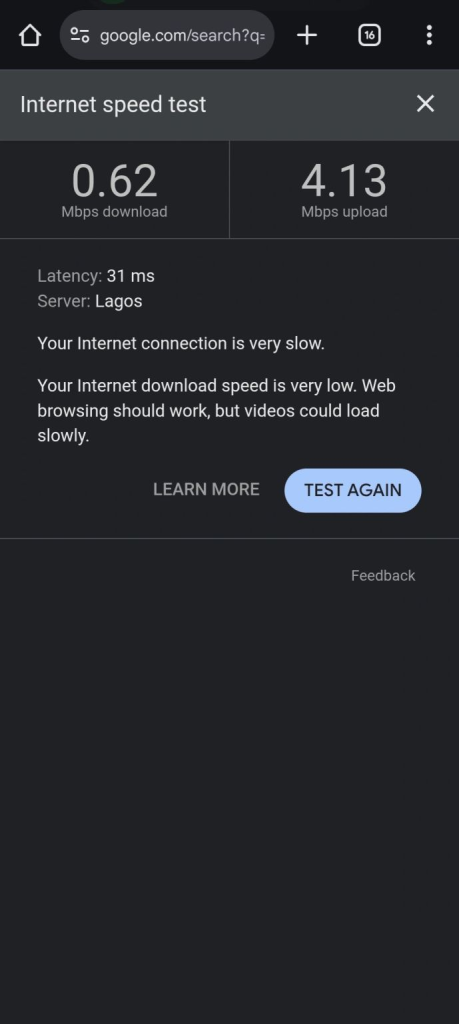
“In the heart of one of Nigeria’s busiest commercial districts — surrounded by banks, tech companies, and multinationals — MTN’s 5G delivered a jaw‑dropping 0.62 Mbps. Not once. Not twice. Consistently,” Alex N. wrote. He condemned the issue as a “systemic failure in quality delivery and customer transparency” and called for a national conversation on “standards, accountability, and the widening gap between what Nigerians are promised and what we actually receive.”
The Post Unearths a Chorus of Frustration
The post, viewed hundreds of thousands of times, transcended a simple complaint to become a rallying point for widespread consumer discontent. The comments section evolved into a raw national forum on telecommunications woes.
- Customers Echo Claims: Many professionals shared identical experiences. Anthony I (Climate Consultant) confirmed the “complete mismatch between marketing and reality,” stating he had taken his modem outdoors in a futile attempt to improve service. User Stephen Menkiti alleged deceptive practices, commenting, “MTN can offer night but present it like day.”
- Broader Systemic Critiques: Commenters like Christopher Olu-Crown called the situation a “rot that cuts deep across all ISPs in the country,” while Dare Lawal pointed to “governance failure in manifestation” and a weak regulatory framework from the Nigerian Communications Commission (NCC).
- A Defiant Defense: The post also drew defenders of MTN. Isaac Audu-Usman, FCCA, FCA, a finance executive, stated that for him, “MTN is still miles ahead of the pack,” praising its fiber-to-the-office service. This highlighted the inconsistent and location-dependent nature of network quality in Nigeria.
- Technical Debate Emerges: Industry professionals weighed in with technical perspectives. Rami Sabag, CEO of TASCO TECHNOLOGIES LTD., argued that “5G is built for mobile internet and not for home use,” suggesting a mismatch of expectations. Network engineer Osei Badu-Nkansah advised users to check for “LTE 5G” indicators, implying some networks may be using misleading labeling.
MTN Nigeria Issues Public Apology and Launches Probe
The viral pressure prompted an official corporate response. Both an MTN Group technology manager, Emmanuel Idoko, and the official MTN Nigeria corporate account publicly replied to the post within days.
“Good day Chief… Please accept our sincere apologies for the poor 5G experience,” Idoko wrote, requesting the user’s location for an urgent technical investigation. The MTN Nigeria account echoed this, stating, “We would like to conduct targeted checks to resolve this issue quickly.”
Underlying Themes: Accountability, Local Support, and Alternatives
The discussion branched into deeper national issues:
- Regulatory Failure: A prevailing sentiment accused the NCC of inadequate oversight. ‘Mo Olumide Obidiran tagged the FCCPC, stating, “we’re not raising enough dust over the CULTURE of consistent service failure.”
- The “Starlink Question”: Several commenters, including Anthony I and Tosin Akindubuwa, suggested switching to Starlink. Alex N. responded that while considered, it was a different technology and that he preferred to support reliable local providers where possible.
- Economic Impact: Users shared stories of lost opportunities. Perfect Joseph recounted missing an online job interview due to network failure, and Jacob Kumenda noted the critical need for reliable infrastructure for businesses.
Analysis: A Watershed Moment for Consumer Advocacy
This episode signifies a potential turning point in Nigerian telecoms consumer culture. A high-profile user leveraging verifiable data has forced a top-tier multinational to publicly apologize and initiate a probe. It has shifted the narrative from isolated complaints to a national debate on advertising ethics, regulatory rigor, and infrastructure investment.
Whether this leads to sustained improvement or fades as a fleeting social media storm remains to be seen. However, the collective voice amplified by Alex N.’s post has delivered a clear, unprecedented message to the telecom industry: Nigerian consumers are increasingly informed, demanding, and capable of holding powerful corporations accountable for the promises they sell.
# # #
This report is synthesized from publicly available social media discourse.
Anthony Nwosu
0802 893 1940