



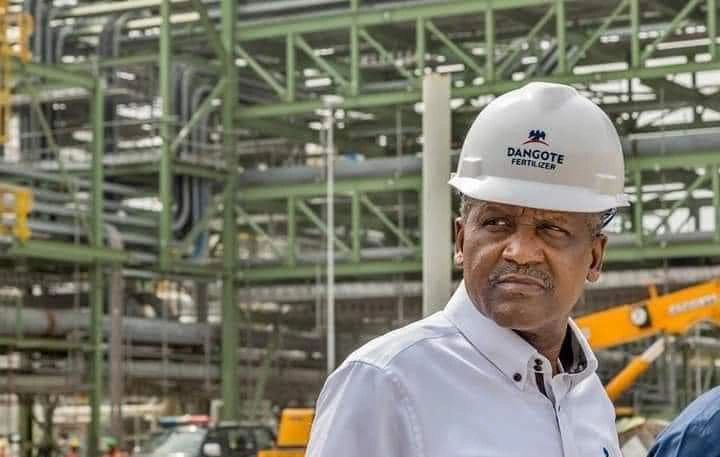
Few Nigerians are aware that before Africa’s richest man, Aliko Dangote, began constructing his multibillion-dollar oil refinery, he first established a full-scale construction company to make the project possible.
Faced with Nigeria’s infrastructure challenges, Dangote recognized early that building Africa’s largest oil refinery would require more than foreign contractors or imported expertise. To overcome logistical and infrastructural constraints, he created Dangote Projects Limited, a specialized engineering and construction subsidiary under the Dangote Industries Limited (DIL) umbrella.
The firm was tasked with handling every stage of the refinery’s development — from civil works to mechanical installations — enabling the conglomerate to maintain full control over the massive project’s execution.
Building the Infrastructure Before the Refinery
Industry analysts have described Dangote’s approach as a masterclass in strategic industrial planning. Instead of relying on existing national infrastructure, which was often unreliable or inadequate, the businessman chose to build the facilities and systems required to sustain construction.
Nigeria’s weak road networks, inconsistent power supply, and limited port capacity posed serious obstacles. In response, Dangote’s team embarked on a series of parallel projects to support the refinery’s construction.
Among them was a 435-megawatt power plant, built to provide electricity not only for the refinery and fertilizer complex but also for parts of the surrounding Lekki Free Zone.
The company also developed internal road networks, bridges, and a deep-sea port (Lekki Port Access Jetty) to accommodate the heavy equipment arriving for installation.
Empowering Local Workforce
Beyond infrastructure, Dangote Industries invested heavily in human capital. Over 30,000 Nigerian engineers, welders, and technicians were trained through various programs, creating a skilled local workforce that significantly reduced dependence on foreign expertise.
To ensure project efficiency, the conglomerate procured and operated more than 2,000 heavy-duty construction machines, giving Dangote Projects Limited one of the largest privately owned construction fleets in Africa.
A Self-Sufficient Industrial Ecosystem
By building his own construction capacity, Dangote effectively developed an entire ecosystem to support one of the world’s largest single-train refineries.
Analysts say the strategy demonstrates a deep understanding of Nigeria’s industrial realities. “You can’t build world-class infrastructure in Nigeria without first building the infrastructure to build it,” one industry observer noted.
With the refinery now nearing full operational capacity, Dangote’s integrated model — encompassing power generation, logistics, construction, and manufacturing — stands as a unique example of large-scale self-reliance in Africa’s industrial sector.